Archive for the ‘CrashBlogging’ Category

Scientists warn of wheat disease

Saturday, March 15th, 2008

Scientists say poorer populations in vulnerable countries could starve if a disease called Ug-99 hits yields hard enough to push up wheat prices.

There is already a global wheat shortage and UN agencies are concerned about the impact of high food prices.

Ug-99 is a form of black stem rust that prevents wheat taking up nutrients and can wipe out whole harvests.

Scientists at the John Innes Centre, in England, are trying to find wheat with a natural resistance to the disease.

Most wheat grown in Africa, Asia and China, has little resistance to Ug-99.

The BBC’s Anna Hill says scientists at the John Innes Centre are testing a wide variety of native wheats from Asia and Africa to see if they can find natural resistance to the disease and breed new varieties from them.

But this could take more than five years, by which time Ug-99 could already be causing wide spread harvest failure.

More…

The EPA’s tailspin

Saturday, March 15th, 2008

– This is an editorial from Nature Magazine; one of the world’s preeminent magazines about science and for scientists.

= = = = =

The director of the Environmental Protection Agency is sabotaging both himself and his agency.

The US Environmental Protection Agency (EPA) is fast losing the few shreds of credibility it has left. The Bush administration has always shown more zeal in protecting business interests than the environment (see Nature 447, 892–893; 2007). But the agency’s current administrator, Stephen Johnson, a veteran EPA toxicologist who was promoted to the top slot in 2005, has done so with reckless disregard for law, science or the agency’s own rules — or, it seems, the anguished protests of his own subordinates.

On 27 February, to take the first of two examples that surfaced last week, Senator Barbara Boxer (Democrat, California) used a routine budget hearing to give Johnson a grilling. Why hadn’t he given her state permission to regulate the carbon dioxide emissions of vehicle exhausts? California needs a waiver from the EPA to regulate in this way, and in the past such waivers have been granted easily. And, Boxer reminded him via a series of leaked memos and PowerPoint presentations, Johnson’s own top-level staff begged him to sign the waiver in this case. “This is a choice only you can make,” one colleague wrote to him. “But I ask you to think about the history and the future of the agency in making it. If you are asked to deny this waiver, I fear the credibility of the agency that we both love will be irreparably damaged.”

More…


World `Squandered’ Decade in Climate Debate, Top Scientist Says

Saturday, March 15th, 2008

– This reminds me of something James Gustave Speth said in, Red Sky at Morning:

The results of two decades of international environmental negotiations are disappointing. It is not that what has been agree upon is wrong or useless. But, the bottom line is that these treaties and their associated agreements and protocols do not drive the changes that are needed. Thus far, the climate convention is not protecting the climate, the biodiversity convention is not protecting biodiversity, the desertification convention is not preventing desertification, and even the older and stronger Convention on the Law of the Sea is not protecting fisheries. Nor are they poised to do so in the immediate future. On the big issues the trends of deterioration continue. With few exceptions, our instruments of choice, international environmental law, is not yet changing them, and the hour is late.

– – – – – – – – – – – – – – –

March 11 (Bloomberg) — World leaders wasted a decade debating whether global warming is happening, and now need to act quickly to limit its effects, a former chairman of the United Nations Intergovernmental Panel on Climate Change said.

The pace of greenhouse-gas emissions risks locking in thousands of years of higher sea levels, as well as damaging marine ecosystems such as coral reefs, melting sea-ice and acidifying the oceans, said Robert Watson, now chief scientific adviser at the U.K. environment ministry.

European nations, which have taken a lead in reducing output of pollution linked to global warming, have “failed miserably” to get the U.S., the largest industrialized emitter, to follow suit, or to work well with China and India, Watson said. China’s emissions growth will swamp pollution cuts planned by the U.K., Germany and other developed nations, U.S. researchers said.

“Have we squandered the last 10 years? Largely yes,” Watson told delegates today at the Oceanology International conference in London. “We should have been acting far more to reduce greenhouse-gas emissions over the last 10 years, especially trying to get technology transfer with developing countries and bringing the United States on board.”

More…

Ozone Rules Weakened at Bush’s Behest

Friday, March 14th, 2008

– It could be argued that one of the few clear wins that the environmental movement has had in recent decades against the many creeping threats against global ecology has been humanity’s response to the ozone depletion threat.

– Now our president has seen fit to dilute part of this success. He will not be remembered well by history and all the generations that will follow us.

= = = = = = = = = = = = =

EPA Scrambles To Justify Action

The Environmental Protection Agency weakened one part of its new limits on smog-forming ozone after an unusual last-minute intervention by President Bush, according to documents released by the EPA.

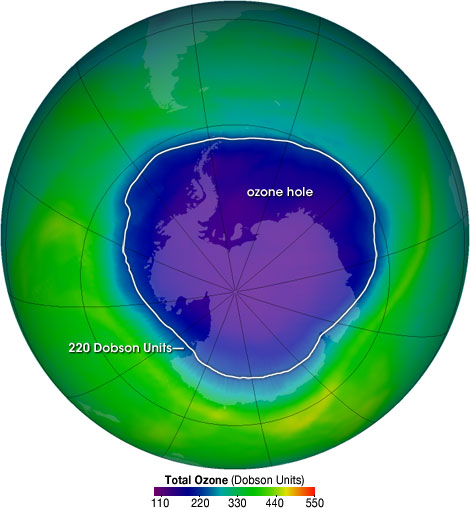
Ozone holeEPA officials initially tried to set a lower seasonal limit on ozone to protect wildlife, parks and farmland, as required under the law. While their proposal was less restrictive than what the EPA’s scientific advisers had proposed, Bush overruled EPA officials and on Tuesday ordered the agency to increase the limit, according to the documents.

“It is unprecedented and an unlawful act of political interference for the president personally to override a decision that the Clean Air Act leaves exclusively to EPA’s expert scientific judgment,” said John Walke, clean-air director for the Natural Resources Defense Council.

The president’s order prompted a scramble by administration officials to rewrite the regulations to avoid a conflict with past EPA statements on the harm caused by ozone.

Solicitor General Paul D. Clement warned administration officials late Tuesday night that the rules contradicted the EPA’s past submissions to the Supreme Court, according to sources familiar with the conversation. As a consequence, administration lawyers hustled to craft new legal justifications for the weakened standard.

More…

Rush To Produce Corn-based Ethanol Will Worsen ‘Dead Zone’ In Gulf Of Mexico, Study Says

Thursday, March 13th, 2008

The U.S. government’s rush to produce corn-based ethanol as a fuel alternative will worsen pollution in the Gulf of Mexico, increasing a “Dead Zone” that kills fish and aquatic life, according to University of British Columbia researcher Simon Donner.

In the first study of its kind, Donner and Chris Kucharik of the University of Wisconsin quantify the effect of biofuel production on the problem of nutrient pollution in a waterway.

The researchers looked at the estimated land and fertilizer required to meet proposed corn-based ethanol production goals. Recently, the U.S. Senate announced its energy policy aims of generating 36 billion gallons annually of ethanol by the year 2022, of which 15 billion gallons can be produced from corn starch. The corn-ethanol goal represents more than three times than triple the production in 2006.

“This rush to expand corn production is a disaster for the Gulf of Mexico,” says Donner, an assistant professor in the Dept. of Geography. “The U.S. energy policy will make it virtually impossible to solve the problem of the Dead Zone.”

More…

EU warns of climate change threat

Thursday, March 13th, 2008

An EU report says climate change will have a growing impact on global security, multiplying existing threats such as shortages of food and water.

It warns that climate change could cause millions of people to migrate towards Europe as other parts of the world suffer environmental degradation.

States that are “already fragile and conflict prone” could be over-burdened, the report says.

EU proposals to tackle climate change will be discussed by leaders this week.

The stark warning from the report – drawn up by the EU’s foreign affairs chief Javier Solana and the European Commission – is that climate change is not just a threat in itself – it is “a threat multiplier”.

It says shortages of food and water – even radicalisation and state failure – are likely to get worse if no action is taken.

Africa is likely to be especially at risk, which means migration could intensify, both within Africa itself and towards Europe.

EU External Relations Commissioner Benita Ferrero-Waldner told the BBC: “If the weakest countries cannot adapt, it may lead to, for instance, more forced migration, and even possibly radicalisation and state failure, causing internal and external security risks.”

Polar icecaps

The report also highlights the Arctic as a possible area of future conflict. With the melting of the polar icecaps, new waterways and trade routes are opening up.

The region is rich in untapped oil and gas resources, and last year Russia staked its claim by planting a flag on the seabed beneath the North Pole.

There is, it says, “an increasing need to address the growing debate over territorial claims and access to new trade routes”.

But the report does not offer much in the way of specific solutions. It recommends more dialogue, international co-operation and further research.

The EU prides itself on being a world leader on climate change, but turning talk into action is not easy.

On the one hand, the EU scheme for carbon emissions trading is being expanded to take in aviation for the first time.

But plans to limit car emissions and switch to renewable energy are being hampered by objections from industries and some member states, which say they are being unfairly penalised.

To the original article… 

Climate change’s most deadly threat: drought

Thursday, March 13th, 2008

Anthropologist Brian Fagan uses Earth’s distant past to predict the crises that may lie in its future.

Spring is on its way back to northern latitudes. In many locales, it will arrive earlier than “normal,” yielding, ostensibly, a longer growing season, a hotter summer, balmier autumn, and future winters will lack their ferocious post-Pleistocene bites.

While vineyards are being planned for northern England, millions of residents around desiccated Atlanta are praying for enough rain to flow through their taps.

Brian Fagan believes climate is not merely a backdrop to the ongoing drama of human civilization, but an important stage upon which world events turn.

As it turns out, the anecdotal evidence of climate change in this, the 21st century, shares much in common with a historical antecedent, the Medieval Warm Period, circa AD 800 to 1200, that radically shaped societies across the globe.

The Medieval Warm Period was a time when the capacity of agriculture rapidly expanded and enabled people to flourish in Europe. Yet elsewhere, extended lack of rainfall, or too much of it, brought famine, plagues, and wars.

This bout of global warming was followed by the Little Ice Age that lasted roughly from AD 1300 until the middle of the 19th century and cast Europe and North America back into a big chill. Since then, mean global temperature has been slowly and steadily rising, accompanied by huge leaps in agricultural output and skyrocketing human population.

Today, climate experts tell us that over the past two decades, temperature has registered an alarming unnatural spike and is expected to keep climbing.

Despite the well-established fact that Earth is heating up, skeptics still are trying to poke holes in the assertion that it is owed to humans pumping more CO2 into the atmosphere. Climate change is, and always has been cyclical, they say. Or maybe, some insist, it is God who has his hand on the thermostat.

More…

FDA Investigation Leads to Several Indictments for Importing Contaminated Ingredients Used in Pet Food

Sunday, March 9th, 2008

Contaminated pet food caused pet illnesses and deaths last year

The U.S. Food and Drug Administration’s (FDA) Office of Criminal Investigations announced that two Chinese nationals and the businesses they operate, along with a U.S. company and its president and chief executive officer, were indicted by a federal grand jury today in separate but related cases. The indictments are for their roles in a scheme to import products purported to be wheat gluten into the United States that were contaminated with melamine. These products were used to make pet food.

Xuzhou Anying Biologic Technology Development Co., LTD. (XAC), a Chinese firm that processes and exports plant proteins to the United States; Mao Linzhun, a Chinese national who is the owner and manager of XAC; Suzhou Textiles, Silk, Light Industrial Products, Arts and Crafts I/E Co. LTD. (SSC), a Chinese export broker that exports products from China to the United States; and Chen Zhen Hao, president of SSC and a Chinese national were charged in a 26-count indictment returned by a federal grand jury today in Kansas City, Mo.

Also indicted were ChemNutra, Inc., a Las Vegas, Nevada corporation that buys food and food components from China to sell to U.S. companies in the food industry, along with ChemNutra owners Sally Qing Miller and her husband, Stephen S. Miller, who were charged in a separate, but related, 27-count indictment. Sally Qing Miller, a Chinese national, is the controlling owner and president of ChemNutra; Stephen Miller is an owner and CEO of ChemNutra. The indictments charge all seven defendants with delivering adulterated food that contained melamine, a substance which may render the food injurious to health, into interstate commerce; introduction of a misbranded food into interstate commerce; and other charges.

The indictments allege that more than 800 tons of purported wheat gluten, totaling nearly $850,000, was imported into the United States between Nov. 6, 2006, and Feb. 21, 2007. According to the indictments, SSC falsely declared to the Chinese government that those shipments were not subject to mandatory inspection by the Chinese government prior to export.

More…

Australians worst nation on Earth at preserving wildlife

Sunday, March 9th, 2008

SYDNEY – Australians love their wildlife – after all, who could fail to warm to a koala, or a wombat, or a kangaroo? But few Australians know that they have the worst record on the planet for conserving their beautiful and unusual animals.

Of all the mammal species that have become extinct in the past 200 years, nearly half are Australian.

Since the British arrived, 27 mammals – about 10 per cent of the total – have disappeared.

These are statistics that “embarrass many conservationists, myself included”, says Tammie Matson, head of the species programme at WWF Australia.

More…

A Global Need for Grain That Farms Can’t Fill

Saturday, March 8th, 2008

LAWTON, N.D. — Whatever Dennis Miller decides to plant this year on his 2,760-acre farm, the world needs. Wheat prices have doubled in the last six months. Corn is on a tear. Barley, sunflower seeds, canola and soybeans are all up sharply.

“For once, there’s great reason to be optimistic,” Mr. Miller said.

But the prices that have renewed Mr. Miller’s faith in farming are causing pain far and wide. A tailor in Lagos, Nigeria, named Abel Ojuku said recently that he had been forced to cut back on the bread he and his family love.

“If you wanted to buy three loaves, now you buy one,” Mr. Ojuku said.

Everywhere, the cost of food is rising sharply. Whether the world is in for a long period of continued increases has become one of the most urgent issues in economics.

Many factors are contributing to the rise, but the biggest is runaway demand. In recent years, the world’s developing countries have been growing at about 7 percent a year, an unusually rapid rate by historical standards.

The high growth rate means hundreds of millions of people are, for the first time, getting access to the basics of life, including a better diet. That jump in demand is helping to drive up the prices of agricultural commodities.

Farmers the world over are producing flat-out. American agricultural exports are expected to increase 23 percent this year to $101 billion, a record. The world’s grain stockpiles have fallen to the lowest levels in decades.

“Everyone wants to eat like an American on this globe,” said Daniel W. Basse of the AgResource Company, a Chicago consultancy. “But if they do, we’re going to need another two or three globes to grow it all.”

More…

– This article is from the NY Times and they insist that folks have an ID and a PW in order to read their stuff. You can get these for free just by signing up. However, a friend of mine suggests the website bugmenot.com :arrow: as an alternative to having to do these annoying sign ups. Check it out. Thx Bruce S. for the tip.