Archive for the ‘CrashBlogging’ Category

Antarctic glaciers surge to ocean

Saturday, February 23rd, 2008

By Martin Redfern
Rothera Research Station, Antarctica

UK scientists working in Antarctica have found some of the clearest evidence yet of instabilities in the ice of part of West Antarctica.

If the trend continues, they say, it could lead to a significant rise in global sea level.

The new evidence comes from a group of glaciers covering an area the size of Texas, in a remote and seldom visited part of West Antarctica.

The “rivers of ice” have surged sharply in speed towards the ocean.

David Vaughan, of the British Antarctic Survey, explained: “It has been called the weak underbelly of the West Antarctic Ice Sheet, and the reason for that is that this is the area where the bed beneath the ice sheet dips down steepest towards the interior.

“If there is a feedback mechanism to make the ice sheet unstable, it will be most unstable in this region.”

There is good reason to be concerned.

Satellite measurements have shown that three huge glaciers here have been speeding up for more than a decade.

The biggest of the glaciers, the Pine Island Glacier, is causing the most concern.

More…

Greenland’s Rising Air Temperatures Drive Ice Loss At Surface And Beyond

Saturday, February 23rd, 2008

A new NASA study confirms that the surface temperature of Greenland’s massive ice sheet has been rising, stoked by warming air temperatures, and fueling loss of the island’s ice at the surface and throughout the mass beneath.

Greenland’s enormous ice sheet is home to enough ice to raise sea level by about 23 feet if the entire ice sheet were to melt into surrounding waters. Though the loss of the whole ice sheet is unlikely, loss from Greenland’s ice mass has already contributed in part to 20th century sea level rise of about two millimeters per year, and future melt has the potential to impact people and economies across the globe. So NASA scientists used state-of-the-art NASA satellite technologies to explore the behavior of the ice sheet, revealing a relationship between changes at the surface and below.

“The relationship between surface temperature and mass loss lends further credence to earlier work showing rapid response of the ice sheet to surface meltwater,” said Dorothy Hall, a senior researcher in Cryospheric Sciences at NASA’s Goddard Space Flight Center, in Greenbelt, Md., and lead author of the study.

A team led by Hall used temperature data captured each day from 2000 through 2006 from the Moderate Resolution Imaging Spectroradiometer (MODIS) instrument on NASA’s Terra satellite. They measured changes in the surface temperature to within about one degree of accuracy from about 440 miles away in space. They also measured melt area within each of the six major drainage basins of the ice sheet to see whether melt has become more extensive and longer lasting, and to see how the various parts of the ice sheet are reacting to increasing air temperatures.

The team took their research at the ice sheet’s surface a step further, becoming the first to pair the surface temperature data with satellite gravity data to investigate what internal ice changes occur as the surface melts. Geophysicist and co-author, Scott Luthcke, also of NASA Goddard, developed a mathematical solution, using gravity data from NASA’s Gravity Recovery and Climate Experiment (GRACE) twin satellite system. “This solution has permitted greatly-improved detail in both time and space, allowing measurement of mass change at the low-elevation coastal regions of the ice sheet where most of the melting is occurring,” said Luthcke.

The paired surface temperature and gravity data confirm a strong connection between melting on ice sheet surfaces in areas below 6,500 feet in elevation, and ice loss throughout the ice sheet’s giant mass. The result led Hall’s team to conclude that the start of surface melting triggers mass loss of ice over large areas of the ice sheet.

More…

Rat Invasions Causing Seabird Decline Worldwide

Saturday, February 23rd, 2008

– I wrote about this recently with regard to new Zealand’s natural history but the problems associated with rats being distributed world-wide into new environments is a major global ecological disaster.

= = = = =

Invasive rats on ocean islands are threatening the survival of many of the world’s seabirds, according to a new report.

The global analysis found that non-native rats have been observed preying on roughly a quarter of all seabird species, often with disastrous consequences. (See photos of rat-seabird conflict.)

The voracious rodents attack bird nesting colonies, eating eggs, chicks, and sometimes even adult birds.

Now 102 of 328 recognized seabird species are considered threatened or endangered by the World Conservation Union, with predation by invasive species ranking among the top dangers.

“Seabirds are important ecological actors in the oceans and on islands, but 30 percent of all seabirds are at risk of extinction,” said study co-author Bernie Tershy of the University of California, Santa Cruz.

“Invasive rats are likely the single largest threat to seabirds,” said Tershy, also a former grantee of the National Geographic Conservation Trust. (The National Geographic Society owns National Geographic News.)

Smaller seabird species and those that nest in burrows or rock crevices are particularly at risk, the study said.

That group includes storm-petrels, auklets, murrelets, and shearwaters, according to lead author Holly Jones of Yale University in New Haven, Connecticut.

“Rats can have a larger impact on entire seabird populations in species with adults that are small enough to prey on,” Jones said.

“Burrow- and crevice-nesting seabirds share the same underground habitat [as rats], which makes a predation encounter more likely.”

More…

Financial instability

Thursday, February 21st, 2008

– One of the ‘legs’ of the Perfect Storm Hypothesis asserts that our first-world hi-tech societies are like houses of cards; being built higher and high each year and growing more unstable as we go.

nasdaq-stock-market.jpg– The increasing snarl of inter linkages and interdependencies are making the entire system more unstable. Many folks feel, however, that the additional redundancies should make it more robust but that is an irrelevancy because the deepest truth is that a chain is only as strong as its weakest link.

– The following two stories are both from the financial world and they both illustrate how something (insurance) that one would assume would make a system more robust against failure has, in these cases, actually made it more fragile.

– – – – – – – – – – – – – – –

story #1:

Bonds Unbound by James Surowiecki on the Financial Page of The New Yorker Magazine, Feb 11, 2008

story # 2:

Arcane Market Is Next to Face Big Credit Test by Gretchen Morgenson, New Yorks Times, Feb 17, 2008

– research thanks to L.A.

– The second article is from the NY Times and they insist that folks have an ID and a PW in order to read their stuff. You can get these for free just by signing up. However, a friend of mine suggests the website bugmenot.com :arrow: as an alternative to having to do these annoying sign ups. Check it out. Thx Bruce S. for the tip.

Uproar over Archbishop’s sharia law stance

Saturday, February 9th, 2008

– I’ve expressed my concerns before over the high rates of Islamic immigration into the various European countries. 3% of Britain and Germany’s populations are now Islamic. In the Netherlands and France, it stands at 6%.

– Personally, and in spite of the fact that I consider myself a liberal thinker, I do not believe that societies can stand such a high rates of immigration – especially when the newcomers do not particularly care to be assimilated into their new country’s culture and strive, instead, to import and preserve their own culture in the midst of their host’s. And then, on top of that, you have the deeply uncomfortable fact that sincere Islamic believers believe that their religion is right and that all the others are wrong. It’s not a formula for evolving a harmonious multi-cultural society – it’s a formula for a culture war.

– I think it is right to offer hospitality to your guests. But I think the guests have a responsibility as well to respect your house if they want to be there. I think it’s reckless to invite someone in who has already declared that they think how you live and worship is wrong and who covets your house and the destruction of your society.

= = = = = = = = = = = = = = = = =

The Archbishop of Canterbury has been widely criticised after he called for aspects of Islamic sharia law to be adopted in Britain.

Dr Rowan Williams said that it “seems inevitable” that elements of the Muslim law, such as divorce proceedings, would be incorporated into British legislation.

The Archbishop’s controversial stance has received widespread criticism from Christian and secular groups, the head of the equality watchdog, several high-profile Muslims and MPs from all parties.

Amid the storm of protest, Downing Street moved quickly to distance itself from the Archbishop’s remarks, insisting that British law would and should remain based on British values.

A spokesman for Mr Brown said: “Our general position is that sharia law cannot be used as a justification for committing breaches of English law, nor should the principles of sharia law be included in a civil court for resolving contractual disputes.

More…

India culls 3.4m birds but fails to contain avian flu outbreak

Friday, February 8th, 2008

India is struggling to contain its worst avian influenza -epidemic, in spite of culling 3.4m birds and setting up a 5km poultry exclusion zone round the state of West -Bengal, the epicentre of the outbreak.

The government’s failure to reassure farmers that they will receive fair compensation for birds culled by rapid response teams has left experts scrambling to stop the disease entering the crowded markets of Calcutta and Delhi and led to a crisis of confidence in India’s -poultry industry.

The latest outbreak of the H5N1 strain of bird flu, confirmed on January 15, is proving more difficult to contain than earlier manifestations at large poultry farms in the states of Maharashtra and Gujarat in 2006 and, last year, in Manipur.

Roughly 80 per cent of rural households in West Bengal keep hens and ducks in their backyards to supplement their incomes, a practice encouraged by the state government, which distributes millions of chicks to poor communities each year.

More…

Western U.S. Faces Drought Crisis, Warming Study Says

Saturday, February 2nd, 2008

The U.S. West will see devastating droughts as global warming reduces the amount of mountain snow and causes the snow that does fall to melt earlier in the year, a new study says.

By storing moisture in the form of snow, mountains act as huge natural reservoirs, releasing water into rivers long into the summer dry season.

“We’re losing that reservoir,” said research leader Tim Barnett, an oceanographer and climate researcher at the University of California, San Diego.

“Spring runoff is getting earlier and earlier in the year, so you have to let water go over the dams into the ocean.”

Summers are also becoming hotter and longer. “That dries things out more and leads to fires,” Barnett added.

“Our results are not good news for those living in the western United States,” the scientists write in their report, which appears in today’s online edition of the journal Science.

Unnatural Changes

Barnett and his team used computer models to study water flow in Western rivers over the past 50 years.

The researchers found that the changes currently affecting the U.S. West have less than a one percent chance of being due to natural variability, Barnett told National Geographic News.

His team verified that by running a variety of control tests under pre-industrial conditions that mimicked known natural cycles.

(Related: “Ancient “Megadroughts” Struck U.S. West, Could Happen Again, Study Suggests” [May 24, 2007].)

What’s been occurring recently, he said, is different from natural variability and is driven by the buildup of greenhouse gases such as carbon dioxide in Earth’s atmosphere.

More…

UBS Reports Record Loss After $14 Billion Writedown

Wednesday, January 30th, 2008

– This story is not remarkable in and of itself. There are always financial reversals and some of them can be quite uncomfortable for those affected.

– What I find notable here is that this story is part of a pattern that’s been growing for months now. I can’t recall a time when so many stories of financial losses have appeared. The world’s financial markets certainly have a lot of resilience and protections built into them – not to mention the vested interests of those who participate in them and who therefore want to see them healthy. But there must be a limit somewhere to just how many hits the markets can take without deep instability setting in.

– Here are a list of such stories plucked from the ever passing river of world news and data:

= = = = = = = = = = = = = = = = = = =

UBS Reports Record Loss After $14 Billion Writedown

FDIC Approves the Assumption of all the Deposits of Douglass National Bank, Kansas City, Missouri

Banks may need $143 billion in fresh capital

French Bank Rocked by Rogue Trader

SunTrust: $555 Million in Write-Downs

Wachovia profit falls further than expected (98%)

BofA: $5.28 Billion in CDO Write-Downs

Writedowns Surpass $100 Billion

– I could go on, but need I say more?…

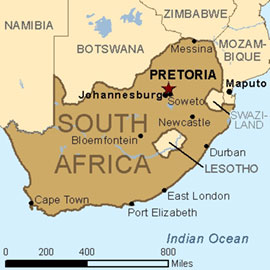
Power chaos in South Africa

Tuesday, January 29th, 2008

– Over the last week or two, I’ve seen a number of stories coming out of South Africa about power shortages there.

South Africa– Our societies and their infrastructures are like a house of cards in many ways. We build them higher and wider all the time and the number of interrelationships and dependencies within them grows as well. To keep it all going requires constant reevaluation to ensure that everything required is coordinated and working well.

– Apparently, the government in South Africa has dropped the ball with regard to ensuring the country has sufficient electrical power – a process that takes long-term planning and constant reevaluation.

– I think we can expect more of this because (1) it is getting more difficult to keep all our systems up and running as they get more complicated, (2) as the world becomes a tougher place, the ideologies of those moving up into power are becoming more demagogic and such such simplicity is not compatible with the requirements of running complex societies, and (3) the inputs to the systems we are trying to maintain in our societies are becoming less reliable. We have less food, less water, worse weather, more population and the list goes on and on.

– I think we need to expect increasing breakdowns.

= = = = = = = = = = =

Links to stories on the South African situation:

SA facing ‘critical’ power shortage

Supply of generators dries up

South African mines look for power shortages to end

Many British Muslim Women Embrace Political Islam

Sunday, January 27th, 2008

Two and a half years after British-born Muslims carried out suicide bombings in London that killed 52 people, British authorities are worried about the growing number of Muslim youth turning their backs on mainstream British society.

Most surprising is that many second-generation daughters of South Asian immigrants are embracing a political form of Islam.

Some say British Muslims have felt a growing sense of alienation since Sept. 11, 2001, and the London bombings, which has inspired some to segregate themselves from mainstream society and to greater assert their Muslim identity.

The ‘Muslim Woman’s Dilemma’

At the Islam Channel TV network, located in a sleek glass and steel building near London’s financial district, the reporters are mostly women — all with their heads covered. Some reveal only their eyes underneath black veils.

The network broadcasts a talk show called, “The Muslim Woman’s Dilemma.” Host Aamna Durrani wears a headscarf tightly wrapped around her head that falls into soft drapes over her shoulders.

Durrani was born in London to Pakistani parents and is increasingly asserting her Muslim identity, especially since 9/11 and the 2005 London suicide bombings that led to what she says are draconian anti-terrorism laws.

“My allegiance to the Muslim ummah, the community, definitely has got a lot, lot stronger as a result of the war on terror. And it has made the sense of solidarity throughout the world a lot stronger — and definitely for Muslim women here in Britain. It has really made us think where our loyalties lie,” Durrani says.

Growing Alienation from British Society

Analysts here say another cause of local Muslims’ growing alienation has been Britain’s role in the war in Iraq. They say it has inspired many young Muslims to segregate themselves from mainstream society.

A 2006 Pew poll showed 81 percent of Muslims surveyed considered their Islamic identity more important than being British. Like some others, Durrani says she would take part in the electoral process only if it were based on Islamic law and the Koran.

More…