Archive for the ‘The Perfect Storm’ Category

The Battle for Pork Chop Hill (healthcare)

Tuesday, June 16th, 2009

obama-listening– A friend of mine is an M.D. and recently he responded to President Obama’s request for grass-roots input from the U.S. public on health care reform by writing a letter to the president detailing his thoughts.   He sent me a copy of his letter to see if I had any thoughts and/or comments.

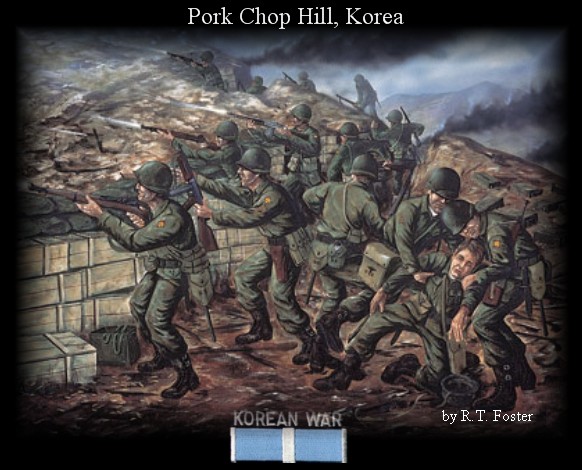
– I found it a well-written, thoughtful letter full of excellent suggestions but when I responded to him, I found it impossible to get into the spirit of it.   To me, here in the U.S., the battle for serious health care reform, is a meaningless battle – a lot like those battles when our troops fought for mastery of particular hilltop in WWII and the Korean War.   The hills won one day at a terrible cost would be abandoned just a few days later as the conditions of the larger enclosing battles changed.

– Frankly, I don’t think there’s any chance that the U.S. will ever enact serious health care reform and in my response to my friend, below, you’ll see why.

= = = = = = = = = = = = = = = = = = = = = = = = = = =

Dr. H.,

Thank you for responding to the president’s request for input on our health care system.   What you’ve written here is an excellent public service.

I too have thoughts about all of this but I’m afraid I am less optimistic that calls for ideas will lead to any changes of significance.   My fear, as I’ve told you before, is that the medical and pharmaceutical industries in the U.S. have been thoroughly captured by large and powerful profit-centric corporate interests and that nothing will wrest control back from them short of a revolution.

Corporations vs. People

I don’t mean an armed revolution.   I mean a revolution in how we, as human beings, think about what the purposes of our national governments should be.   I’m fond of saying that, “One cannot have two number-one priorities.“  When it comes to deciding what governments are for, we certainly cannot.   We either have to place the welfare and happiness of the nation’s people first or the freedom of the nation’s corporations  to do whatever they want to do in their pursuit of profits.  We cannot have it both ways.

Once this choice is explained clearly and brought into our collective consciousness, I have little doubt that most people would feel that government’s number-one priority should be to maximize the quality of life for its citizens.   But, absent such explanations and awarenesses, our country, and most others as well, have been primarily molded by those who seek profit and power for themselves with little regard for the circumstances of others.

(As an aside, let me say that I am not against Capitalism.   Indeed, it is the engine that creates wealth and innovation in our societies.   I am only saying that at the very top of the decision pyramid, when corporate interests clash with the best interests of the people, the decision makers should opt for the good of the people.   Done even handedly, this might limit the range of actions of corporations but it would still be a level playing field for them and none would be disadvantaged verses the others.   More over, those decisions makers at the very top would be strongly instructed to stay out of the way of corporations to the maximum extent possible – save when the people’s best interests are at stake).

So, from my POV, the battle here is not how we can ‘fix’ health care.  It goes far far deeper than that.   Until we, as a people, decide that the happiness and well being of the nation’s people IS the highest priority of the national government, we will always have these battles.   And, given the drive and tenacity of those whose primary aims are for power and profit, we will usually lose these battles.

Beyond all of this, there are bigger problems for our country and the world yet looming.

Globalization

A healthy vibrant country can organize its finances to support free medical care for all of its citizens.  Several countries around the world have proven this decisively.   But, I’m not sure that a country whose finances are faltering badly can do this.   And our country is faltering badly at this point in its history.   Globalization was touted as our “friend”.   Indeed, as the “world’s friend”; better and cheaper products for everyone and improved standards of living for all.
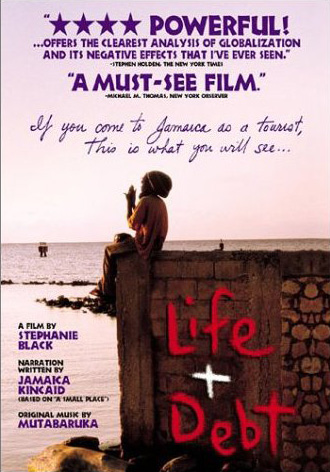
life-and-debtBut, it hasn’t turned out that way for some of us.  Small countries, like Jamaica (see the Movie “Life and Debt“), have had food stuffs injected  into their markets at far lower prices than their local farmers could sell for.  The result is that the local farmers have all lost their farms and moved to the cities and now entire countries are completely dependent on the food stuffs supplied by the multinational corporate proponents of Globalization.  Sure, these folks can buy their food cheaper.  But now they’ve lost their independence, their jobs, their communities and they are utterly dependent on outside forces for their survival.   Globalization has made them into captive consumers.

And the rich nations have not escaped unscathed.   Multinational corporations seeking ever larger profits have convinced us in the U.S. to send our manufacturing and high-tech industries overseas.    They promised us lower costs on all the cheap goods  love to buy at Wal-Mart.  And for a while, that was fun.   But now we see the deep truth that a nation can only continue being rich if it produces and sells things of value.  And we’ve been turned into a nation of consumers and borrowers by Globalization and are getting poorer by the day.

The multinationals saw great opportunity some years back when they gazed at, for example, the U.S. and China.   They thought, “China is poor and has really cheap labor and the U.S. is rich and its labor is expensive.   If we connect these two situations, goods will flow from China to the U.S. and money will flow from the U.S. to China and we’ll set ourselves up as the folks in the middle coordinating the exchange and getting hugely rich.“  And, for the multinationals and China, it’s been a good deal.  But, for the U.S., the promises of Globalism have only impoverished us.

So, back to socialized health care.   I don’t believe that even if the U.S. wanted to implement serious socialized healthcare, that we could.   What would we pay for it with?   We are no longer a wealth generating nation.

So, that’s one of the big looming problems I was referring to.

Economies and Growth

The other has to do with the idea that most of our societies are built upon the principle that healthy economies are growth economies.  That’s worked well for us as a species up until now but it isn’t going to work much longer.   We’re coming to the limits of what the planet can supply for food and water and we’ve clearly exceeded what it can supply for renewable resources. We’ve built the very foundations of our societies on a non-renewable resource, oil, that will be running out soon.   And we’ve messed with the atmosphere’s Carbon Dioxide so badly that we’re well on our way towards a major climate shift.

And, in the midst of all of these dire warnings written so clearly on the wall of our future, the very best folks can come up with, as they consider and fret about the problems of the currently global economic downturn, is that with luck and perseverance, soon we’ll have our economies all back up and running just as before – with ever increasing growth, consumption and pollution as the cornerstones of our brave new world – same as the old unworkable, unsustainable world.

So, that would be the second problem – and it’s a big one.

Perspectives
pork-chop-hillIf you are down inside the workings of a specific nation and deeply involved and  invested in the concerns and problems of the local health care system, then it might seem reasonable to you to fight the good fight  for a better way of doing things.

But I would suggest that if one gets out of the trenches and ascends above the entire field of battle to a great height, one might see that in the bigger picture it isn’t going to matter if your brave and idealistic unit captures that small hill called “Healthcare”.   Bigger forces are afoot and visible from a greater height.

Those are my thoughts, Dr. H.   As always, I know I sound like a great pessimist.   But I don’t feel that way.   I think I am simply seeing the bigger picture.   I too am idealistic and I talk and rail and write about all of this almost daily.   But, in truth, I don’t do these things because I think I can really change them.   I act more because speaking the truth is right in and of itself and needs no other justification.

At the end of your letter, you listed the following points:

1. There is no place in medical care for “For Profit”.

2. Insurance companies’ priority is profit for shareholders.

3. Direct to patient advertising should be banned.

4. Medical Schools need to be induced to greatly increase graduation of primary care physicians, including loan forgiveness for those who go into primary care practice.

5. Providers should be incentivized for keeping patients healthy and minimizing expensive tests and medications.

6. We should have a single payer system that links patients and families with primary care providers that have support from social services, nutrition and exercise referrals and other support groups.

7. Hopefully we can move toward a society with less income inequality and social injustice where we prioritize education and opportunity and improve the quality of life for all.

I agree and applaud everyone of them.  And I say this not withstanding the fact that I think this battle over health care will be swept away by the larger trends that are afoot.

Again, thanks for writing your letter to the President.  I deeply admire your motives and your idealism.   Please do not take anything I’ve said here as a criticism – it is not intended to be.

Your friend,

Dennis Gallagher
US condemns North Korean threat

Sunday, June 14th, 2009

– See here for previous pieces on the North Korean problem:

= = = = = = = = = = = = = = = = =

North Korea’s threat to “weaponise” its plutonium stocks is “provocative” and “deeply regrettable”, US Secretary of State Hillary Clinton says.

She said the move had been denounced around the world and would isolate North Korea’s government further.

The North said it would start enriching uranium and use the plutonium for nuclear weapons hours after a UN vote for tough new sanctions against it.

The US would vigorously enforce the new sanctions, Mrs Clinton said.

Speaking during a visit to Canada, she said that the latest UN moves provided the tools needed for “to take appropriate action” against North Korea.

The North says it will view any US-led attempts to “blockade” it as an “act of war”.

The warning from North Korea’s foreign ministry was carried by Pyongyang’s official news agency on Saturday.

More…

Connected World Gives Viruses The Edge

Sunday, June 14th, 2009

“The findings also suggest that as human activity makes the world more connected, natural selection will favour more virulent and dangerous parasites.”

– This quote from the article text below is no surprise to me or to anyone who has looked at the logic of how contagious diseases spread.   You pack more and more people together and the situation begins to favors more and more virulent diseases.   The Black Death in Europe was, perhaps, the first concrete demonstration of this.  The world today is ripe and getting riper for this sort of thing.   We’ve been extremely lucky that some of the very nasty things around like Ebola have not thus far gotten loose in a population center.

= = = = = = = = =  * * * = = = = = = = = = = =

That’s one conclusion from a new study that looked at how virulence evolves in parasites. The research examined whether parasites evolve to be more or less aggressive depending on whether they are closely connected to their hosts or scattered among more isolated clusters of hosts.

The research was led by Geoff Wild, an NSERC-funded mathematician at the University of Western Ontario, with colleagues from the University of Edinburgh.

“Our study follows up on some recent findings that suggest that reduced dispersal of parasites across scattered host clusters favours the evolution of parasites with lower virulence – in the case of influenza, for example, a milder, possibly less deadly, case of flu,” said Dr. Wild.

“Some researchers had contended from this that the parasites were evolving to support the overall fitness of the group,” he added. “The argument for adaptation at the group level is that the parasites become more prudent to prevent overexploitation and hence to avoid causing the extinction of the local host population.”

However, Dr. Wild and his colleagues were not convinced that Darwinian theory – so successful in providing explanations based on the notion that adaptation maximizes individual fitness – was ready for such a major makeover.

The researchers decided to move the arguments from words to harder science. Together they developed a formal mathematical model that incorporated variable patch sizes and the host parasite population dynamics. It was then run to determine the underlying evolutionary mechanisms, the results of which were published in the Nature paper.

More…

Recession fails to dampen world’s appetite for arms

Friday, June 12th, 2009

– Nice to know that some parts of the world’s economy are doing OK.

= = = = = = = = = = = = =

sub230

STOCKHOLM – World governments spent a record US$1.46 trillion ($2.35 trillion) on upgrading their armed forces last year despite the economic downturn, with China climbing to second place behind top military spender the United States, a Swedish research group said.

Global military spending was 4 per cent higher than in 2007 and up 45 per cent from a decade ago, the Stockholm International Peace Research Institute, or SIPRI, said in its annual report.

“So far the global arms industry, booming from the wars in Iraq and Afghanistan and from spending increases by many developing countries, has shown few signs of suffering from the crisis,” SIPRI said.

However, the report added arms companies may face reduced demand if governments cut future military spending in response to rising budget deficits.

It also noted that US arms purchases – by far the highest in the world – were expected to rise less rapidly under President Barack Obama after sharp growth during the Bush Administration.

More…

AP, Washington Times: “Experts suspect global warming may be driving wild climate swings that appear to be punishing the Amazon with increasing frequency”

Friday, June 12th, 2009

– This from the Climate Progress Blog – one of my favorites:

– – – – – – – – – – – – – – – – – – – –

Big media struggles with how — or even whether — to explain to the public that the increase in extreme weather we are seeing is precisely what scientists have been predicting would occur because of human-caused climate change (see, for instance, “CNN, ABC, WashPost, AP, blow Australian wildfire, drought, heatwave “Hell (and High Water) on Earth” story — never mention climate change“).

But the AP and the Washington Times has explained quite well (here) the likely source of Brazil’s double punch — brutal drought followed by brutal flooding, Hell and High Water:

Across the Amazon basin, river dwellers are adding new floors to their stilt houses, trying to stay above rising floodwaters that have killed 48 people and left 405,000 homeless.

Flooding is common in the world’s largest remaining tropical wilderness, but this year the waters rose higher and stayed longer than they have in decades, leaving some fruit trees entirely submerged.

Farmer Nelci de Fatima Goncalves pulls a cow across a cracked field caused by a drought in Passo Fundo, Rio Grande do Sul, Brazil, last month. Southern Brazilian states far from the Amazon have suffered from an extended drought, caused by La Nina, a periodic cooling of waters in the Pacific Ocean. (Associated Press)The surprise isn’t just the record flooding, it’s that the flooding followed record droughts:

Only four years ago, the same communities suffered an unprecedented drought that ruined crops and left mounds of river fish flapping and rotting in the mud.

Experts suspect global warming may be driving wild climate swings that appear to be punishing the Amazon with increasing frequency.

The BBC also got the story right last month, “Experts say global warming may be behind the wild climate swings that have brought periods of unprecedented droughts and flooding to the Amazon in recent years.”

More…

Global Warming Will Wreck Your Business Plan

Friday, June 12th, 2009

Climate change will increase water scarcity, alter food production and dramatically change energy supply and migration patterns, according to a new report released by Lloyd’s, the world’s leading specialist insurance market.

Climate change and security: risks and opportunities for business, launched in conjunction with the International Institute for Strategic Studies (IISS), highlights that these changes will bring threats – and opportunities – for businesses.

Lloyd’s Chief Executive, Dr Richard Ward, said:

“Climate change will change the way we live and work, and will lead to greater competition for scarce resources, such as food and water. This is likely to result in increased economic nationalism and greater global insecurity, which will in turn add to the complexity and cost of doing business.”

Wow…this guy has some balls. To mention that shortages “such as food and water” will “add to the complexity and cost of doing business…” I mean who cares about all the death and destruction that will cause…can’t have the cost of business get higher.

He goes on to say:

“Every organization needs to have a clear understanding of its particular vulnerabilities and have in place a range of mitigation strategies. Their ability to understand what the impacts of climate change are going to be could not only protect them from threats but could also open up new business opportunities.”

Yea so you know, take a look at the world falling to pieces and see where you can get in there and make a buck.

IISS Director of Transnational Threats and Political Risks, Nigel Inkster, said:

“Climate change has the potential to act as an accelerator of global instability and has been recognized in both the USA and Europe as an issue affecting national security. Climate change could lead to increased competition between states for ever more scare resources and could in the worst case lead to inter-state conflict.”

more…

– Hat tip to The Naib at The Sietch Blog for this

Swine flu pandemic declared

Thursday, June 11th, 2009

LATEST The World Health Organisation has told its member nations it is declaring a swine flu pandemic – the first global flu pandemic in 41 years.

In a statement sent to member countries, WHO said it decided to raise the pandemic alert level from phase 5 to 6, meaning that a global outbreak of swine flu has begun.

The decision was made after the UN health agency held an emergency meeting on swine flu with its experts.

Countries were preparing for tighter swine flu controls as some nations said they had received advance notice of the declaration from the WHO.

Moving to phase 6, the highest level, means a pandemic has begun. It triggers drugmakers to speed up production of a swine flu vaccine and prompt governments to devote more money to containing the virus.

The last pandemic – the Hong Kong flu of 1968 – killed about 1 million people. Ordinary flu kills about 250,000 to 500,000 people each year.

On Wednesday, the WHO reported that the virus has infected at least 27,737 people in 74 countries and caused 141 deaths. Most cases have been in North America, but Europe and Australia have seen a sharp increase in recent days.

Four patients with swine flu were fighting for their lives in Melbourne hospitals, while Thailand’s Public Health Ministry said the country’s case load had nearly tripled to 46, including 17 infected at a disco in the resort town of Pattaya.

Earlier there had been speculation that a  jump in infections in Australia could push WHO to finally announce a pandemic. Australia’s cases reached 1275 by late Wednesday.

More…

For 300 years Britain has outsourced mayhem. Finally it’s coming home

Wednesday, June 10th, 2009

– I’ve long thought that Britain has had a lot to own up to that it has largely been in denial of.   Things like selling salt from the sea to the Indians during Gandhi’s years of protest. Not that the U.S., with its Monroe Doctrine and its manipulation of Latin American events for its own benefit, hasn’t much of the same history and denial.   But Monbiot (one of my favorites authors) surely nails the paper to the church door here.   I think the average U.S. and British citizen, living blissfully within the cocoons of wealth created by these rapacious adventures, has very little idea how much of their comfort came at what cost to others.

– But, irony abounds.   Those who were disadvantaged by these manipulations; China with the Opium, Chile with the Copper and etc., are quick to point at their wounds and moralize.   But, inevitably, as the winds of history shift, they will come into ascendance and practice all the same self-aggrandizements at the expense of the weaker.  Indeed, I find myself wondering frequently what sort of a world-master China is going to make - given the current trends.

– – – – – – – – – – – – – – – – – – – – – – – – – – – – –

Opium, famine and banks all played their part in this country’s plundering of the globe. Now it’s over, we find it hard to accept

Why now? It’s not as if this is the first time Britain’s representatives have been caught out. The history of governments in all countries is the history of scandal, as those who rise to the top are generally the most ambitious, ruthless and unscrupulous people politics can produce. Pushing their own interests to the limit, they teeter perennially on the brink of disgrace, except when they fly clean over the edge. So why does the current ballyhoo threaten to destroy not only the government but also our antediluvian political system?

The past 15 years have produced the cash-for-questions racket, the Hinduja and Ecclestone affairs, the lies and fabrications that led to the invasion of Iraq, the forced abandonment of the BAE corruption probe, the cash-for-honours caper and the cash-for-amendments scandal. By comparison to the outright subversion of the functions of government in some of these cases, the is small beer. Any one of them should have prompted the sweeping political reforms we are now debating. But they didn’t.

The expenses scandal, by contrast, could kill the Labour party. It might also force politicians of all parties to address our unjust voting system, the unelected Lords, the excessive power of the executive, the legalised blackmail used by the whips, and a score of further anachronisms and injustices. Why is it different?

I believe that the current political crisis has little to do with the expenses scandal, still less with Gordon Brown’s leadership. It arises because our economic system can no longer extract wealth from other nations. For the past 300 years, the revolutions and reforms experienced by almost all other developed countries have been averted in Britain by foreign remittances.

The social unrest that might have transformed our politics was instead outsourced to our colonies and unwilling trading partners. The rebellions in Ireland, India, China, the Caribbean, Egypt, South Africa, Malaya, Kenya, Iran and other places we subjugated were the price of political peace in Britain. After decolonisation, our plunder of other nations was sustained by the banks. Now, for the first time in three centuries, they can no longer deliver, and we must at last confront our problems.

There will probably never be a full account of the robbery this country organised, but there are a few snapshots. In his book Capitalism and Colonial Production, Hamza Alavi estimates that the resource flow from India to Britain between 1793 and 1803 was in the order of £2m a year, the equivalent of many billions today. The economic drain from India, he notes, “has not only been a major factor in India’s impoverishment … it has also been a very significant factor in the industrial revolution in Britain”. As Ralph Davis observes in The Industrial Revolution and British Overseas Trade, from the 1760s onwards India’s wealth “bought the national debt back from the Dutch and others … leaving Britain nearly free from overseas indebtedness when it came to face the great French wars from 1793”.

More, much more…

– Research thanks to Robin S.

Europe swings Right as depression deepens

Wednesday, June 10th, 2009

– The economic situation is beginning to exert powerful effects on the political landscape.  Witness this analysis of current events in Europe.

– – – – – – – – – – – – – – – – – – – –

The establisment Left had been crushed across most of Europe, just as it was in the early 1930s.

We have seen the ultimate crisis of capitalism — what Marxist-historian Eric Hobsbawm calls the “dramatic equivalent of the collapse of the Soviet Union” — yet socialists have completely failed to reap any gain from the seeming vindication of their views.

It is not clear why a chunk of the blue-collar working base has swung almost overnight from Left to Right, but clearly we are seeing the delayed detonation of two political time-bombs: rising unemployment and the growth of immigrant enclaves that resist assimilation.

Note that Right-wing incumbents in France (Sarkozy) and Italy (Berlusconi), survived the European elections unscathed.

Left-wing incumbents in Germany, Austria, the Netherlands, Spain, Portugal, Hungary, Poland, Denmark, and of course Britain were either slaughtered, or badly mauled.

The Dutch Labour party that has dominated national politics for the last half century fell behind the anti-immigrant movement of Geert Wilders (banned from entering Britain). It serves them right for the staggeringly stupid decision to force through the European Constitution (renamed Lisbon) after it had already been rejected by their own voters by a fat margin in the 2005 referendum.

The Portuguese Socialists face Siberian exile after seeing a 18pc drop in their vote. The slow drip-drip of debt-deflation for a boom-bust Club Med state, trapped in the eurozone with an overvalued exchange rate (viz core Europe, and the world), has suddenly turned into a torrent. The country is already in deflation (-0.6pc in April). It has been suffering its own version of Japanese perma-slump for half a decade.

Portugal’s opposition is calling for an immediate vote of no censure, while the Government clings to constitutional fig-leaves to hide its naked legitimacy. “O Governo está na sua plenitude de funções,” said the chief spokesman. You can guess what that means. Not long for this world, surely.

In Germany and Austria, the Social Democrats suffered their worst defeats since World War Two. I don’t say that with pleasure. A vibrant labour-SPD movement is vital for German political stability. It was the peeling away of Socialist support during the Bruning deflation of the Depression years — so like today’s Weber-Trichet deflation — that led to the catastrophic election of July 1932, when the Nazis and Communists took half the Reichstag seats.

More…

– Research thanks to Robin S.

North Korea would use nuclear weapons in a ‘merciless offensive’

Tuesday, June 9th, 2009

– Ever wondered why the world lets North Korea boast and swagger like they do?

– They starve their own people and worship their ‘great leaders’ like they are gods.    They test fire missiles right over Japan and they develop nuclear weapons right in front of us with an ‘in your face‘ attitude.

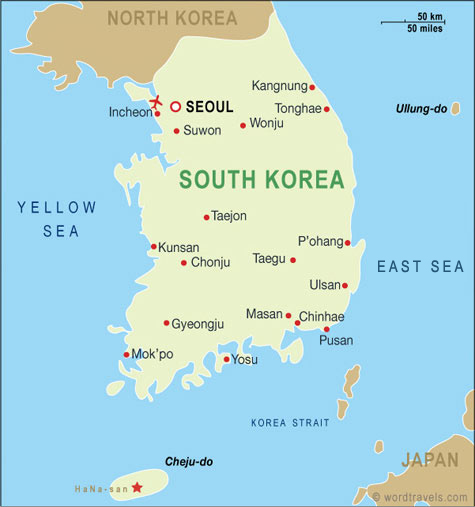
– The why has to do with the size of their standing army (700,000 within 90 miles of the South Korean border) … and with the physical location of Seoul, the capital of South Korea.

The layout of the Koreas

The layout of the Koreas

Check the map:

– Seoul is within the range of vast arrays of North Korean artillery and it is far too close to the border to save it if the North Koreans swarmed across en masse.

– In short, for those who oppose North Korea’s insanity, the cards are very badly dealt.   Yes, we could do a full body slam on them and take them down once and for all, but it would inevitably cost us the capital city of a major ally.   NOT a good choice.

– So, we talk to the North Koreans and try to reason with them and we hope that their semi-insane leadership will simply die of stupidity or something soon so saner minds can take over.   We dicker with Russia and China, who love to play the ‘people’s devil’s advocates‘ in such situations – so long as their bacon’s not in the fire.

– And then, China has an additional problem with North Korea that we don’t hear much about here in the west.   And that is unwanted immigration.   The North Korean / Chinese border isn’t much more effective than the U.S. / Mexico border.   And North Korea has a lot of desperate starving people who want to get to the ever so much more affluent China  and the Chinese have a lot on their hand now just dealing with those coming across.   Without the cooperation and good-will of the North Korean authorities, they’d have a lot bigger problem – and they don’t need that.

– So, we cannot act against North Korea without hurting ourselves badly and yet they just cannot be allowed to go on like they are.   It’s that fatal embrace business again.

– If you doubt what I’m saying here, then just read the following article:

= = = = = = = = = = = = = = = = =

North Korea today said it would use nuclear weapons in a “merciless offensive” if provoked — its latest bellicose rhetoric apparently aimed at deterring any international punishment for its recent atomic test blast.

The tensions emanating from Pyongyang are beginning to hit nascent business ties with the South: a Seoul-based fur manufacturer became the first South Korean company to announce Monday it was pulling out of an industrial complex in the North’s border town of Kaesong.

The complex, which opened in 2004, is a key symbol of rapprochement between the two Koreas but the goodwill is evaporating quickly in the wake of North Korea’s nuclear test on May 25 and subsequent missile tests.

Pyongyang raised tensions a notch by reviving its rhetoric in a commentary in the state-run Minju Joson newspaper today.

“Our nuclear deterrent will be a strong defensive means…as well as a merciless offensive means to deal a just retaliatory strike to those who touch the country’s dignity and sovereignty even a bit,” said the commentary, carried by the official Korean Central News Agency.

It appeared to be the first time that North Korea referred to its nuclear arsenal as “offensive” in nature. Pyongyang has long claimed that its nuclear weapons program is a deterrent and only for self-defense against what it calls US attempts to invade it.

More…

– Research thanks to Charles P.