Archive for the ‘The Perfect Storm’ Category

Global Warming to Affect U.S. Transport

Saturday, March 15th, 2008

Flooded roads and subways, deformed railroad tracks, and weakened bridges may be the wave of the future with continuing warming, a new study says.

Climate change will affect every type of transportation through rising sea levels, increased rainfall, and surges from more intense storms, the National Research Council said in a report released Tuesday.

Complicating matters, people continue to move into coastal areas, creating the need for more roads and services in the most vulnerable regions, the report noted.

“The time has come for transportation professionals to acknowledge and confront the challenges posed by climate change and to incorporate the most current scientific knowledge into the planning of transportation systems,” said Henry Schwartz Jr., past president and chairman of the engineering firm Sverdrup/Jacobs Civil Inc., and chairman of the committee that wrote the report.

Five Major Threats

The report cites five major areas of growing threat:

More heat waves, requiring load limits at hot-weather or high-altitude airports and causing thermal expansion of bridge joints and rail track deformities.

(Related story: Global Warming Likely Causing More Heat Waves, Scientists Say [August 1, 2006])

Rising sea levels and storm surges flooding coastal roadways, forcing evacuations, inundating airports and rail lines, flooding tunnels, and eroding bridge bases.

(Related story: Rising Seas Threaten China’s Sinking Coastal Cities [January 17, 2008])

More rainstorms delaying air and ground traffic, flooding tunnels and railways, and eroding road, bridge < recent (see>, and pipeline supports.

More frequent strong hurricanes, disrupting air and shipping service, blowing debris onto roads, and damaging buildings.

Rising arctic temperatures thawing permafrost, resulting in road, railway, and airport runway subsidence and potential pipeline failures.

(Related story: Arctic Summers Ice Free by 2040, Study Predicts [December 12, 2006])

System Not Built for Change

The nation’s transportation system was built for local conditions based on historical weather data, but those data may no longer be reliable in the face of new weather extremes, the report warns.

More…

Australia’s food bowl lies empty

Saturday, March 15th, 2008

As the BBC looks at the impact of rising food prices around the world, Sydney correspondent Nick Bryant reports from Australia on how the worst drought on record has slashed its exports of wheat.

Though located in a remote corner of the planet, the fields of Australia’s food bowl are central to the worldwide price of wheat.

In this part of rural New South Wales, water-starved farms and cavernous empty grain silos have the potential to create a ripple effect which spreads around the globe.

And that is precisely what is happening right now.

Low yield

After America, Australia is normally the second largest exporter of grain, and in a good year it would hope to harvest about 25 million tonnes.

But the country remains in the grip of the worst drought in a century, which is why the 2006 crop yielded only 9.8m tonnes.

Global wheat stocks are at their lowest levels since 1979, and the ongoing Australian drought is one of the reasons why.

More…

Scientists warn of wheat disease

Saturday, March 15th, 2008

Scientists say poorer populations in vulnerable countries could starve if a disease called Ug-99 hits yields hard enough to push up wheat prices.

There is already a global wheat shortage and UN agencies are concerned about the impact of high food prices.

Ug-99 is a form of black stem rust that prevents wheat taking up nutrients and can wipe out whole harvests.

Scientists at the John Innes Centre, in England, are trying to find wheat with a natural resistance to the disease.

Most wheat grown in Africa, Asia and China, has little resistance to Ug-99.

The BBC’s Anna Hill says scientists at the John Innes Centre are testing a wide variety of native wheats from Asia and Africa to see if they can find natural resistance to the disease and breed new varieties from them.

But this could take more than five years, by which time Ug-99 could already be causing wide spread harvest failure.

More…

The EPA’s tailspin

Saturday, March 15th, 2008

– This is an editorial from Nature Magazine; one of the world’s preeminent magazines about science and for scientists.

= = = = =

The director of the Environmental Protection Agency is sabotaging both himself and his agency.

The US Environmental Protection Agency (EPA) is fast losing the few shreds of credibility it has left. The Bush administration has always shown more zeal in protecting business interests than the environment (see Nature 447, 892–893; 2007). But the agency’s current administrator, Stephen Johnson, a veteran EPA toxicologist who was promoted to the top slot in 2005, has done so with reckless disregard for law, science or the agency’s own rules — or, it seems, the anguished protests of his own subordinates.

On 27 February, to take the first of two examples that surfaced last week, Senator Barbara Boxer (Democrat, California) used a routine budget hearing to give Johnson a grilling. Why hadn’t he given her state permission to regulate the carbon dioxide emissions of vehicle exhausts? California needs a waiver from the EPA to regulate in this way, and in the past such waivers have been granted easily. And, Boxer reminded him via a series of leaked memos and PowerPoint presentations, Johnson’s own top-level staff begged him to sign the waiver in this case. “This is a choice only you can make,” one colleague wrote to him. “But I ask you to think about the history and the future of the agency in making it. If you are asked to deny this waiver, I fear the credibility of the agency that we both love will be irreparably damaged.”

More…


World `Squandered’ Decade in Climate Debate, Top Scientist Says

Saturday, March 15th, 2008

– This reminds me of something James Gustave Speth said in, Red Sky at Morning:

The results of two decades of international environmental negotiations are disappointing. It is not that what has been agree upon is wrong or useless. But, the bottom line is that these treaties and their associated agreements and protocols do not drive the changes that are needed. Thus far, the climate convention is not protecting the climate, the biodiversity convention is not protecting biodiversity, the desertification convention is not preventing desertification, and even the older and stronger Convention on the Law of the Sea is not protecting fisheries. Nor are they poised to do so in the immediate future. On the big issues the trends of deterioration continue. With few exceptions, our instruments of choice, international environmental law, is not yet changing them, and the hour is late.

– – – – – – – – – – – – – – –

March 11 (Bloomberg) — World leaders wasted a decade debating whether global warming is happening, and now need to act quickly to limit its effects, a former chairman of the United Nations Intergovernmental Panel on Climate Change said.

The pace of greenhouse-gas emissions risks locking in thousands of years of higher sea levels, as well as damaging marine ecosystems such as coral reefs, melting sea-ice and acidifying the oceans, said Robert Watson, now chief scientific adviser at the U.K. environment ministry.

European nations, which have taken a lead in reducing output of pollution linked to global warming, have “failed miserably” to get the U.S., the largest industrialized emitter, to follow suit, or to work well with China and India, Watson said. China’s emissions growth will swamp pollution cuts planned by the U.K., Germany and other developed nations, U.S. researchers said.

“Have we squandered the last 10 years? Largely yes,” Watson told delegates today at the Oceanology International conference in London. “We should have been acting far more to reduce greenhouse-gas emissions over the last 10 years, especially trying to get technology transfer with developing countries and bringing the United States on board.”

More…

Perpetuity Shorter in Wyoming

Saturday, March 15th, 2008

– In spite of the fact that my wife and I are working our way towards working in land conservation in future years, I have had strong doubts about many of the land conservation efforts going on today. Like, for instance, when green groups band together and buy large swaths of rain forest and put it all into non-development trusts in coordination with the local governments.

– It all sounds so good on paper but what few folks think about, in my opinion, is that over the long term these ‘paper’ agreements will only have force and be honored so long as the structures (groups, governments, and trusts) behind them continue to have traction and power. If the world begins to get unstable and wars are breaking out over resources and it all gets even more dog-eat-dog than it is now, none of these agreements ‘in perpetuity’ are going to be respected.

– Hell, the Brazilian and Indonesian governments, in perfect health and stability, cannot keep the loggers and miners out of their forests. Who can imagine that if folks are starving, say, in Guyana and the central government there is on the ropes, that some idealistic agreement with green groups based far away on the other side of the planet to only allow eco-tourism activities in the local forests will be honored?

Yeah, right. I think the words ‘in perpetuity’ are going to be ever more, shall we say, flexible as time goes on.

– Along this line comes this excellent piece from the Blog, Only in it for the Gold, wherein Michael discusses how ‘in perpetuity’ is getting a bit shorter in Wyoming…

– – – – – – – – – – – – – – –

To “Perpetuity Shorter in Wyoming“…

Monsanto Threatens Biodiversity

Saturday, March 15th, 2008

The genetically modified MON810 maize seed has just been banned. Marie-Monique Robin draws an alarming portrait of Monsanto, the firm that invented it.

“You should carry out an investigation into Monsanto. We all need to know the truth about this American multinational, seeing that it is laying hands on the world’s seeds, and therefore on the world’s food.” The request came from an Indian farmer; it did not fall on deaf ears, for the journalist nearby was Marie-Monique Robin, who was an experienced investigative reporter and had already made several documentaries on biodiversity and what threatens it. The name was familiar to her: a North-American multinational with a frightful record, one of the industrial age’s worst polluters, world leader on the GM plants market, which threatens to grow into a monopoly that will jeopardize food safety the world over.
Marie-Monique Robin plunged into the investigation and spent days and nights on the internet. Her first surprise was to find that “Everything was there, and had been there, before our very eyes, for quite a long time. The company has been so often taken to court that lots of its in-house data are now de-classified and available on line. Then I went to check the data in the field.”

For three years the journalist travelled the world, all over South and North America, Europe, and Asia. She meticulously put the pieces of the jigsaw puzzle together. Although Monsanto’s chief executives refused to be interviewed, she made a point of giving the company’s viewpoint through written and video records. Nicolas Hulot makes this clear in the preface: “Her book is no pamphlet based on fantasies and gossip. It brings to light a dreadful reality.” The company’s story as told by Marie-Monique Robin is instructive indeed. Orwell himself would have done no better.

More…

Ozone Rules Weakened at Bush’s Behest

Friday, March 14th, 2008

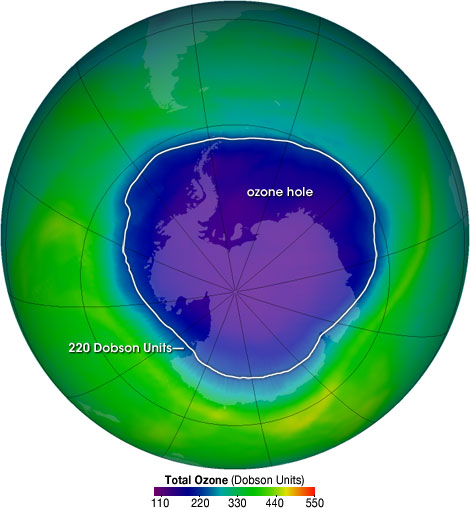
– It could be argued that one of the few clear wins that the environmental movement has had in recent decades against the many creeping threats against global ecology has been humanity’s response to the ozone depletion threat.

– Now our president has seen fit to dilute part of this success. He will not be remembered well by history and all the generations that will follow us.

= = = = = = = = = = = = =

EPA Scrambles To Justify Action

The Environmental Protection Agency weakened one part of its new limits on smog-forming ozone after an unusual last-minute intervention by President Bush, according to documents released by the EPA.

Ozone holeEPA officials initially tried to set a lower seasonal limit on ozone to protect wildlife, parks and farmland, as required under the law. While their proposal was less restrictive than what the EPA’s scientific advisers had proposed, Bush overruled EPA officials and on Tuesday ordered the agency to increase the limit, according to the documents.

“It is unprecedented and an unlawful act of political interference for the president personally to override a decision that the Clean Air Act leaves exclusively to EPA’s expert scientific judgment,” said John Walke, clean-air director for the Natural Resources Defense Council.

The president’s order prompted a scramble by administration officials to rewrite the regulations to avoid a conflict with past EPA statements on the harm caused by ozone.

Solicitor General Paul D. Clement warned administration officials late Tuesday night that the rules contradicted the EPA’s past submissions to the Supreme Court, according to sources familiar with the conversation. As a consequence, administration lawyers hustled to craft new legal justifications for the weakened standard.

More…

Southern Baptists Back a Shift on Climate Change

Friday, March 14th, 2008

Signaling a significant departure from the Southern Baptist Convention’s official stance on global warming, 44 Southern Baptist leaders have decided to back a declaration calling for more action on climate change, saying its previous position on the issue was “too timid.”

The largest denomination in the United States after the Roman Catholic Church, the Southern Baptist Convention, with more than 16 million members, is politically and theologically conservative.

Yet its current president, the Rev. Frank Page, signed the initiative, “A Southern Baptist Declaration on the Environment and Climate Change.” Two past presidents of the convention, the Rev. Jack Graham and the Rev. James Merritt, also signed.

“We believe our current denominational engagement with these issues has often been too timid, failing to produce a unified moral voice,” the church leaders wrote in their new declaration.

A 2007 resolution passed by the convention hewed to a more skeptical view of global warming.

In contrast, the new declaration, which will be released Monday, states, “Our cautious response to these issues in the face of mounting evidence may be seen by the world as uncaring, reckless and ill-informed.”

The document also urges ministers to preach more about the environment and for all Baptists to keep an open mind about considering environmental policy.

Jonathan Merritt, the spokesman for the Southern Baptist Environment and Climate Initiative and a seminarian at Southeastern Baptist Theological Seminary in Wake Forest, N.C., said the declaration was a call to Christians to return to a biblical mandate to guard the world God created.

More…

– This article is from the NY Times and they insist that folks have an ID and a PW in order to read their stuff. You can get these for free just by signing up. However, a friend of mine suggests the website bugmenot.com :arrow: as an alternative to having to do these annoying sign ups. Check it out. Thx Bruce S. for the tip.

Rush To Produce Corn-based Ethanol Will Worsen ‘Dead Zone’ In Gulf Of Mexico, Study Says

Thursday, March 13th, 2008

The U.S. government’s rush to produce corn-based ethanol as a fuel alternative will worsen pollution in the Gulf of Mexico, increasing a “Dead Zone” that kills fish and aquatic life, according to University of British Columbia researcher Simon Donner.

In the first study of its kind, Donner and Chris Kucharik of the University of Wisconsin quantify the effect of biofuel production on the problem of nutrient pollution in a waterway.

The researchers looked at the estimated land and fertilizer required to meet proposed corn-based ethanol production goals. Recently, the U.S. Senate announced its energy policy aims of generating 36 billion gallons annually of ethanol by the year 2022, of which 15 billion gallons can be produced from corn starch. The corn-ethanol goal represents more than three times than triple the production in 2006.

“This rush to expand corn production is a disaster for the Gulf of Mexico,” says Donner, an assistant professor in the Dept. of Geography. “The U.S. energy policy will make it virtually impossible to solve the problem of the Dead Zone.”

More…