Archive for the ‘The Perfect Storm’ Category

Why bird flu has been kept at bay

Saturday, February 9th, 2008

– This is good news. Perhaps the idea that we are only one or two small mutations away from Bird Flu evolving so it can jump from human to human is incorrect.

= = = = = = = = = = = = = = =

Scientists say they have identified a key reason why bird flu has so far not posed a widespread menace to humans.

So far, the H5N1 strain has mainly infected birds and poultry workers, but experts fear the virus could mutate to pass easily from human to human.

However, Massachusetts Institute of Technology found that to enter human respiratory cells the virus must first pick a very specific type of lock.

The study appears in the journal Nature Biotechnology.

The researchers say their discovery may help scientists better monitor changes in H5N1 – and find better ways to fight it.

Flu viruses attack by binding sugar chains, called glycans, that line the airways and lungs.

Latching on

The chemical linkages between the sugar molecules in these chains differ between humans and birds.

Until now it has been assumed that bird flu viruses would be adapt to humans simply by acquiring mutations that enable them to attach to the human types.

But Dr Ram Sasisekharan and colleagues found this step depends on the shape assumed by the flexible sugar chains rather than the type of linkage.

Bird flu viruses currently require cone-shaped glycans to infect birds, so the umbrella shape found in humans has protected most of us from avian flu.

More…

Thousands Of Crop Varieties Depart For Arctic Seed Vault

Saturday, February 9th, 2008

– This is a follow up story on one I covered earlier here: and here: .

– – – – – – – – – – – –

At the end of January, more than 200,000 crop varieties from Asia, Africa, Latin America and the Middle East—drawn from vast seed collections maintained by the Consultative Group on International Agricultural Research (CGIAR)—will be shipped to a remote island near the Arctic Circle, where they will be stored in the Svalbard Global Seed Vault (SGSV), a facility capable of preserving their vitality for thousands of years.

The cornucopia of rice, wheat, beans, sorghum, sweet potatoes, lentils, chick peas and a host of other food, forage and agroforestry plants is to be safeguarded in the facility, which was created as a repository of last resort for humanity’s agricultural heritage. The seeds will be shipped to the village of Longyearbyen on Norway’s Svalbard archipelago, where the vault has been constructed on a mountain deep inside the Arctic permafrost.

The vault was built by the Norwegian government as a service to the global community, and a Rome-based international NGO, the Global Crop Diversity Trust, will fund its operation. The vault will open on February 26, 2008.

This first installment from the CGIAR collections will contain duplicates from international agricultural research centers based in Benin, Colombia, Ethiopia, India, Kenya, Mexico, Nigeria, Peru, the Philippines and Syria. Collectively, the CGIAR centers maintain 600,000 plant varieties in crop genebanks, which are widely viewed as the foundation of global efforts to conserve agricultural biodiversity.

“Our ability to endow this facility with such an impressive array of diversity is a powerful testament to the incredible work of scientists at our centers, who have been so dedicated to ensuring the survival of the world’s most important crop species,” said Emile Frison, Director General of Rome-based Bioversity International, which coordinates CGIAR crop diversity initiatives.

“The CGIAR collections are the ‘crown jewels’ of international agriculture,” said Cary Fowler, Executive Director of the Global Crop Diversity Trust, which will cover the costs of preparing, packaging and transporting CGIAR seeds to the Arctic. “They include the world’s largest and most diverse collections of rice, wheat, maize and beans. Many traditional landraces of these crops would have been lost had they not been collected and stored in the genebanks.”

For example, the wheat collection held just outside Mexico City by the CGIAR-supported International Maize and Wheat Improvement Center (CIMMYT) contains 150,000 unique samples of wheat and its relatives from more than 100 countries. It is the largest unified collection in the world for a single crop. Overall, the maize collection represents nearly 90 percent of maize diversity in the Americas, where the crop originated. CIMMYT will continue to send yearly shipments of regenerated seed until the entire collection of maize and wheat has been backed up at Svalbard.

Storage of these and all the other seeds at Svalbard is intended to ensure that they will be available for bolstering food security should a manmade or natural disaster threaten agricultural systems, or even the genebanks themselves, at any point in the future.

“We need to understand that genebanks are not seed museums but the repositories of vital, living resources that are used almost every day in the never-ending battle against major threats to food production,” Bioversity International’s Frison said. “We’re going to need this diversity to breed new varieties that can adapt to climate change, new diseases and other rapidly emerging threats.”

More…

Uproar over Archbishop’s sharia law stance

Saturday, February 9th, 2008

– I’ve expressed my concerns before over the high rates of Islamic immigration into the various European countries. 3% of Britain and Germany’s populations are now Islamic. In the Netherlands and France, it stands at 6%.

– Personally, and in spite of the fact that I consider myself a liberal thinker, I do not believe that societies can stand such a high rates of immigration – especially when the newcomers do not particularly care to be assimilated into their new country’s culture and strive, instead, to import and preserve their own culture in the midst of their host’s. And then, on top of that, you have the deeply uncomfortable fact that sincere Islamic believers believe that their religion is right and that all the others are wrong. It’s not a formula for evolving a harmonious multi-cultural society – it’s a formula for a culture war.

– I think it is right to offer hospitality to your guests. But I think the guests have a responsibility as well to respect your house if they want to be there. I think it’s reckless to invite someone in who has already declared that they think how you live and worship is wrong and who covets your house and the destruction of your society.

= = = = = = = = = = = = = = = = =

The Archbishop of Canterbury has been widely criticised after he called for aspects of Islamic sharia law to be adopted in Britain.

Dr Rowan Williams said that it “seems inevitable” that elements of the Muslim law, such as divorce proceedings, would be incorporated into British legislation.

The Archbishop’s controversial stance has received widespread criticism from Christian and secular groups, the head of the equality watchdog, several high-profile Muslims and MPs from all parties.

Amid the storm of protest, Downing Street moved quickly to distance itself from the Archbishop’s remarks, insisting that British law would and should remain based on British values.

A spokesman for Mr Brown said: “Our general position is that sharia law cannot be used as a justification for committing breaches of English law, nor should the principles of sharia law be included in a civil court for resolving contractual disputes.

More…

India culls 3.4m birds but fails to contain avian flu outbreak

Friday, February 8th, 2008

India is struggling to contain its worst avian influenza -epidemic, in spite of culling 3.4m birds and setting up a 5km poultry exclusion zone round the state of West -Bengal, the epicentre of the outbreak.

The government’s failure to reassure farmers that they will receive fair compensation for birds culled by rapid response teams has left experts scrambling to stop the disease entering the crowded markets of Calcutta and Delhi and led to a crisis of confidence in India’s -poultry industry.

The latest outbreak of the H5N1 strain of bird flu, confirmed on January 15, is proving more difficult to contain than earlier manifestations at large poultry farms in the states of Maharashtra and Gujarat in 2006 and, last year, in Manipur.

Roughly 80 per cent of rural households in West Bengal keep hens and ducks in their backyards to supplement their incomes, a practice encouraged by the state government, which distributes millions of chicks to poor communities each year.

More…

Western U.S. Faces Drought Crisis, Warming Study Says

Saturday, February 2nd, 2008

The U.S. West will see devastating droughts as global warming reduces the amount of mountain snow and causes the snow that does fall to melt earlier in the year, a new study says.

By storing moisture in the form of snow, mountains act as huge natural reservoirs, releasing water into rivers long into the summer dry season.

“We’re losing that reservoir,” said research leader Tim Barnett, an oceanographer and climate researcher at the University of California, San Diego.

“Spring runoff is getting earlier and earlier in the year, so you have to let water go over the dams into the ocean.”

Summers are also becoming hotter and longer. “That dries things out more and leads to fires,” Barnett added.

“Our results are not good news for those living in the western United States,” the scientists write in their report, which appears in today’s online edition of the journal Science.

Unnatural Changes

Barnett and his team used computer models to study water flow in Western rivers over the past 50 years.

The researchers found that the changes currently affecting the U.S. West have less than a one percent chance of being due to natural variability, Barnett told National Geographic News.

His team verified that by running a variety of control tests under pre-industrial conditions that mimicked known natural cycles.

(Related: “Ancient “Megadroughts” Struck U.S. West, Could Happen Again, Study Suggests” [May 24, 2007].)

What’s been occurring recently, he said, is different from natural variability and is driven by the buildup of greenhouse gases such as carbon dioxide in Earth’s atmosphere.

More…

UBS Reports Record Loss After $14 Billion Writedown

Wednesday, January 30th, 2008

– This story is not remarkable in and of itself. There are always financial reversals and some of them can be quite uncomfortable for those affected.

– What I find notable here is that this story is part of a pattern that’s been growing for months now. I can’t recall a time when so many stories of financial losses have appeared. The world’s financial markets certainly have a lot of resilience and protections built into them – not to mention the vested interests of those who participate in them and who therefore want to see them healthy. But there must be a limit somewhere to just how many hits the markets can take without deep instability setting in.

– Here are a list of such stories plucked from the ever passing river of world news and data:

= = = = = = = = = = = = = = = = = = =

UBS Reports Record Loss After $14 Billion Writedown

FDIC Approves the Assumption of all the Deposits of Douglass National Bank, Kansas City, Missouri

Banks may need $143 billion in fresh capital

French Bank Rocked by Rogue Trader

SunTrust: $555 Million in Write-Downs

Wachovia profit falls further than expected (98%)

BofA: $5.28 Billion in CDO Write-Downs

Writedowns Surpass $100 Billion

– I could go on, but need I say more?…

Rethinking the Meat-Guzzler

Wednesday, January 30th, 2008

– This article gives a great overview of how human consumption of meat is affecting the world. It is one of the many stories, woven of interconnections and interdependencies that form the world around us, that so many of us are ignorant of.

– I think the article is over optimistic, however, about people getting smarter about meat consumption.

– The world’s richer people will continue to consume meat much as they have. And the world’s nouveau rich, in India and China, among other places, will also step up to the table and attempt to match the meat consumption patterns of the US and Europe. This will, inevitably, drive up grain prices to feed all of these feed-lot animals and that, along with the current fad of growing crops for ethanol fuels, will further raise the prices poor folks have to pay for their food.

– So long as the rich can pay for higher priced food comfortably and so long as they hope that growing crops for ethanol will allow them to avoid the consumption down-sizing that Peak Oil implies, these trends will continue. And long before the rich say, “enough”, the poor will have been priced out of the food market and the resulting social unrest will be well underway.

= = = = = = = = = = = = = = = = =

A SEA change in the consumption of a resource that Americans take for granted may be in store — something cheap, plentiful, widely enjoyed and a part of daily life. And it isn’t oil.

It’s meat.

The two commodities share a great deal: Like oil, meat is subsidized by the federal government. Like oil, meat is subject to accelerating demand as nations become wealthier, and this, in turn, sends prices higher. Finally — like oil — meat is something people are encouraged to consume less of, as the toll exacted by industrial production increases, and becomes increasingly visible.

Global demand for meat has multiplied in recent years, encouraged by growing affluence and nourished by the proliferation of huge, confined animal feeding operations. These assembly-line meat factories consume enormous amounts of energy, pollute water supplies, generate significant greenhouse gases and require ever-increasing amounts of corn, soy and other grains, a dependency that has led to the destruction of vast swaths of the world’s tropical rain forests.

Just this week, the president of Brazil announced emergency measures to halt the burning and cutting of the country’s rain forests for crop and grazing land. In the last five months alone, the government says, 1,250 square miles were lost.

The world’s total meat supply was 71 million tons in 1961. In 2007, it was estimated to be 284 million tons. Per capita consumption has more than doubled over that period. (In the developing world, it rose twice as fast, doubling in the last 20 years.) World meat consumption is expected to double again by 2050, which one expert, Henning Steinfeld of the United Nations, says is resulting in a “relentless growth in livestock production.”

Americans eat about the same amount of meat as we have for some time, about eight ounces a day, roughly twice the global average. At about 5 percent of the world’s population, we “process” (that is, grow and kill) nearly 10 billion animals a year, more than 15 percent of the world’s total.

Growing meat (it’s hard to use the word “raising” when applied to animals in factory farms) uses so many resources that it’s a challenge to enumerate them all. But consider: an estimated 30 percent of the earth’s ice-free land is directly or indirectly involved in livestock production, according to the United Nation’s Food and Agriculture Organization, which also estimates that livestock production generates nearly a fifth of the world’s greenhouse gases — more than transportation.

To put the energy-using demand of meat production into easy-to-understand terms, Gidon Eshel, a geophysicist at the Bard Center, and Pamela A. Martin, an assistant professor of geophysics at the University of Chicago, calculated that if Americans were to reduce meat consumption by just 20 percent it would be as if we all switched from a standard sedan — a Camry, say — to the ultra-efficient Prius. Similarly, a study last year by the National Institute of Livestock and Grassland Science in Japan estimated that 2.2 pounds of beef is responsible for the equivalent amount of carbon dioxide emitted by the average European car every 155 miles, and burns enough energy to light a 100-watt bulb for nearly 20 days.

Grain, meat and even energy are roped together in a way that could have dire results. More meat means a corresponding increase in demand for feed, especially corn and soy, which some experts say will contribute to higher prices.

This will be inconvenient for citizens of wealthier nations, but it could have tragic consequences for those of poorer ones, especially if higher prices for feed divert production away from food crops. The demand for ethanol is already pushing up prices, and explains, in part, the 40 percent rise last year in the food price index calculated by the United Nations’ Food and Agricultural Organization.

More…

– thx to Mike M. for pointing this story out to me.

– This article is from the NY Times and they insist that folks have an ID and a PW in order to read their stuff. You can get these for free just by signing up. However, a friend of mine suggests the website bugmenot.com :arrow: as an alternative to having to do these annoying sign ups. Check it out. Thx Bruce S. for the tip.
Power chaos in South Africa

Tuesday, January 29th, 2008

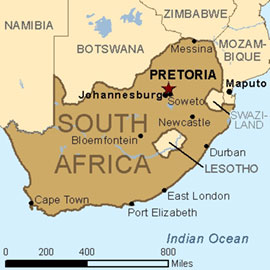
– Over the last week or two, I’ve seen a number of stories coming out of South Africa about power shortages there.

South Africa– Our societies and their infrastructures are like a house of cards in many ways. We build them higher and wider all the time and the number of interrelationships and dependencies within them grows as well. To keep it all going requires constant reevaluation to ensure that everything required is coordinated and working well.

– Apparently, the government in South Africa has dropped the ball with regard to ensuring the country has sufficient electrical power – a process that takes long-term planning and constant reevaluation.

– I think we can expect more of this because (1) it is getting more difficult to keep all our systems up and running as they get more complicated, (2) as the world becomes a tougher place, the ideologies of those moving up into power are becoming more demagogic and such such simplicity is not compatible with the requirements of running complex societies, and (3) the inputs to the systems we are trying to maintain in our societies are becoming less reliable. We have less food, less water, worse weather, more population and the list goes on and on.

– I think we need to expect increasing breakdowns.

= = = = = = = = = = =

Links to stories on the South African situation:

SA facing ‘critical’ power shortage

Supply of generators dries up

South African mines look for power shortages to end

Many British Muslim Women Embrace Political Islam

Sunday, January 27th, 2008

Two and a half years after British-born Muslims carried out suicide bombings in London that killed 52 people, British authorities are worried about the growing number of Muslim youth turning their backs on mainstream British society.

Most surprising is that many second-generation daughters of South Asian immigrants are embracing a political form of Islam.

Some say British Muslims have felt a growing sense of alienation since Sept. 11, 2001, and the London bombings, which has inspired some to segregate themselves from mainstream society and to greater assert their Muslim identity.

The ‘Muslim Woman’s Dilemma’

At the Islam Channel TV network, located in a sleek glass and steel building near London’s financial district, the reporters are mostly women — all with their heads covered. Some reveal only their eyes underneath black veils.

The network broadcasts a talk show called, “The Muslim Woman’s Dilemma.” Host Aamna Durrani wears a headscarf tightly wrapped around her head that falls into soft drapes over her shoulders.

Durrani was born in London to Pakistani parents and is increasingly asserting her Muslim identity, especially since 9/11 and the 2005 London suicide bombings that led to what she says are draconian anti-terrorism laws.

“My allegiance to the Muslim ummah, the community, definitely has got a lot, lot stronger as a result of the war on terror. And it has made the sense of solidarity throughout the world a lot stronger — and definitely for Muslim women here in Britain. It has really made us think where our loyalties lie,” Durrani says.

Growing Alienation from British Society

Analysts here say another cause of local Muslims’ growing alienation has been Britain’s role in the war in Iraq. They say it has inspired many young Muslims to segregate themselves from mainstream society.

A 2006 Pew poll showed 81 percent of Muslims surveyed considered their Islamic identity more important than being British. Like some others, Durrani says she would take part in the electoral process only if it were based on Islamic law and the Koran.

More…

‘Huge’ gas field found off Brazil

Sunday, January 27th, 2008

– I personally don’t think that a Peak Oil crises is going to come to a sudden head.  So long as global systems remain mostly intact, those who produce oil will work ever harder and harder to meet demand as prices rise – driven ever onward by the rising prices.

– No, when things unravel, I think it will be from a series of small cuts that will begin to impact the functioning of the overall system.  And, as their cumulative impact builds into a positive feedback cycle, we will find that the transition happens rather quickly.

– The way that  the current financial crises is developing, one could imagine that it could progress to the point where it begins to feed back strongly on itself and the results could be bad.

– But, that’s not why I’m writing this piece.   I wanted to tell you about a new gas field that’s been found off the coast of Brazil.  it’s the second major find there in recent months.

– It is these kinds of things that makes me think that the Peak Oil crises will come on slowly and that long before we feel deep pain from it, something else will have unraveled to much greater effect elsewhere.

= = = = = = = = = = =

A huge natural gas field has been found a short distance off Rio de Janeiro’s coastline, Petrobras, Brazil’s state-controlled oil company, says.

The company believes the new field, Jupiter, could match the recently discovered Tupi oil field in size.

Tupi is thought to be one of the largest fields discovered in the past 20 years.

But Petrobras officials say further work needs to be done to establish Jupiter’s exact dimensions.

The new field is located just 37km (23 miles) from Tupi, some 5,100m (5,600 yards) below the surface of the Atlantic Ocean, around 290km from Rio de Janeiro, Petrobras says.

While not providing any specific details on the size of the new reserve, Petrobras said “its structure could have dimensions similar to Tupi”.

Petrobras estimates Tupi contains between five and eight billion barrels of light oil.

More…