Corn Prices Jump to Record $6 a Bushel, Driving Up Costs for Food, Alternative Energy

April 3rd, 2008

NEW YORK (AP) — Corn prices jumped to a record $6 a bushel Thursday, driven up by an expected supply shortfall that will only add to Americans’ growing grocery bill and further squeeze struggling ethanol producers.

Corn prices have shot up nearly 30 percent this year amid dwindling stockpiles and surging demand for the grain used to feed livestock and make alternative fuels including ethanol. Prices are poised to go even higher after the U.S. government this week predicted that American farmers — the world’s biggest corn producers — will plant sharply less of the crop in 2008 compared to last year.

“It’s a demand-driven market and we may not be planting enough acres to supply demand, so that adds to the bullishness of corn,” said Elaine Kub, a grains analyst with DTN in Omaha, Neb.

Corn for the most actively traded May contract rose 4.25 cents to settle at $6 a bushel on the Chicago Board of Trade, after earlier rising to $6.025 a bushel — a new all-time high.

Worldwide demand for corn to feed livestock and to make biofuel is putting enormous pressure on global supply. And with the U.S. expected to plant less corn, the supply shortage will only worsen. The U.S. Department of Agriculture projected that farmers will plant 86 million acres of corn in 2008, an 8 percent drop from last year.

More…

Melting Mountain Glaciers Will Shrink Grain Harvests in China and India

April 3rd, 2008

Lester R. Brown

The world is now facing a climate-driven shrinkage of river-based irrigation water supplies. Mountain glaciers in the Himalayas and on the Tibet-Qinghai Plateau are melting and could soon deprive the major rivers of India and China of the ice melt needed to sustain them during the dry season. In the Ganges, the Yellow, and the Yangtze river basins, where irrigated agriculture depends heavily on rivers, this loss of dry-season flow will shrink harvests.

The world has never faced such a predictably massive threat to food production as that posed by the melting mountain glaciers of Asia. China and India are the world’s leading producers of both wheat and rice—humanity’s food staples. China’s wheat harvest is nearly double that of the United States, which ranks third after India. With rice, these two countries are far and away the leading producers, together accounting for over half of the world harvest.

The Intergovernmental Panel on Climate Change reports that Himalayan glaciers are receding rapidly and that many could melt entirely by 2035. If the giant Gangotri Glacier that supplies 70 percent of the Ganges flow during the dry season disappears, the Ganges could become a seasonal river, flowing during the rainy season but not during the summer dry season when irrigation water needs are greatest.

More…


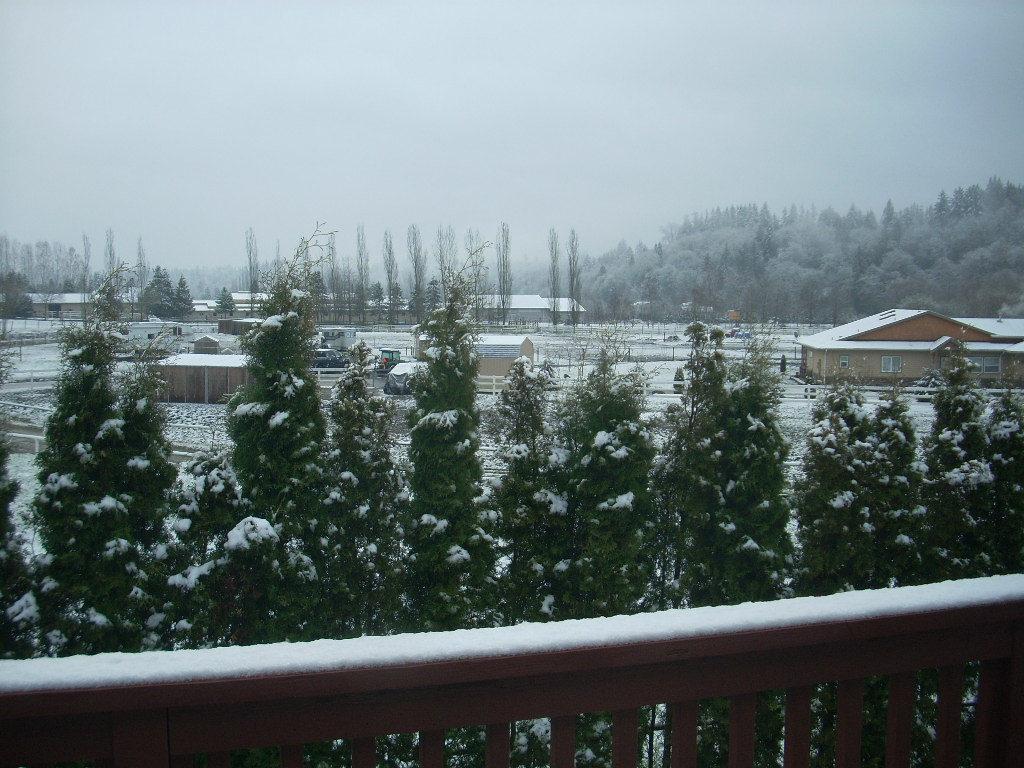
080330 – The view from here (snow)

March 30th, 2008

– This is what it looks like here today. We decided, after being open for only an hour, to give ourselves a break and close the nursery for the day. The likelihood that folks are coming out to shop at a nursery in the snow seemed low to us and the joy of giving ourselves a day of freedom high. So….. we went for it. Yip-ee!

The view east towards Stevens Pass

Colombia says it found uranium linked to FARC

March 30th, 2008

The seizure of up to 66 pounds of low-grade uranium linked to the FARC rebels adds weight to the evidence found in a captured rebel laptop that the guerrillas were interested in buying and selling the material, according to the Colombian Defense Ministry.

But the 30 kilos of uranium found Wednesday in plastic bags dug up about three feet from a road in southern Bogotá was “impoverished,” the ministry said, and in that state could not have been used to make a radioactive bomb.

Authorities were waiting for further analysis to determine how dangerous the material found really is, armed forces commander Freddy Padilla said at a press conference late Wednesday.

More…

Empty bowls, stomachs and pockets

March 30th, 2008

– Can you hear the writing on the wall?

– – – – – – –

Disquiet over the soaring rice price

THE soaring price of rice and dwindling stockpiles of Asia’s staple food are causing anxiety across the continent. In particular the Philippines, a big, hungry country which cannot grow enough to feed itself, could be in trouble. The front pages of Manila’s newspapers scream about a “rice crisis”, as politicians float drastic solutions, such as forcing the country’s top 100 companies to take up rice farming. Farmers in Thailand, the world’s largest rice exporter, are delighted with the price surge, although some were this week said to be hiring guards to protect their valuable crops against “rice bandits”.

The president of the Philippines, Gloria Macapagal Arroyo, last month pleaded publicly with neighbouring Vietnam, the second-largest exporter, to guarantee supplies. The two countries signed an agreement on Wednesday March 26th apparently to do just that. But the various escape clauses that Vietnam insisted upon suggest it was more of a face-saving measure than a firm pledge. Vietnam and India, another big rice exporter, have recently announced export restrictions to try to curb soaring food prices at home. This will make it tough for poor, rice-importing countries, in Africa as well as Asia, to secure supplies.

More…

Biofuels drive running out of gas

March 30th, 2008

– From the New Zealand Herald - 

Growing concern about the merit of biofuels is threatening to derail a Government push to get the new fuels flowing out of petrol pumps in little more than three months.

The biofuel bill, now before a select committee, proposes to make oil companies begin selling a small but progressively higher amount of biofuels each year from July 1.

But while the bill passed its first reading comfortably, widespread political support is no longer as assured because of worries that the legislation does not deal strongly enough with questions about whether biofuels will come from sustainable sources.

Global debate about biofuels has shifted in recent months and in Britain – where the fuels are set to begin flowing on April 1 – a dispute is raging about whether biofuels will do more harm than good by leading to rainforest destruction and food shortages.

National MP Nick Smith yesterday said his party would not back the biofuel bill unless the issue was sorted out and it was made clear that the fuels coming into New Zealand would be from sustainable sources.

More…

Futurist Ray Kurzweil Pulls Out All the Stops (and Pills) to Live to Witness the Singularity

March 30th, 2008

– I wish Ray well on this idea but after reading a number of articles and books that were written in the past that tried to envision the future, I haven’t much faith in our ability to predict the future out very far. Just think about the movie 2001.

– These links explore the Singularity concept which some of you may not be familiar with:

= = = = = = = = = = = = = = = = =

Ray Kurzweil, the famous inventor, is trim, balding, and not very tall. With his perfect posture and narrow black glasses, he would look at home in an old documentary about Cape Canaveral, but his mission is bolder than any mere voyage into space. He is attempting to travel across a frontier in time, to pass through the border between our era and a future so different as to be unrecognizable. He calls this border the singularity. Kurzweil is 60, but he intends to be no more than 40 when the singularity arrives.

Kurzweil’s notion of a singularity is taken from cosmology, in which it signifies a border in spacetime beyond which normal rules of measurement do not apply (the edge of a black hole, for example). The word was first used to describe a crucial moment in the evolution of humanity by the great mathematician John von Neumann. One day in the 1950s, while talking with his colleague Stanislaw Ulam, von Neumann began discussing the ever-accelerating pace of technological change, which, he said, “gives the appearance of approaching some essential singularity in the history of the race beyond which human affairs as we know them could not continue.”

More…

In Africa, the Situation has Become Volatile

March 30th, 2008

In many countries on the continent the price rise has hit hard, causing protests in Senegal, Burkina Faso and Cameroon.

West Africa,

Special Report.

In the hubbub of Treichville market in the south of Abidjan, Ivory Coast’s economic capital, two friends on greying horses wind between the cages of chickens and stacks of vegetables. By their own description — not really poor and not really middle class either — they confirm how difficult it has become to fill their shopping baskets. “Today, with 10,000 CFA (23 USD), you can feed your family for 3 days. A few months ago, that was enough for a week.” As a result, these two mothers leave out certain products. They no longer buy milk or butter, which have gone from 400 CFA (0.91USD) to nearly 1000 CFA (2.29USD). Some families are only eating one meal a day. “I sometimes skip lunch”, says one of them.

Further on, Mady digs her hand into her sack of Asian rice “I have to sell the kilo at 350 CFA (0.80USD) compared to 250 CFA (0.60USD) a couple of months ago” she explains. It’s the same story with oil, another staple for cooking in Africa. “Last year, I would buy a 200 litre barrel for 100,000 CFA (229USD). Today it costs me 146,000 CFA (335USD)” Nearly a 50% price rise impacting directly on the price of a bottle. “Now, the women are only buying 3 litres instead of the usual 5”.

More…


Huge Swath of Antarctica Ice Collapses

March 30th, 2008

A chunk of Antarctic ice about seven times the size of Manhattan suddenly collapsed, putting an even greater portion of glacial ice at risk, scientists said Tuesday.

Satellite images show the runaway disintegration of a 160-square-mile chunk in western Antarctica, which started February 28.

It was the edge of the Wilkins Ice Shelf and has been there for hundreds, maybe 1,500 years.

This is the result of global warming, said British Antarctic Survey scientist David Vaughan.

Because scientists noticed satellite images within hours, they diverted satellite cameras and even flew an airplane over the ongoing collapse for rare pictures and video.

“It’s an event we don’t get to see very often,” said Ted Scambos, lead scientist at the National Snow and Ice Data Center in Boulder, Colorado.

“The cracks fill with water and slice off and topple. … That gets to be a runaway situation.”

Global Warming

While icebergs naturally break away from the mainland, collapses like this are unusual but are happening more frequently in recent decades, Vaughan said. (Related: National Geographic’s Larsen Ice Shelf Expedition.)

More…

080330 – New posting in the Philosophy Area

March 30th, 2008

– I’ve made a new page in my Philosophy Area entitled, The Really Big Questions. If you like your questions big, I suggest you might like to read it <smile>.