Bird flu outbreak nears Calcutta

January 26th, 2008

The bird flu epidemic in the Indian state of West Bengal has inched closer to the capital, Calcutta, with an outbreak reported close to the city.

Tests on dead birds from Balagarh, less than a two-hour drive from Calcutta, have tested positive for the disease.

Nine of the state’s 19 districts have been already hit by the flu. Officials say more than 2m birds would be culled.

The H5N1 strain of bird flu is regarded as highly pathogenic and can also cause disease and death in humans.

Health experts have warned that the outbreak could get out of control.

No cases of human infection have still been reported though a member of the culling team has been admitted to hospital with respiratory disorder and fever.

State animal husbandry minister Anisur Rehman said the government had a “long way to go” in culling the targeted two million birds.

Only a third of the target has been achieved – barely 700,000 birds have been culled in the last 10 days.

“More culling teams are needed in all the affected districts but these are things that cannot be hurried. The men in the culling teams have to be quarantined first before they can be asked to start the operations,” Mr Rehman said.

More…

Brazil Amazon deforestation soars

January 26th, 2008

– I don’t know why folks have a hard time getting the point of The Perfect Storm Hypothesis. This story is a perfect example of the interdependencies the hypothesis talks about.

– Over population and poverty drives people to settle in forested land – clearing it as they go. World food shortages drive growers to grow food where previous trees stood. Less trees mean less water retention which dries the remaining forest making it less resilient. Less forest means less CO2 uptake. More CO2 in the atmosphere leads to warmer weather. Warmer weather means less winter snow pack. Less winter snow pack means less summer water. Less summer water means less ability to grow food using ‘wet agricultural methods’. Less food grown means more pressure to cut the forests to grow the food where they stood. Societies deeply dependent on diminishing oil resources and now trying to avoid the fact by promoting biofuel growing and use. Biofuels, the growth of which, takes the same fields we used to grow human food on. And as a result, we have less food and need more room to grow it and we all turn again to the land the forest stand upon.

– And around and around it goes in branching causal relationships and positive feedback cycles. And behind it all, human greed, ignorance, rapaciousness and leaders who talk but do not act. Leaders who see the truth but do not believe.

= = = = = = = = = = = = = = = =

The Brazilian government has announced a huge rise in the rate of Amazon deforestation, months after celebrating its success in achieving a reduction.

In the last five months of 2007, 3,235 sq km (1,250 sq miles) were lost.

Gilberto Camara, of INPE, an institute that provides satellite imaging of the area, said the rate of loss was unprecedented for the time of year.

Officials say rising commodity prices are encouraging farmers to clear more land to plant crops such as soya.

The monthly rate of deforestation saw a big rise from 243 sq km (94 sq miles) in August to 948 sq km (366 sq miles) in December.

“We’ve never before detected such a high deforestation rate at this time of year,” Mr Camara said.

His concern, outlined during a news conference in Brasilia on Wednesday, was echoed by Environment Minister Marina Silva.

Expensive soya

Ms Silva said rising prices of raw materials and commodities could be spurring the rate of forest clearing, as more and more farmers saw the Amazon as a source of cheap land.

“The economic reality of these states indicate that these activities impact, without a shadow of a doubt, on the forest,” she said.

The state of Mato Grosso was the worst affected, contributing more than half the total area of forest stripped, or 1,786 sq km (700 sq miles).

The states of Para and Rondonia were also badly affected, accounting for 17.8% and 16% of the total cleared respectively.

The situation may also be worse than reported, with the environment ministry saying the preliminary assessment of the amount of forest cleared could double as more detailed satellite images are analysed.

President Luiz Inacio Lula da Silva is due to attend an emergency meeting on Thursday to discuss new measures to tackle deforestation in the Amazon.

More…

Brazil vows to stem Amazon loss

January 26th, 2008

– This stuff really gets me. I think if we went back and looked at the last twenty years, we could find an article like this every year or so. “Scientists report Brazilian Rain forest being decimated” And then a short while later, “Brazilian authorities vow to step up protection of the forests”.

– Over and over again, the problem is brought up and action decided on and then … apparently nothing of substance happens and the next year, another report on how the forests (which we all depend upon) are still disappearing.

-Human intelligence is much overrated.

= = = = = = = = = = = = = = = = =

Brazil has agreed emergency measures to stem deforestation as government figures revealed a sharp increase in the rate of clearances in the Amazon.

The steps were announced after an emergency cabinet meeting chaired by President Luiz Inacio Lula da Silva.

The measures include sending extra federal police and environmental agents to stop farmers and cattle ranchers illegally felling any more rain forest.

In the last five months of 2007, 3,235 sq km (1,250 sq miles) were lost.

Environment Minister Marina Silva said environmental agents and police would be deployed around 36 cities and towns where illegal clearing jumped dramatically last year. People or businesses who buy anything produced on the deforested land could face fines, she said.

The plan involves a 25% rise in the police force assigned to the region.

More…

The Choice between Food and Fuel

January 26th, 2008

Food prices are skyrocketing. Arable land is becoming scarce. And forests continue to disappear across the globe. The world must decide between affordable food and biofuels.

All it takes for Hans Dietrich Driftmann, a businessman from Germany’s northern Holstein region, to explain the way the world works is a package of muesli — or at least to explain the way his world, the world of agricultural markets, works.

Driftmann picks up a packet of “Köllns kernige Multikorn-Flocken” (“Kölln’s Crunchy Multigrain Flakes”) and reads out the list of ingredients: oats, wheat, barley and rye. Then he slips a set of price tables out of a plastic sleeve and does a couple of calculations to illustrate how the prices of the muesli’s ingredients have changed: rye has gone up by 55 percent, barley by 70 percent and wheat 90 percent. The price of oats has also skyrocketed — by 80 percent — since the last harvest a year ago. This final figure is what really hits home for Driftmann.

For the last two decades he has been the CEO of Kölln-Werke, Germany’s top producer of oats and a major player in the muesli market. It’s an old family-owned company, founded in 1795 and headquartered in the town of Elmshorn, a place with a skyline dominated by enormous grain silos painted sky-blue. The silos are beacons for truck drivers approaching Elmshorn to unload their grain — if they come at all these days.

Today Driftmann is grateful for every truck that shows up at his silos. This year’s oats harvest, he says, was “miserable.” His buyers search the whole world for grain, even in places like Finland and Australia. Price is almost secondary. “The problem is availability,” says Driftmann.

More…

India’s Avian Flu Outbreak Is `Serious,’ WHO Says

January 24th, 2008

Jan. 23 (Bloomberg) — An outbreak of avian flu in India’s West Bengal state is “serious” and the virus has spread rapidly to many districts, the World Health Organization’s representative said.

The outbreak is the 10th in India since the H5N1 avian influenza virus was first reported to have killed poultry there in February 2006. No human cases have been recorded in India.

India has the capacity to handle the situation as the “fundamentals of planning are sound,” S.J. Habayeb, the organization’s representative in the South Asian nation, said in an interview conducted over e-mail.

The disease has spread to more districts in West Bengal, taking the total number to nine, Farm Minister Sharad Pawar said in New Delhi today. “We are trying to control the situation.”

The government has stepped up culling, with the total number of chickens killed almost doubling to 414,597 today from the 242,200 reported yesterday, according to the agriculture ministry. India confirmed the disease among poultry in the state on Jan. 15.

As many as 116,203 chickens have died from the virus, the ministry said in the release. Samples from six districts have tested negative. About 258 teams have been deployed for culling and surveillance operations in West Bengal, the ministry added.

`Backyard Culling’

“The main problem we are facing is culling in the backyards,” Anisur Rahman, West Bengal’s animal resources minister, said in a telephone interview from the state capital of Kolkata, also known as Calcutta. “In other places, where the disease was reported, the farmers carried their poultry to a central farm in a village. Here, volunteers have to go to each house and convince farmers to do the culling.”

The teams, working in the villages, have gone up from 400 to 650 today, Rahman said.

“Culling is going on at a rapid pace,” he said. “At the same time, we are faced with a situation where poultry is being tested positive from new areas which are far-flung.”

The virus is known to have infected 351 people in 14 countries since late 2003, killing 219 of them, the Geneva-based World Health Organization said on its Web site two days ago. Indonesia has the highest number of fatalities, with 97 deaths.

Millions could die if the H5N1 virus develops the characteristics of seasonal flu and begins spreading easily between humans through coughing and sneezing.

Early signs of the disease range from fever and coughing to diarrhea and vomiting, researchers said in a Jan. 17 report in the New England Journal of Medicine.

Original article…

W Bengal bird flu ‘is spreading’

January 24th, 2008

Officials in the Indian state of West Bengal say that the bird flu epidemic has spread to two more of the state’s 19 districts, taking the total to nine.

They say that the spread of the H5N1 virus means that even more chicken and duck will have to be killed than was originally estimated.

On Monday officials said that around 2m birds would need to be culled – a figure that will now rise.

Health experts have warned that the outbreak could get out of control.

The H5N1 strain of bird flu is regarded as highly pathogenic and can also cause disease and death in humans.

However, most human victims have contracted the disease through close contact with affected birds.

There is little evidence that the virus can be transmitted easily between humans.

More…

– “There is little evidence that the virus can be transmitted easily between humans.” Many scientists studying the H5N1 virus feel that the virus could be one or two mutations away from developing a form that would travel easily from human to human – similar to what happened in 1917 when the Spanish Flu swept the world and killed millions.

– See: &

Dry, polluted, plagued by rats: the crisis in China’s greatest river

January 24th, 2008

Ships stranded as Yangtze reaches a 142-year low

The waters of the Yangtze have fallen to their lowest levels since 1866, disrupting drinking supplies, stranding ships and posing a threat to some of the world’s most endangered species.

Asia’s longest river is losing volume as a result of a prolonged dry spell, the state media warned yesterday, predicting hefty economic losses and a possible plague of rats on nearby farmland.

News of the drought – which is likely to worsen pollution in the river – comes amid dire reports about the impact of rapid economic growth on China’s environment.

The government also revealed yesterday that the country’s most prosperous province, Guangdong, has just had its worst year of smog since the Communist party took power in 1949, while 56,000 square miles of coastline waters failed to meet environmental standards.

But the immediate concern is the Yangtze, which supplies water to hundreds of millions of people and thousands of factories in a delta that accounts for more than 40% of China’s economic output. According to the Chinese media, precipitation and water levels are at or near record lows in its middle and upper stretches.

The scale of the problem was revealed by the Yangtze water resources commission in a report on the Xinhua news agency’s website yesterday. It said that the Hankou hydrological centre near Wuhan city found the river’s depth had fallen to its lowest level in 142 years.

More…


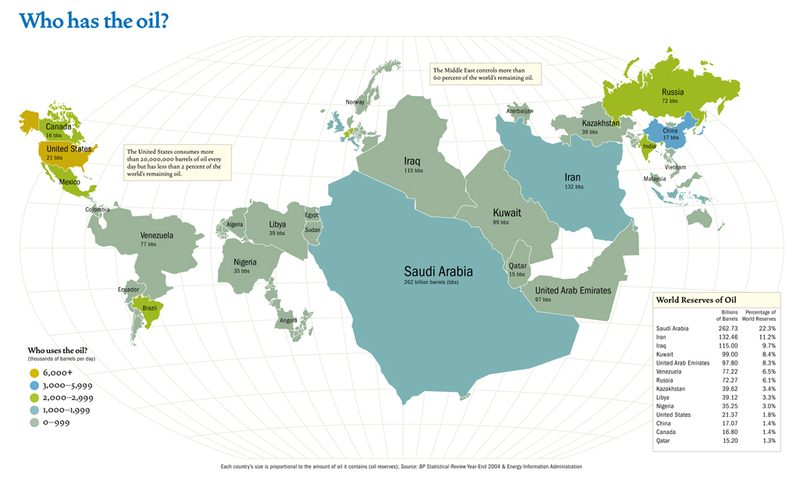
Oil Map of the World

January 23rd, 2008

Great article on The Daily Galaxy discussing the distribution of oil in the world.

Where the world’s oil is

Read the article here:

Warning on rising Med Sea levels

January 21st, 2008

The level of the Mediterranean Sea is rising rapidly and could increase by up to half a metre in the next 50 years, scientists in Spain have warned.

A study by the Spanish Oceanographic Institute says levels have been rising since the 1970s with the rate of increase growing in recent years.

It says even a small rise could have serious consequences in coastal areas.

The study noted that the findings were consistent with other investigations into the effects of climate change.

The study, entitled Climate Change in the Spanish Mediterranean, said the sea had risen “between 2.5mm and 10mm (0.1 and 0.4in) per year since the 1990s”.

If the trend continued it would have “very serious consequences” in low-lying coastal areas even in the case of a small rise, and “catastrophic consequences” if a half-metre increase occurred, the study warned.

More…

A New, Global Oil Quandary: Costly Fuel Means Costly Calories

January 19th, 2008

KUANTAN, Malaysia — Rising prices for cooking oil are forcing residents of Asia’s largest slum, in Mumbai, India, to ration every drop. Bakeries in the United States are fretting over higher shortening costs. And here in Malaysia, brand-new factories built to convert vegetable oil into diesel sit idle, their owners unable to afford the raw material.

This is the other oil shock. From India to Indiana, shortages and soaring prices for palm oil, soybean oil and many other types of vegetable oils are the latest, most striking example of a developing global problem: costly food.

The food price index of the Food and Agriculture Organization of the United Nations, based on export prices for 60 internationally traded foodstuffs, climbed 37 percent last year. That was on top of a 14 percent increase in 2006, and the trend has accelerated this winter.

In some poor countries, desperation is taking hold. Just in the last week, protests have erupted in Pakistan over wheat shortages, and in Indonesia over soybean shortages. Egypt has banned rice exports to keep food at home, and China has put price controls on cooking oil, grain, meat, milk and eggs.

According to the F.A.O., food riots have erupted in recent months in Guinea, Mauritania, Mexico, Morocco, Senegal, Uzbekistan and Yemen.

“The urban poor, the rural landless and small and marginal farmers stand to lose,” said He Changchui, the agency’s chief representative for Asia and the Pacific.

A startling change is unfolding in the world’s food markets. Soaring fuel prices have altered the equation for growing food and transporting it across the globe. Huge demand for biofuels has created tension between using land to produce fuel and using it for food.

A growing middle class in the developing world is demanding more protein, from pork and hamburgers to chicken and ice cream. And all this is happening even as global climate change may be starting to make it harder to grow food in some of the places best equipped to do so, like Australia.

In the last few years, world demand for crops and meat has been rising sharply. It remains an open question how and when the supply will catch up. For the foreseeable future, that probably means higher prices at the grocery store and fatter paychecks for farmers of major crops like corn, wheat and soybeans.

There may be worse inflation to come. Food experts say steep increases in commodity prices have not fully made their way to street stalls in the developing world or supermarkets in the West.

More…

– research thanks to Rolf A.

– This article is from the NY Times and they insist that folks have an ID and a PW in order to read their stuff. You can get these for free just by signing up. However, recently, a friend of mine suggested the website bugmenot.com :arrow: as an alternative to having to do these annoying sign ups. Check it out. Thx Bruce S. for the tip.