WATER TABLES FALLING AND RIVERS RUNNING DRY

July 24th, 2007

– This is an excerpt from Lester R. Brown’s book, Plan B 2.0.

– Sometimes it is hard to give folks the big picture they need in order to be able to see the Perfect Storm coming in the future. They get a few bits and pieces here and there and they say or think, that can’t be enough to add up to a global catastrophe.

– Well, Lester Brown pulls a lot of facts and figures here together on the related subjects of water tables and rivers and, in aggregate, it is extremely sobering. And remember, these two elements are only a prt of what the Perfect Storm hypothesis is about.

— — — — — — —

As the world’s demand for water has tripled over the last half-century and as the demand for hydroelectric power has grown even faster, dams and diversions of river water have drained many rivers dry. As water tables fall, the springs that feed rivers go dry, reducing river flows.

Scores of countries are overpumping aquifers as they struggle to satisfy their growing water needs, including each of the big three grain producers–China, India, and the United States. More than half the world’s people live in countries where water tables are falling.

There are two types of aquifers: replenishable and nonreplenishable (or fossil) aquifers. Most of the aquifers in India and the shallow aquifer under the North China Plain are replenishable. When these are depleted, the maximum rate of pumping is automatically reduced to the rate of recharge.

For fossil aquifers, such as the vast U.S. Ogallala aquifer, the deep aquifer under the North China Plain, or the Saudi aquifer, depletion brings pumping to an end. Farmers who lose their irrigation water have the option of returning to lower-yield dryland farming if rainfall permits. In more arid regions, however, such as in the southwestern United States or the Middle East, the loss of irrigation water means the end of agriculture.

The U.S. embassy in Beijing reports that Chinese wheat farmers in some areas are now pumping from a depth of 300 meters, or nearly 1,000 feet. Pumping water from this far down raises pumping costs so high that farmers are often forced to abandon irrigation and return to less productive dryland farming. A World Bank study indicates that China is overpumping three river basins in the north–the Hai, which flows through Beijing and Tianjin; the Yellow; and the Huai, the next river south of the Yellow. Since it takes 1,000 tons of water to produce one ton of grain, the shortfall in the Hai basin of nearly 40 billion tons of water per year (1 ton equals 1 cubic meter) means that when the aquifer is depleted, the grain harvest will drop by 40 million tons–enough to feed 120 million Chinese.

In India, water shortages are particularly serious simply because the margin between actual food consumption and survival is so precarious. In a survey of India’s water situation, Fred Pearce reported in New Scientist that the 21 million wells drilled are lowering water tables in most of the country. In North Gujarat, the water table is falling by 6 meters (20 feet) per year. In Tamil Nadu, a state with more than 62 million people in southern India, wells are going dry almost everywhere and falling water tables have dried up 95 percent of the wells owned by small farmers, reducing the irrigated area in the state by half over the last decade.

As water tables fall, well drillers are using modified oil-drilling technology to reach water, going as deep as 1,000 meters in some locations. In communities where underground water sources have dried up entirely, all agriculture is rain-fed and drinking water is trucked in. Tushaar Shah, who heads the International Water Management Institute’s groundwater station in Gujarat, says of India’s water situation, “When the balloon bursts, untold anarchy will be the lot of rural India.”

In the United States, the U.S. Department of Agriculture reports that in parts of Texas, Oklahoma, and Kansas–three leading grain-producing states–the underground water table has dropped by more than 30 meters (100 feet). As a result, wells have gone dry on thousands of farms in the southern Great Plains. Although this mining of underground water is taking a toll on U.S. grain production, irrigated land accounts for only one fifth of the U.S. grain harvest, compared with close to three fifths of the harvest in India and four fifths in China.

Pakistan, a country with 158 million people that is growing by 3 million per year, is also mining its underground water. In the Pakistani part of the fertile Punjab plain, the drop in water tables appears to be similar to that in India. Observation wells near the twin cities of Islamabad and Rawalpindi show a fall in the water table between 1982 and 2000 that ranges from 1 to nearly 2 meters a year.

In the province of Baluchistan, water tables around the capital, Quetta, are falling by 3.5 meters per year. Richard Garstang, a water expert with the World Wildlife Fund and a participant in a study of Pakistan’s water situation, said in 2001 that “within 15 years Quetta will run out of water if the current consumption rate continues.”

Iran, a country of 70 million people, is overpumping its aquifers by an average of 5 billion tons of water per year, the water equivalent of one third of its annual grain harvest. Under the small but agriculturally rich Chenaran Plain in northeastern Iran, the water table was falling by 2.8 meters a year in the late 1990s. New wells being drilled both for irrigation and to supply the nearby city of Mashad are responsible. Villages in eastern Iran are being abandoned as wells go dry, generating a flow of “water refugees.”

Saudi Arabia, a country of 25 million people, is as water-poor as it is oil-rich. Relying heavily on subsidies, it developed an extensive irrigated agriculture based largely on its deep fossil aquifer. After several years of using oil money to support wheat prices at five times the world market level, the government was forced to face fiscal reality and cut the subsidies. Its wheat harvest dropped from a high of 4 million tons in 1992 to some 2 million tons in 2005. Some Saudi farmers are now pumping water from wells that are 1,200 meters deep (nearly four fifths of a mile).

In neighboring Yemen, a nation of 21 million, the water table under most of the country is falling by roughly 2 meters a year as water use outstrips the sustainable yield of aquifers. In western Yemen’s Sana’a Basin, the estimated annual water extraction of 224 million tons exceeds the annual recharge of 42 million tons by a factor of five, dropping the water table 6 meters per year. World Bank projections indicate the Sana’a Basin–site of the national capital, Sana’a, and home to 2 million people–will be pumped dry by 2010.

In the search for water, the Yemeni government has drilled test wells in the basin that are 2 kilometers (1.2 miles) deep–depths normally associated with the oil industry–but they have failed to find water. Yemen must soon decide whether to bring water to Sana’a, possibly by pipeline from coastal desalting plants, if it can afford it, or to relocate the capital. Either alternative will be costly and potentially traumatic.

Israel, even though it is a pioneer in raising irrigation water productivity, is depleting both of its principal aquifers–the coastal aquifer and the mountain aquifer that it shares with Palestinians. Israel’s population, whose growth is fueled by both natural increase and immigration, is outgrowing its water supply. Conflicts between Israelis and Palestinians over the allocation of water in the latter area are ongoing. Because of severe water shortages, Israel has banned the irrigation of wheat.

In Mexico–home to a population of 107 million that is projected to reach 140 million by 2050–the demand for water is outstripping supply. Mexico City’s water problems are well known. Rural areas are also suffering. For example, in the agricultural state of Guanajuato, the water table is falling by 2 meters or more a year. At the national level, 51 percent of all the water extracted from underground is from aquifers that are being overpumped.

Since the overpumping of aquifers is occurring in many countries more or less simultaneously, the depletion of aquifers and the resulting harvest cutbacks could come at roughly the same time. And the accelerating depletion of aquifers means this day may come soon, creating potentially unmanageable food scarcity.

While falling water tables are largely hidden, rivers that are drained dry before they reach the sea are highly visible. Two rivers where this phenomenon can be seen are the Colorado, the major river in the southwestern United States, and the Yellow, the largest river in northern China. Other large rivers that either run dry or are reduced to a mere trickle during the dry season are the Nile, the lifeline of Egypt; the Indus, which supplies most of Pakistan’s irrigation water; and the Ganges in India’s densely populated Gangetic basin. Many smaller rivers have disappeared entirely.

Since 1950, the number of large dams, those over 15 meters high, has increased from 5,000 to 45,000. Each dam deprives a river of some of its flow. Engineers like to say that dams built to generate electricity do not take water from the river, only its energy, but this is not entirely true since reservoirs increase evaporation. The annual loss of water from a reservoir in arid or semiarid regions, where evaporation rates are high, is typically equal to 10 percent of its storage capacity.

The Colorado River now rarely makes it to the sea. With the states of Colorado, Utah, Arizona, Nevada, and, most important, California depending heavily on the Colorado’s water, the river is simply drained dry before it reaches the Gulf of California. This excessive demand for water is destroying the river’s ecosystem, including its fisheries.

A similar situation exists in Central Asia. The Amu Darya–which, along with the Syr Darya, feeds the Aral Sea–is diverted to irrigate the cotton fields of Central Asia. In the late 1980s, water levels dropped so low that the sea split in two. While recent efforts to revitalize the North Aral Sea have raised the water level somewhat, the South Aral Sea will likely never recover.

China’s Yellow River, which flows some 4,000 kilometers through five provinces before it reaches the Yellow Sea, has been under mounting pressure for several decades. It first ran dry in 1972. Since 1985 it has often failed to reach the sea, although better management and greater reservoir capacity have facilitated year-round flow in recent years.

The Nile, site of another ancient civilization, now barely makes it to the sea. Water analyst Sandra Postel, in Pillar of Sand, notes that before the Aswan Dam was built, some 32 billion cubic meters of water reached the Mediterranean each year. After the dam was completed, however, increasing irrigation, evaporation, and other demands reduced its discharge to less than 2 billion cubic meters.

Pakistan, like Egypt, is essentially a river-based civilization, heavily dependent on the Indus. This river, originating in the Himalayas and flowing westward to the Indian Ocean, not only provides surface water, it also recharges aquifers that supply the irrigation wells dotting the Pakistani countryside. In the face of growing water demand, it too is starting to run dry in its lower reaches. Pakistan, with a population projected to reach 305 million by 2050, is in trouble.

In Southeast Asia, the flow of the Mekong is being reduced by the dams being built on its upper reaches by the Chinese. The downstream countries, including Cambodia, Laos, Thailand, and Viet Nam–countries with 168 million people–complain about the reduced flow of the Mekong, but this has done little to curb China’s efforts to exploit the power and the water in the river.

The same problem exists with the Tigris and Euphrates Rivers, which originate in Turkey and flow through Syria and Iraq en route to the Persian Gulf. This river system, the site of Sumer and other early civilizations, is being overused. Large dams erected in Turkey and Iraq have reduced water flow to the once “fertile crescent,” helping to destroy more than 90 percent of the formerly vast wetlands that enriched the delta region.

In the river systems just mentioned, virtually all the water in the basin is being used. Inevitably, if people upstream use more water, those downstream will get less. As demands continue to grow, balancing water demand and supply is imperative. Failure to do so means that water tables will continue to fall, more rivers will run dry, and more lakes and wetlands will disappear.

To the original…

China postpones pollution report

July 23rd, 2007

China has indefinitely postponed the release of an environmental report on the costs of economic development.

Several local governments are reported to have objected to the release of “sensitive” information about the pollution they cause.

Government officials from different departments also appear to disagree on how to calculate the figures.

But despite the setback, the man in charge of the scheme says the research should continue.

The project – to calculate how much money pollution costs China each year, the so-called “green gross domestic product” – was launched in 2004.

But the scheme seems never to have progressed smoothly.

Rare insight

Figures for 2004 – which revealed pollution cost China about 511bn yuan ($68bn, £33bn) or 3% of GDP – were not released until late last year.

Although officials have promised on a number of occasions to release the results for 2005, these figures have yet to materialise.

Now Wang Jinnan, the technical head of the project, has told the Beijing News that the release will be “postponed indefinitely”.

“Some local governments are quite sensitive about the research and calculations for their provinces,” he said.

“Separate trial provinces and municipalities have formally issued a request not to publish the calculation results, and have exerted pressure.”

Mr Wang added that despite the difficulties, the research should continue.

There also appears to be a difference of opinion between the State Environmental Protection Administration and the National Bureau of Statistics.

Earlier this month, NBS head Xie Fuzhan seemed to cast doubt on whether a figure for the “green GDP” could even be calculated.

Wang’s comments give a rare insight into the arguments going on within the government about how to achieve sustainable development.

They also show that even admitting how much damage pollution causes in China is a sensitive topic.

Last month, the Financial Times said the Chinese government had successfully removed controversial figures from a forthcoming World Bank report.

It said China had objected to statistics that revealed some 760,000 people died prematurely from air and water pollution each year.

To the original…

Tiny Brain No Problem for French Tax Official

July 23rd, 2007

– For those who worry about the competence of their tax officials, here’s a story to put your minds at rest:

— — — — — — — —

From Spiegel On-Line International:

Something that many people secretly believed has been confirmed: You don’t actually need a brain to work in a tax office. A French civil servant has been found to have a huge cavity filled with fluid in his head — yet lives a completely normal life.

The commonly spouted wisdom that people only use 10 percent of their brain power may have been dismissed as a myth, but one French man seems to be managing fine with just a small fraction of his actual brain.

In fact the man, who works as a civil servant in southern France, has succeeded in living an entirely normal life despite a huge fluid-filled cavity taking up most of the space where his brain should be.

Neurologists at the University of Marseille described the incredible case in the latest edition of the medical journal Lancet published Friday.

They describe how the 44-year-old man went to the hospital in 2003 because he felt a mild weakness in his left leg. When the doctors went to look at his brain to see if the problem lay there, they found, well, pretty much nothing but a great black hole.

The man told the hospital that as a child he had suffered from hydrocephalus (also known as “water on the brain”), a condition in which an abnormal ammount of cerebrospinal fluid accumulates in the brain cavities, causing pressure inside the skull. To treat the condition, a valve known as a “shunt” had been inserted in his head to drain away the fluid when he was a six-month old baby. It was removed when he was 14.

This information prompted the doctors to give him a computed tomography scan (CT) and a magnetic resonance imaging scan (MRI). They then saw that there was what they — somewhat euphemistically — called a “massive enlargement” of the lateral ventricles, chambers that hold the fluid which cushions and protects the brain and which are usually tiny.

— — — — —

More…

And the same story as ScienceDaily reported it…

Melting Glaciers On The Tibetan Plateau

July 22nd, 2007

– The paragraph at the end of this article is the kicker. It refers to the Yangtze River which begins in the Tibetan highlands. And it says,

The Yangtze River rises in the mountains of Qinghai Province on the Tibetan plateau and flows 6,300km to the East China Sea, opening at Shanghai. The Yangtze river basin accounts for 40% of China’s freshwater resources, more than 70% of the country’s rice production, 50% of its grain production, more than 70% of fishery production, and 40% of the China’s GDP.

– What this article doesn’t say is that as high altitude glaciers and summer snowpacks diminish, those downsteam who depend on these sources for melt water to supply their summer needs are going to experience serious water shortages in the future. This is true in the western US, in India south of the Himalayas, in South America west of the Andes and, now we see, in some of the most populated areas of mainland China. It doesn’t bode well.

— — — — — — — — —

Science Daily “If I compare this land to what it used to be in the 1960s, it is difficult for me to recognize it,” recalls Qi Mei Duo Jie, a 71-year-old nomadic herder from Yanshiping in China’s central-western Qinghai Province. “Glaciers are melting, temperatures are rising and rainy seasons have become unpredictable.”

Yanshiping is the last town on the Qinghai-Tibet Highway before entering Tibet. At an altitude of 4700 metres, its landscape in summer is marked by shaggy yaks grazing in the green alpine pastures and the transparent blue waters of Buqu River – a tributary of the Yangtze. Winters are white and freezing, with temperatures reaching as low as -20°C.

It is no surprise that people welcome a warmer, more comfortable climate in this remote region. But there is another side to the changing climate story.

Pressure on the plateau

Nomadic groups of Tibetans have been moving around this area for time immemorial, following the natural rhythm of the seasons and availability of grassland to raise their livestock.

Qi Mei Duo Jie’s family has been raising yaks for at least three generations.

“This year has been very dry, and with less grassland it will take longer to properly feed and raise livestock,” he says. “This will mean a lower income for us.”

To compound the situation, warmer climate conditions are attracting more cattle and sheep farmers to this harsh but beautiful high-altitude area, putting additional pressure on the already fragile alpine landscape. This pressure is also starting to squeeze out local wildlife, such as Tibetan antelopes, that depend on the grasslands too. There have even been reports of brown bears wandering close to villages in search of food.

And if bears roaming around town aren’t enough to lose sleep over, the remote rural region is experiencing pollution from greenhouse gases that have been emitted from big cities as far away as Beijing and Shanghai.

These are some of the consequences of climate change on the Qinghai-Tibetan Plateau.

More…

Gulf dead zone to be biggest ever

July 22nd, 2007

This year could see the biggest “dead zone” since records began form in the waters of the Gulf of Mexico.

Scientists say conditions are right for the zone to exceed last summer’s 6,662 sq miles (17,255 sq km).

The dead zone is an area of water virtually devoid of oxygen which cannot support marine life.

It is caused by nutrients such as fertilisers flowing into the Gulf, stimulating the growth of algae which absorbs the available oxygen.

The volume of nutrients flowing down rivers such as the Mississippi into the Gulf has tripled over the last 50 years.

The annual event has been blamed for shark attacks along the Gulf coast, as sharks, along with other highly mobile species, flee the inhospitable waters.

Animals which cannot move simply die.

More…

Bogus bun scandal

July 22nd, 2007

– News from China of late has been full of horror stories about bad food, bad water, bad toys and bogus chemicals. So, when a story hit a week or so back about a fellow making buns for pork rolls out of cardboard suitably softened and bleached with chemicals and made to taste ‘reasonable’ with pork flavoring, it seemed like just another in a long line of ugly stories.

– But, in this case, it turned out to be a hoax.

— — — — — — —

It turns out that the cardboard bun scandal–the sensational story that’s had people talking (and cracking jokes, ie “I always thought those lamb skewers tasted a little funny”) over the last few weeks–was an elaborate hoax concocted by a freelance TV reporter in Beijing.

This AP story says that an investigation determined that the reporter, whose last name is Zi, gathered meat, flour and cardboard and convinced four migrant workers to make the buns while he filmed them. Beijing Television (BTV) apologized on-air Wednesday night, and said that the reporter had been detained by police. The station also said it would punish the editors of the program, and take steps to improve its ethical standards.

More…

Police plea on genital mutilation

July 21st, 2007

– I’ve written on this sort of thing before. I like to think I’m an open-minded liberal but this kind of cultural practice completely crosses the line with me. No amount of hand-wringling over cultural relativism is going to make me accept that women are not the equal of men and that they do not deserve every right and freedom men have across the board. Women are not cows or goats to be sexually altered to please the whims and insecurities of men.

– Previous posts on closely related topics are here: & & & & .

— — — — —

The Metropolitan Police is offering a £20,000 reward for information which would bring to justice anyone involved in female genital mutilation.

The campaign is being launched at the start of the summer holidays, during which young girls – mainly from African communities – are thought most at risk.

Mutilation involves the partial or total removal of external female genitalia for cultural reasons.

Up to 7,000 girls in the UK are seen as at risk of this form of circumcision.

The long summer holiday is seen as the most likely time for parents to seek the procedure for their daughter as she has time to recover from what is usually a brutal ordeal before returning to school.

She can be sent abroad for the treatment, but police say they know it is also being carried out within the UK itself.

A new law was introduced in 2003, which not only repeated 1985 legislation banning the procedure, but also criminalised those who took a child outside the country for mutilation to be performed.

No-one has been prosecuted under the new legislation.

“It’s a hidden act,” said Alastair Jeffrey, head of the Child Abuse Investigation Command, as he announced the reward. “And that’s why it’s so hard to uncover.

“This is child abuse. It is not an attack on anyone’s culture, it is an attack on anyone who commits this horrendous abuse of children.”

More…

Green Myth-Busting: 70’s Ice Age Predictions

July 19th, 2007

– There are certain arguments I get from climate crisis doubters that on first blush, I have trouble refuting. “There!“, they say, “That proves all this global climate crisis stuff is bogus.

– “The Great Global Warming Swindle” video shown first on British TV back on March 8th of this year was one such. Just packed full of scientists testifying and with flashy charts and data, it seemed to show that global warming was just a contrived crisis. But, as the days and weeks followed showed, the only thing that was ‘full of it’ was the show itself. See: & & & .

– Another theory the climate deniers have grabbed onto and pointed at as having ‘disproved’ the idea that global climate change is being caused by mankind it the ‘Sun did it theory‘. They ran with that one for awhile but recently articles have come out from the scientific community putting the lie to that refuge as well. See: & &

– Then there’s the ‘Cosmic Rays are doing it theory‘. A sample proponent of the theory: and a sample rebuttal: .

– Sometimes the climate change deniers go back in time to find their material. One issue I’ve had tossed at me more than once involves research done in the 70’s that suggested that the world was on the brink of an ice-age. Some high-profile people like Carl Sagan pushed this idea and that gave the public the impression that it was the consensus opinion of the climate science community in general, which wasn’t true. Reasic has taken the time to publish a nice piece, called Green Myth-Busting 70’s Ice Age Predictions, placing this fiasco in perspective here: .

– Now, let’s turn our attentions towards the future of climate denial as in, ‘What’s next’?

– Well, the other day I saw several interesting stories about an ice core that they drilled in Greenland some five hundred miles north of the island’s southern tip. The expectation was, that when they got to the bottom of the ice and found the materials and DNA there from whatever lived there the last time the ice had melted, they would be looking at stuff from the last big melt which was about 125,000 years ago. But, in fact, the materials they found there were from about 450,000 years ago which strongly implies that during the big melt 125,000 years ago, this part of Greenland remained covered with ice. Here are links to some of the articles: &

– So, what might all of this mean to the climate deniers? Well, the fact that the scientists didn’t find what they expected at the bottom of the hole means that their theories are obviously wrong. You can probably expect to see a series of such claims soon. But, in fact, it means that the existing theories need to be adjusted and that is the normal and reasonable course that science aways follows. Skeptics expect science to be 100% accurate or they say it is all wrong. Scientists know that science is a self-correcting entity and they welcome new data and the changes those data cause. Each change means the picture has grown a bit clearer.

A Churchill quote

July 17th, 2007

“Americans will always do the right thing…… after they have exhausted all other possibilities”

– thx to Robert S. in NZ for that gem – I feel better now.

CF Bulbs and that clamshell packaging

July 17th, 2007

We were in one of the gigantic Costco stores the other day and stocked up on compact fluorescent bulbs and I walked out feeling virtuous.

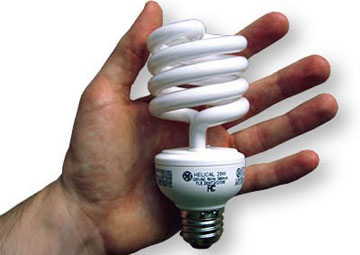
The CF Bulb

I was looking forward to getting home and swapping out a lot of old-style incandescent bulbs for these things and then enjoying the fact that I was getting just as much light for way less money and being good for the environment as well.

I’d opened and installed four before my wife came to me and pointed out the packaging they were in. I’m so used to buying things that come in those hard clear plastic moulded packages that you have to get strong scissors to even get into that I hadn’t noticed what the packaging was in my excitment to get into them and put the new bulbs up.` And, the truth is I hate the kind of non-recycleable 10,000 years packaging in the dump to delivery a product that will last at best a few years and at worse days or weeks.

the CF bulb

– But this was particularly outrageous as the product being delivered was and is being touted as a way to help preserve the planet. Unbelievable. My bulbs will last three to five years – maybe ten at the outside. Their packaging may still be here in the year 12,007. That’s easily twice all of human history. That’s (at 20 years per generation) 500 generations of human beings. That’s a damn long time. No one will remember my name after a few generations but the memory of my purchase will lie in a hole some where for all of that time – because why?

Well, interestingly, as I was searching for an image of a CF Bulb still in its hard plastic packaging, I chanced across a website called Landing the Deal which was discussing here why these bulbs are so hard to sell. Their theory about the hard plastic packaging was that it was to protect people from the small amount of Mercury inside which would be released if the bulb were broken.

That sound good – so long as you don’t actually try to think about it. Consider that these bulbs, after a hard and dangerous wrestle with sharp edged scissors, are going to come out of their packaging in the middle of your family (the ones who are being protected, remember) and the bulbs are going to be placed in the very areas where your family lives for a long time. And we’ll all just have to hope there are no accidents. And there the bulbs will be day after day without their protective plastic covering. Oh my gosh, am I missing something? No, but I think the people behind this theory might be.

Just for grins, never ever having done this before, I Googled “campaign against hard plastic packaging” and immediatly turned up a slew of strong hits. People are on this problem. Are they doing any good – I don’t know but they are on it. I also discovered that there’s a specific name for this kind of packaging – it’s called ‘clamshell packaging’. I like that better than Eternal amoured razor shark tooth packaging, I think, but it’s close.

Without having done the research, my two cents on why manufacturers prefer this packaging all goes back to the capitalistic corporate maximization of profit above all things motive.

If the plastic packaging is reasonably cheap to employ, then it’s a natural winner because it protects the product in transit so there are less damaged returns, it can be shaped to stack efficiently to lowe shipping costs, it can be designed so that it stands up as its own display without requiring a lot of external display apparatus, and it reduces shop lifting. All of those add to the item’s profitability. Once money changes hands and the product leaves the retail outlet, any problems with packaging trash disposal becomes someone elses.

Ugly, ugly ugly.

Links of interest: , , and