061228 – Thursday – Emergent Properties

December 27th, 2006

I’ve been frustrated for some time by thinking that I understand what an emergent property is – but having a hard time coming up with an easily grasped example when I’m trying to explain it.

Today, while I was reading The Revenge of Gaia: Earth’s Climate Crisis and the Fate of Humanity by James Lovelock over lunch, I came across an example he provided that I loved.

Remember, the basic idea with an emergent property is that simple units come together and combine and form an aggregate that is more than the obvious sum of their parts and this new property, itself, generally provides something of value which is, itself, then conserved.

Lovelock was talking about the governor James Watt created to control the speed of his steam engine.

…it consists of a vertical shaft driven by the engine on which is mounted two arms that carry metal balls at their ends. The arms are hinged to the shaft so that, as the shaft rotates, the balls swing out. The faster the engine runs, the higher the balls are lifted; a second pair of arms connected to those carrying the rotating balls simply lifts a level controlling the flow of the steam from the boiler of the engine. The faster the engine runs the more the steam valve is closed. It was obvious to me as a child, that the engine would settle down and run at a constant speed, and that simply by changing the setting of the connection to the steam valve the speed could be set as high or as low as one wished.

So, here we have a spinning shaft, some balls on arms and a linkage to the valve controlling the steam flow. When you put them all together, you have a brand new something which regulates the speed of the engine it is connected to. A new something which is would be impossible to predict the characteristics of by simply examining the component parts separately.

061226 – Tuesday – Photos

December 25th, 2006

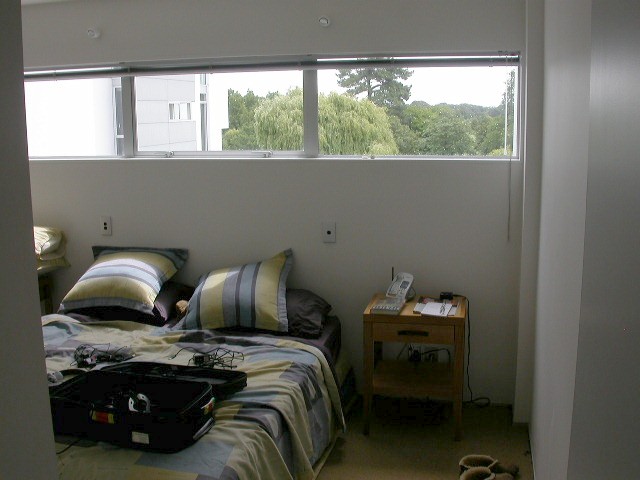
A while back, I said I’d post some photos of our new apartment here and here they are.

View of the Hagley Park Living Room - 1

Living Room -  2 From the windows back to the kitchen

The Kitchen The bedroom

Some of you will be able to click on these pictures and see a larger version of them.

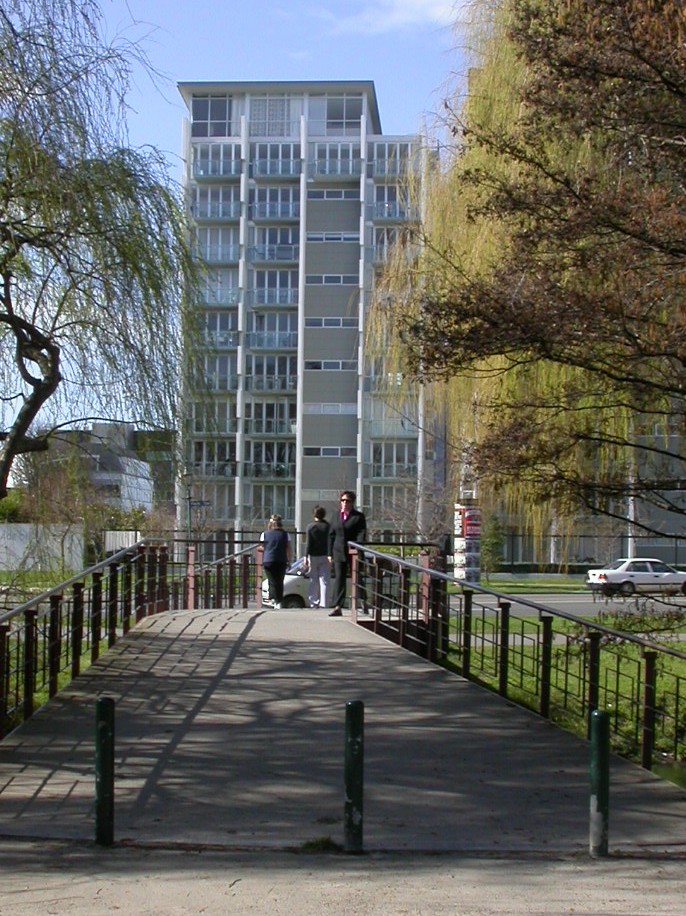
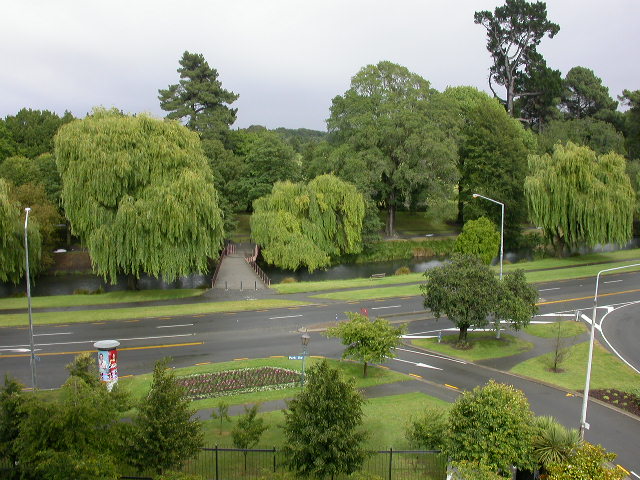
For those of you who haven’t been following along, this apartment is on the 6th floor of a high-rise that overlooks an 800 acre park, Hagley Park, on the west side of the Christchurch city center.   It is really a beautiful location as you can see from the shot off the balcony.  here’s a shot of the building looking back from the park:

Apartment as seen from the park - we're on the 6th floor center.

Disappearing world: Global warming claims tropical island

December 25th, 2006

For the first time, an inhabited island has disappeared beneath rising seas.

Rising seas, caused by global warming, have for the first time washed an inhabited island off the face of the Earth. The obliteration of Lohachara island, in India’s part of the Sundarbans where the Ganges and the Brahmaputra rivers empty into the Bay of Bengal, marks the moment when one of the most apocalyptic predictions of environmentalists and climate scientists has started coming true.

As the seas continue to swell, they will swallow whole island nations, from the Maldives to the Marshall Islands, inundate vast areas of countries from Bangladesh to Egypt, and submerge parts of scores of coastal cities.

Eight years ago, as exclusively reported in The Independent on Sunday, the first uninhabited islands – in the Pacific atoll nation of Kiribati – vanished beneath the waves. The people of low-lying islands in Vanuatu, also in the Pacific, have been evacuated as a precaution, but the land still juts above the sea. The disappearance of Lohachara, once home to 10,000 people, is unprecedented.

It has been officially recorded in a six-year study of the Sunderbans by researchers at Calcutta’s Jadavpur University. So remote is the island that the researchers first learned of its submergence, and that of an uninhabited neighbouring island, Suparibhanga, when they saw they had vanished from satellite pictures.

Two-thirds of nearby populated island Ghoramara has also been permanently inundated. Dr Sugata Hazra, director of the university’s School of Oceanographic Studies, says “it is only a matter of some years” before it is swallowed up too. Dr Hazra says there are now a dozen “vanishing islands” in India’s part of the delta. The area’s 400 tigers are also in danger.

Until now the Carteret Islands off Papua New Guinea were expected to be the first populated ones to disappear, in about eight years’ time, but Lohachara has beaten them to the dubious distinction.

More…

Australia ponders climate future

December 25th, 2006

Parts of Australia are in the grip of the worst drought in memory.

Rainfall in many eastern and southern regions has been at near record lows. On top of that, the weather has been exceptionally warm.

The parched conditions have sparked an emotional debate about global warming.

Conservationists insist the “big dry” is almost certainly the result of climate change and warn that Australia is on the brink of environmental disaster.

Other experts believe such hysteria is wildly misplaced and that the country shouldn’t panic.

‘A war-like scenario’

The drought in Australia has lasted for more than five years.

The worry for some is that this could be the start of a protracted period of low rainfall that could go on for decades.

“The really scary thing is last time we had a drought of this intensity that lasted about five years – it lasted for about 50 years,” cautioned Professor Andy Pitman from Macquarie University in Sydney.

“The politicians truly believe this is a five-year or six-year drought that will break sometime in 2007 or 2008. But it might not break until 2050 and we aren’t thinking in those terms at this stage,” Professor Pitman told the BBC.

Global warming, the drought and the future of dwindling water supplies will undoubtedly dominate talk at barbeques and dinner parties this festive season in Australia.

“We’re in a state of emergency,” said Cate Faehrmann from the Nature Conservation Council of New South Wales. “We need to treat this as a war-like scenario. The people are really worried that we are going to run out of water.”

She added: “I can imagine Australia being a desert in a few decades’ time in some of these agricultural areas. The soil is blowing away, the rivers are drying up.

“I think there will be plots of land abandoned and perhaps whole agricultural practices abandoned.”

More…

Free to choose?

December 23rd, 2006

Modern neuroscience is eroding the idea of free will

In the late 1990s a previously blameless American began collecting child pornography and propositioning children. On the day before he was due to be sentenced to prison for his crimes, he had his brain scanned. He had a tumour. When it had been removed, his paedophilic tendencies went away. When it started growing back, they returned. When the regrowth was removed, they vanished again. Who then was the child abuser?

His case dramatically illustrates the challenge that modern neuroscience is beginning to pose to the idea of free will. The instinct of the reasonable observer is that organic changes of this sort somehow absolve the sufferer of the responsibility that would accrue to a child abuser whose paedophilia was congenital. But why? The chances are that the latter tendency is just as traceable to brain mechanics as the former; it is merely that no one has yet looked. Scientists have looked at anger and violence, though, and discovered genetic variations, expressed as concentrations of a particular messenger molecule in the brain, that are both congenital and predisposing to a violent temper. Where is free will in this case?

Free will is one of the trickiest concepts in philosophy, but also one of the most important. Without it, the idea of responsibility for one’s actions flies out of the window, along with much of the glue that holds a free society (and even an unfree one) together. If businessmen were no longer responsible for their contracts, criminals no longer responsible for their crimes and parents no longer responsible for their children, even though contract, crime and conception were “freely” entered into, then social relations would be very different

More…

From Scum, Perhaps the Tiniest Form of Life

December 23rd, 2006

The smallest form of life known to science just got smaller.

Four million of a newly discovered microbe — assuming the discovery, reported yesterday in the journal Science, is confirmed — could fit into the period at the end of this sentence.

Scientists found the microbes living in a remarkably inhospitable environment, drainage water as caustic as battery acid from a mine in Northern California. The microbes, members of an ancient family of organisms known as archaea, formed a pink scum on green pools of hot mine water laden with toxic metals, including arsenic.

“It was amazing,” said Jillian F. Banfield of the University of California, Berkeley, a member of the discovery team. “These were totally new.” In their paper, the scientists call the microbes “smaller than any other known cellular life form.”

More…

– this story is from the NY Times which requires an ID and PW to login. You just have to sign up once to get these and they are free.

Flu ‘could wipe out 62 million’

December 22nd, 2006

A global flu pandemic could kill 62 million people, experts have warned.

The 1918 pandemic claimed 50 million lives, and experts in The Lancet predict the toll today would be higher than this, despite medical advances.

The world’s poorest nations would be hardest hit, fueled by factors such as HIV and malaria infections, the Harvard University researchers believe.

Yet developing countries can least afford to prepare for a pandemic, which needs to be addressed, they say.

Killer strain

Lethal global flu epidemics tend to occur three or four times a century.

Some scientists believe a new one may be imminent and could be triggered by bird flu.

So far there have been only 258 cases of the latest strain of avian flu, H5N1, recorded in humans.

But the fear is that this strain could mutate and spread quickly and easily between people, triggering a deadly pandemic.

More… and

061222 – Friday – thoughts on New Zealand

December 22nd, 2006

What a mystery and a beauty this life is. Tonight, the apartment is gathered around me – some warm and safe space. I’ve been reading Earth Abides and listening to the wind pressing against the windows. A few minutes ago, my neighbor fired up their stereo and I found I wasn’t annoyed – it was nice to have the company – and their music’s not bad.

A couple of hours ago, I talked to Sharon as we do every evening. She sat in the hall way at home with several cats around her and dragged a ribbon around for their pleasure while we talked. I could see her on the camera and we chatted as if we were both sitting there. I have to remind myself that she’s nearly on the other side of the world.

When the music began to come through the wall, it was comfortable. Someone else enjoying the evening, someone else listening to the wind on the glass doors up here. Someone else safe in their high nest. I washed the dishes and looked at every plate and utensil. “Ours”, I thought. “Ours – this is ours, we own this place and these things so impossibly far away in another national reality.”

Sharon was so close on the phone and camera, the familiar cats, there with her – just outside of my touch, playing. I have to remind myself over and over again, where I am. I’m on those two islands that I’ve been looking at all of my life as I’ve spun the globe wondering and wishing. I’m there, here, sitting in this beautiful room, surrounded by my dreams unimaginably far away from my previous life.

I don’t ‘get’ distance. Oh, I know the numbers of miles and the time involved to get here, but I don’t really get it. Where ever you are, it seems that it is the center of the universe for you, personally. Sharon’s so close on the camera, just a few button pushes away on the phone, when ever I want to talk. I have no real idea how far away she is. I don’t think we ‘get’ distances like that anymore than we ‘get’ death. They are ideas we talk about as if we understand them – but we don’t.

Tomorrow, with luck, I will connect a camera up here so that she can watch me when she wants. It’ll probably be less interesting than I imagine; me playing on the computer, me writing E-mail, me walking over to look down on the street and over at the park and the sky, me sitting eating and reading on the couch. It sounds great to me – but then this is universe central. But, I think she’ll enjoy seeing the apartment and seeing me while we talk in the evenings.

I told her tonight that I’ve felt very little pull thus far to mount an expedition and go up to Kaikoura or to take the train over to Greymouth. I was thinking about why that is when I was riding the bus home from the market today. And, I think it’s because I’ve been doing basically nothing but laying about and doing exactly what I want all day long for over a month. The idea that I might need a break or a distraction seems ludicrous to me. Just organizing the trip sounds like work and focus. Here, I just drift from one whim to the next. I think nothing of deciding to walk 20 minutes to the library to pick up a book that’s come in. The city is ever changing and if I get tired, I can take the bus back or stop into Starbucks and have a coffee until I’ve recovered and girded myself up for the next whim’s expression.

I feel peace and poetry beginning to pool in odd places as these days collect. It’s strange, because in my writings and projections, I’m always seeing the demise of life as we know it in the western world. Yet, here I am at what might be the last truly beautiful place in history and I am drinking it deeply and feeling so very blessed. It is all a mystery; here/there, now/then, near/far, life/death.   I live so intentionally in the abstract and yet I feel so strongly and emotionally about the now.
I know it all changes – it always does. Time flies by like horizontal rain in the wind. In a month, I will be on the other side of the planet again and all the love and mysteries there will enfold me – and this will be a dream; this apartment, this city, this nation, these people. I know they will continue – but for me, they will be waiting for my return before they can animate. All this will be just two small islands on the globe in the hallway that I pass and glance at each day.

Our apartment will be like a beach head in paradise – a promise of our return. It will be waiting, silently, as the months pass while the traffic and the weather passes outside and the neighbor come home in the evening and plays music for an hour in a small personal celebration. I feel that celebration.

Australia Facing Worst Drought for 1000 Years

December 21st, 2006

The irony continues as those who shun action on climate change are suffering the most from climate change.

Along with the United States, Australia has suffered a major drought this year, “the worst for 1000 years.” Australia and the U.S. are the only two industrialized countries that have not ratified the Kyoto Protocol to reduce carbon dioxide emissions.

More…


061222 – Friday – Book reviews…

December 21st, 2006

I’ve just finished the last book in Peter Watts’ Rifters Trilogy. To say I like them would be an understatement. But, saying why I liked them is probably more relevant.

The trilogy consists of the following books:

Starfish
Maelstrom
Behemoth: B-Max
Behemoth: Seppuku

Now, how can a trilogy consist of four books? Well, when Watts wrote the third book of the trilogy, Behemoth, if ended up too long and the publishers forced him to divide it into two parts – strange but true.

If you can tolerate Science Fiction, then I highly recommend these books because they provide and excellent view into what our world’s future might look like. The story line, itself, is fictional and imaginative but the world he paints behind the story line is an excellent extrapolation of where today’s trends may well take us.

Like the better SciFi writers I’ve read in recent years, he has a background in science and the attitude of a generalist and these things deeply inform his work. He switches easily from biology to computer science to psychology and back again as he weaves.

I especially like the Notes and References section he includes at the end of these books. Many of the ideas he paints into his plot have a basis in the things science is revealing today.

Enjoy!