Archive for the ‘CrashBlogging’ Category

Mt Cook glaciers ‘permanently damaged’ by climate change

Friday, May 4th, 2007

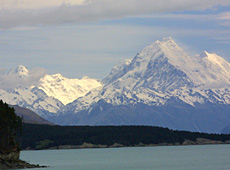
Mt. Cook & Glaciers - New Zealand

New Zealand’s famed Mount Cook glaciers are so affected by a warming climate they will never return to their former splendour, a New Zealand glaciologist has said.

Glaciologist Dr Trevor Chinn, who has been studying the Mount Cook structures since the 1960s, said some had already shrunk up to five kilometres, about 20 per cent, and it was too late for any of them to completely recover.

He said that while some of the world’s glaciers would grow back if the climate cooled to its pre-global warming levels, those fronting lakes, like some at Mount Cook, would not.

“You can’t get a re-advance that will come back if you apply the previous climate … a re-advance across a lake is difficult because the ice breaks off the front of the glacier and floats away,” Chinn said.

He said local warming since the 1890s had started the trend, but man-made climate change in recent decades had exacerbated the effect.

“They will never completely go. For that to happen the climate has to warm enough for the snowline to rise clean above the mountains, but they will retreat quite a bit more,” he said.

More…

Climate Change: Study Maps Those At Greatest Risk From Cyclones And Rising Seas

Monday, April 9th, 2007

“Climate change is not a natural disaster but has largely been caused by wealthy countries emitting greenhouse gases during their industrialisation,” says McGranahan. “Yet the poorest countries that have contributed least to the problem are most vulnerable to its effects. It is therefore incumbent on rich nations to help poorer ones to adapt to the changes ahead.”

—————————

Science Daily  The first global study to identify populations at greatest risk from rising sea levels and more intense cyclones linked to climate change will be published next month in the peer-reviewed journal Environment and Urbanization.

The research shows that 634 million people one tenth of the global population live in coastal areas that lie within just ten metres above sea level.

It calls for action to limit the effects of climate change, to help people migrate away from risk and to modify urban settlements to reduce their vulnerability. But it warns that this will require enforceable regulations and economic incentives, both of which depend on political will, funding and human capital.

Key findings of the study by Gordon McGranahan of the International Institute for Environment and Development (UK) and his colleagues, Deborah Balk and Bridget Anderson, at the City University of New York and Columbia University, are that:

  • Nearly two-thirds of urban settlements with more than 5 million inhabitants are at least partially in the 0-10 metre zone.
  • On average, 14 percent of people in the least developed countries live in the zone (compared to 10 percent in OECD countries).
  • 21 percent of the urban populations of least developed nations are in the zone (11 percent in OECD countries).
  • About 75% of people in the zone are in Asia. 21 nations have more than half of their population in the zone (16 are small island states).
  • Poor countries and poor communities within them are most at risk.

More…

Greenhouse Gas Effect Consistent Over 420 Million Years

Monday, April 9th, 2007

Science Daily New calculations show that sensitivity of Earth’s climate to changes in the greenhouse gas carbon dioxide (CO2) has been consistent for the last 420 million years, according to an article in Nature by geologists at Yale and Wesleyan Universities.

A popular predictor of future climate sensitivity is the change in global temperature produced by each doubling of CO2 in the atmosphere. This study confirms that in the Earth’s past 420 million years, each doubling of atmospheric CO2 translates to an average global temperature increase of about 3° Celsius, or 5° Fahrenheit.

More…

Latest report from the IPCC folks

Saturday, April 7th, 2007

If you follow discussions on Global Climate Change, you’d have to be living under a rock to not know that the IPCC released its latest sub-report on Friday, April 6th.

There are three sub-reports scheduled this year and, jointly, they make up the 4th Intergovernmental Panel on Climate Change Report.

The first sub-report this year concluded with 90% certainty that human activities are causing the rise in global atmospheric temperatures. This 2nd sub-report of the year focuses on the consequences of the warming that’s in progress – and the news is not good.

Bloggers and news organizations have been all over this story for a week working on early leaked documents, final draft documents and final release documents. It’s been a free-for-all and I’m not sure that I can add a lot to the conversation so I’m just going to link to some of the more interesting on-line articles I’ve seen on this topic. Below are links to various stories I’ve found on the web about this latest IPCC report along with a brief note about each link.

– This is a brief history of the IPCC reports in general. It discusses their purpose and the various versions that have been released to date.

– This is a summary in Scientific American about the most recent sub-report.

– This is an opinion piece in the New York Times discussing whether or not grim news like this might finally serve to break President Bush out of his long-standing denial of the problem. (See note at the bottom about the NY Times)

– This is the final draft as the scientists wanted it. But, at the eleventh hour, several governments lobbied to water certain sections down to better align things with their ‘political’ views of reality.

– This is another piece from this NY Times – this time from their environmental section discussing the findings of the sub-report in general. (See note at the bottom about the NY Times)

– This piece is, itself, an aggregation of articles from other news sources. This is from Time Magazine’s Blog called The Ag.

– This is a piece from the Washington Post discussing how the IPCC sub-report was watered down by several governments over the objections of the scientists at the last moment.

– This is another piece from the environmental section of the New York Times. It discusses the consequences of Global Warming as outlined in the IPCC sub-report. (See note at the bottom about the NY Times)

– This is from National Geographic and it explores the consequences of the consequences described by the IPCC. I.e., that these changes may in turn spur extinctions, shortages and conflicts world wide.

– This article from CNN discusses the tension and anger that were palpable in the last hours, before the final version of this sub-report was issued, between the scientists and the governments lobbying to water the report down.

– This is a summary of the IPCC Summary for Policy Makers – Part I, II, & III.

That’s 11 articles. I could have gone on and gathered up another dozen without breaking a sweat. This story’s big and everyone is reporting on it, Blogging on it, analyzing it and rendering opinions about it. I didn’t go to see what the climate skeptics are saying but I’m sure they are churning out vast quantities of confusion and disinformation to deflect the sharp edges of this report.

Frankly, it amazes me that we still need to try and convince people that something is going on with global climate change. And, what amazes me more, is that humanity’s response to this problem has been so pitifully inadequate to date. And now President Bush is saying he thinks we’re doing enough at the same time other folks are saying that we’re way past being able to stop these changes, and now we just need to figure out the best way to cope with the unavoidable.

We’re in some serious doo-doo here, folks. If humanity survives this mess, then it would be interesting to read the history books two hundred years on (if we could be here) and read their opinions about the self-destructive stupidity of our age.

Note that there have been four IPPC reports since the series of reports were begun by the UN in 1990. The current, or fourth, IPCC report is broken into three parts which will be issued at different times over this year. I’ve taken to calling these three reports ‘sub-reports‘ to differ them from their aggregate form. After all, if we call the aggregates and the pieces all ‘reports’, it can get a bit confusing.

—————–

– Some of these articles are from the NY Times and they insist that folks have an ID and a PW in order to read their stuff. You can get these for free just by signing up. However, recently, a friend of mine suggested the website bugmenot.com :arrow: as an alternative to having to do these annoying sign ups. Check it out. Thx Bruce S. for the tip.

Poor Nations to Bear Brunt as World Warms

Wednesday, April 4th, 2007

The world’s richest countries, which have contributed by far the most to the atmospheric changes linked to global warming, are already spending billions of dollars to limit their own risks from its worst consequences, like drought and rising seas.

But despite longstanding treaty commitments to help poor countries deal with warming, these industrial powers are spending just tens of millions of dollars on ways to limit climate and coastal hazards in the world’s most vulnerable regions – most of them close to the equator and overwhelmingly poor.

Next Friday, a new report from the Intergovernmental Panel on Climate Change, a United Nations body that since 1990 has been assessing global warming, will underline this growing climate divide, according to scientists involved in writing it – with wealthy nations far from the equator not only experiencing fewer effects but also better able to withstand them.

Two-thirds of the atmospheric buildup of carbon dioxide, a heat-trapping greenhouse gas that can persist in the air for centuries, has come in nearly equal proportions from the United States and Western European countries. Those and other wealthy nations are investing in windmill-powered plants that turn seawater to drinking water, in flood barriers and floatable homes, and in grains and soybeans genetically altered to flourish even in a drought.

In contrast, Africa accounts for less than 3 percent of the global emissions of carbon dioxide from fuel burning since 1900, yet its 840 million people face some of the biggest risks from drought and disrupted water supplies, according to new scientific assessments. As the oceans swell with water from melting ice sheets, it is the crowded river deltas in southern Asia and Egypt, along with small island nations, that are most at risk.

Like the sinking of the Titanic, catastrophes are not democratic“, said Henry I. Miller, a fellow with the Hoover Institution at Stanford University. “A much higher fraction of passengers from the cheaper decks were lost. We’ll see the same phenomenon with global warming.“

More…

——————

– research thanks to John P. and Lisa G., both of whom forwarded a link to this story to me.

– This article is from the NY Times and they insist that folks have an ID and a PW in order to read their stuff. You can get these for free just by signing up. However, recently, a friend of mine suggested the website bugmenot.com :arrow: as an alternative to having to do these annoying sign ups. Check it out. Thx Bruce S. for the tip.

070320 – Tuesday – Multiculturalism – Not!

Tuesday, March 20th, 2007

This is going to be a piece some folks are going to find offensive. I’m going to attack the idea of universal multicultural tolerance. And note the word ‘universal’ because I am decidedly not against all cultures other than my own. And, in fact, there are aspects of my own culture that I think the planet would be much better off without.

I am sorry that these ideas may offend some because I don’t like offending people. But, these are things that need to be said. I am most definitely open to alternative view points and I welcome your comments and I will respond to them.

I believe that when people immigrate to a new country, they should make a conscious decision to embrace the culture of that country before they go. If they want the benefits of living in the new country, then they should accept its culture as well. If they don’t like its culture, then they should stay home.

Immigration should be encouraged but it should also be controlled. A country’s culture can absorb a certain number of new members with harm or confusion but there is an upper limit and the government should be sensitive to not cross that limit. If too many people come in at once, the country’s self-identity can become confused and the result is that it can become like a person with multiple personalities.

And when large numbers of people are allowed come in without having made a conscious decision to embrace the culture of their new home, the danger of the nation developing multiple personality disorder is magnified exponentially.

In my opinion, Britain, France and Germany have already crossed this fatal line and may never recover. They have let in too many people from other cultures who have brought their native cultures along lock, stock and barrel and setup cultural enclaves within their new nations. Australia is beginning now to grapple with this problem.

Here’s a quote from an editorial in an Australian newspaper that illustrates my point:

Many Britons are concerned that multicultural policies that have discouraged assimilation have divided their society and created what one commentator called a “voluntary apartheid”. In the age of terrorism, this is a worrisome trend, especially considering that a recent survey of British Muslims suggested 100,000 of them felt the 7/7 attacks were justified and that one in five felt little or no loyalty to Britain.

And:

While tolerance is certainly a positive virtue that should be strived for, it cannot be a cultural suicide pact. A culture that is tolerant of those who are intolerant of its freedoms is ripe for destruction, and bit by bit will see all it values eroded. And radical Islam knows this. Just as an Australian wouldn’t go to Saudi Arabia to wear a bikini on the beach and drink beer in the corner pub, those who see the proper role of women as subservient, anonymous and under cover should not expect a postmodern secular democracy such as Britain or Australia to accommodate these beliefs.

It may be too late for Britain and much of Western Europe to maintain coherent cultures but Australian politicians have been speaking up of late:

Treasurer Peter Costello, seen as heir apparent to [Australian Prime Minister] Howard, hinted that some radical clerics could be asked to leave the country if they did not accept that Australia was a secular state, and its laws were made by parliament. “If those are not your values, if you want a country which has Sharia law or a theocratic state, then Australia is not for you“, he said on National Television.

I’d be saying to clerics who are teaching that there are two laws governing people in Australia; one the Australian law and another Islamic law, that is false. If you can’t agree with parliamentary law, independent courts, democracy, and would prefer Sharia law and have the opportunity to go to another country, which practices it, perhaps, then, that’s a better option“, Costello said.

If you examine cultural tolerance in many places in the Islamic world, like Saudi Arabia, it is nearly non-existant. They believe their culture is the right one and they are not going to let other cultural practices corrupt theirs. This is their country and they have the right to preserve their culture. Why should they come to our cultures and expect to practice theirs within ours? If cultures are tolerant of each other, then they can and should mix but intolerant cultures should not expect to get the same treatment.

Winter warmth breaks all records

Saturday, March 17th, 2007

Winter in the Northern Hemisphere this year has been the warmest since records began more than 125 years ago, a US government agency says.

The combined land and ocean surface temperature from December to February was 0.72C (1.3F) above average.

The National Oceanic and Atmospheric Administration said El Nino, a seasonal warming of parts of the Pacific Ocean, had also contributed to the warmth.

But it did not see the high temperature as evidence of man-made global warming.

The Noaa said that temperatures were continuing to rise by a fifth of a degree every decade. The 10 warmest years on record have occurred since 1995.

Weather experts predict that 2007 could be the hottest year on record.

More…

E.U. Raises Bar in Fight Against Global Warming

Saturday, March 17th, 2007

PARIS, March 9 — European Union leaders agreed Friday to take the 27-country bloc beyond the targets of the 1997 Kyoto Protocol on global warming, agreeing to legally binding reductions in greenhouse gas emissions and increasing the use of renewable energy.

During a sometimes contentious two-day meeting in Brussels, the leaders agreed to cut the gas emissions by at least 20 percent from 1990 levels in the next 13 years. They set binding targets for renewable energy sources, such as wind, solar and hydro power, to supply 20 percent of the union’s power needs and for biofuels to be used in 10 percent of the bloc’s road vehicles by 2020.

European governments have been a major promoter of the Kyoto pact, which attempts to counter trends that are warming the Earth’s climate. The United States and some developing countries have withheld support from the pact, saying it is likely to harm economic growth and is based on inconclusive science.

The agreement in Brussels was reached after months of negotiations within the bloc. Leaders said they hoped the aggressive measures would help persuade some of the world’s biggest polluters, including the United States, China and India, to follow their lead.

More…

THE GREAT CHANNEL FOUR SWINDLE

Tuesday, March 13th, 2007

– This post is about The Great Global Warming Swindle which was broadcast on Britain’s Channel 4 on March 8th, 2007. The broadcast took the view that Global Warming is a lie and it has been creating quite a stir since it was aired.

– To locate related posts on this site, search for the term swindle.

————————————

George Marshall @ 2:39 pm

Last night Channel Four kindly gave an hour and half and a large budget to the international network of professional climate change deniers. ‘The Great Global Warming Swindle’ was a propaganda gift to the various vested interests who seek to undermine the fragile political and social will to take action on this global action.

And it was sometimes very convincing, as strongly worded opinions often are when they are not subject to any verification or external challenge. For example, there are excellent rebuttals against the contention that global warming is correlated to cosmic rays (for example see… ) At the bottom I list the growing number of well referenced and detailed rebuttals of the scientific claims in the programme.

There was only one scientific advisor on the programme, Martin Livermore, whose sole scientific qualification is that he is the Director of a web-based think tank, The Scientific Alliance. The Alliance was set up by in 2001 by Robert Durward, the fiercely anti-green director of the British Aggregates Association, and Foresight Communications, a Westminster public relations and lobbying company, to “counter scare-mongering by the so-called green lobby”. (For more…)

The Scientific Alliance has no affiliation with any recognised scientific body but, like most of the contributors to the programme, it does have very strong links with the US public relations and lobbying organisations that have been so effective in setting the Bush agenda on climate change.

The writer and presenter of the programme was Martin Durkin. Although it was written in a highly personal and opinionated style- speaking freely of “lies”, and the “shrill frenzy” of “scare stories” – we never saw Durkin or discovered his personal credentials. As George Monbiot has revealed Durkin is closely affiliated with the Revolutionary Communist Party which has a strong ideological opposition to environmental science (more on Durkin and the RCP.

In 1997 Channel Four was forced to issue a humiliating public apology over a previous series of anti-environment programmes directed by Durkin called “Against Nature”. The Independent Television Commission found that “the views of the four complainants, as made clear to the interviewer, had been distorted by selective editing” and that they had been “misled as to the content and purpose of the programmes when they agreed to take part.”

For this programme Durkin drew up a dream team of scientists who have built personal careers as media pundits debunking the peer-reviewed work of their colleagues. There are few of them, but they are well supported by the Washington lobbies and kept very busy with media debates, documentaries and opinion pieces. (I have personally debated with five of them in media debates).

Is it any surprise then, that they were so persuasive. Most of the people on the programme are professional communicators who are more familiar with the chat show than the lab. Of course they give good interviews – it is what they do for a living.

And let us not forget that we all want to believe them. Wouldn’t it be wonderful to believe that the science is unsettled, that all that carbon dioxide that we are pumping into the atmosphere really has no effect, and that we do not have to worry about the future.

It would be entirely possible to put together a similar programme, with a string of credible former academics, to argue that smoking does no cause cancer, that HIV does not cause AIDS, or that black people are less intelligent. However, Channel Four would not dare broadcast the programme and we would not believe them if they did. Is it not a reflection of the deep public ambivalence about climate change that these dissenters are given such a prominent and uncritical showcase and that we are so keen to listen to them?

Make up your own minds from their track records. Here is a little more information on some of the people who appeared on the programme:

Fred Singer. Despite the caption on the programme, Singer has retired from the University of Virginia and has not had a single article accepted for any peer-reviewed scientific journal for 20 years. His main work has been as a hired gun for business interests to undermine scientific research on environmental and health matters. Before turning to climate change denial he has argued that CFCs do not cause ozone depletion and second hand smoke does not cause cancer (more… ). In 1990 he founded “The Science and Environment Policy Project”, which aggressively contradicts climate science and has received direct funding from Exxon, Shell, Unocal and ARCO. Exxon is also among the funders ($20,000 in 1998 and 2000)

Patrick Michaels is the most prominent US climate change denier. In the programme he claimed “I’ve never been paid a nickel by the old and gas companies” which is a curious claim. According to the US journalist Ross Gebspan Michaels has received direct funding from, among others German Coal Mining Association ($49,000), Edison Electric Institute ($15,000), and the Western Fuels Association ($63,000) an association of US coal producing interests (more…). The WFA is one of the most powerful forces in the US actively denying the basic science of climate change, funding, amongs other things, the Greening Earth Society which is directed by Patrick Michaels. Tom Wigley, one of the leading IPCC scientists, describes Michaels work as “a catalog of misrepresentation and misinterpretation”. (More on Michaels…)

Philip Stott was captioned as a Professor at the University of London although he is retired and is therefore free of any academic accountability. Stott is a geographer by training and has no qualifications in climate science. Since retiring Stott has aimed to become Britain’s leading anti-green pundit dedicating himself to wittily criticizing rainforest campaigns (with Patrick Moore), advocating genetic engineering and claiming that “global warming is the new fundamentalist religion.”

Patrick Moore is Stott’s Canadian equivalent. Since a very personal and painful falling out with Greenpeace in 1986 Moore has put his considerable campaigning energies into undermining environmentalists, especially his former friends and colleagues. Typical of his rhetoric was his claim in the programme that environmentalists were “anti-human” and “treat humans as scum”. Throughout the 1990s Moore worked as lead consultant for the British Columbian Timber Products Association undermining Greenpeace’s international campaign to protect old growth forest there. Whenever he has the chance he also makes strong public statements in favour of genetic engineering, nuclear power, logging the Amazon, and industrial fishing- all, strangely, lead campaigns for Greenpeace (more on Moore..)

Piers Corbyn has no academic status and his role in such programmes is to promote his own weather prediction business. He has steadfastly refused to ever subject his climatological theories to any form of external review or scrutiny.

Richard Lindzen. As a Professor of Meteorology at the credible Massachusetts Institute of Technology, Lindzen is by far the most reputable academic among the US climate deniers and, for this reason, he is heavily cited by sympathetic journalists such as Melanie Phillips and Michael Crichton. His arguments though are identical to the other deniers – for example an article in the Wall Street Journal (June 11 2001) he claims that “there is no consensus, unanimous or otherwise, about long-term climate trends or what causes them”.
He is strongly associated with the other people on the programme though co-authored reports, articles, conference appearances and co-signed statements.

Tim Ball was captioned as the University of Winnipeg. In fact he left in 1996 since when he has run political campaigns through two organisations he helped found: the Natural Resources Stewardship Project and the Friends of Science which, according to their websites aim to run “a proactive grassroots campaign to counter the Kyoto Protocol”; and “encourage and assist the Canadian Federal Government to re-evaluate the Kyoto Protocol”. Ian Clark is also on the board of the NRSP.

REBUTTALS OF THE ALLEGATIONS IN THE PROGRAMME

I have received a lot of postings from people criticising me for not dealing with the specific allegations in the programme. I am not qualified to do so, but here are links to people who are. I am not going to accept any more postings making this point. This website is a discussion of why we find it so hard to come to terms with climate change, not a bulletin board for people who people who are still not prepared to accept the conclusions of 20 years of research by every scientific insitution in the world.

1. Sir John Houghton, one of Britain’s leading climate scientists and former chair of the IPCC. Link… He states baldly that virtually every allegation was false.

2. The Royal Society. In a press release the Royal Society is very critical of the programme and concludes that “Those who promote fringe scientific views but ignore the weight of evidence are playing a dangerous game. They run the risk of diverting attention from what we can do to ensure the world’s population has the best possible future” link….

3. In the Sunday 11th issue of the Observer, six leading climate scientists from four universities criticise the conclusions of the progamme. They say: “we defend the right of people to be sceptical, but for C4 to imply that the thousands of scientists and published peer-reviewed papers, summarised in the recent international science assessment, are misguided or lying lacks scientific credibility and simply beggars belief” link…

4. In 13th March edition of the Guardian, George Monbiot takes out the claims of the programme one by one. Link… On his website full scientific references are given for his article which, unlike the Swindle, was checked by professional climate scientists before publication

5. Realclimate, an excellent blogsite run byclimate scientists in large part to deal with climate skeptic arguments also goes through the allegations point by point link…

6. One of the few real scientists to appear on the programme (that is to say he really does do climate science rather than working for a public relations company) was Professor Carl Wunsch, professor of physical oceanography at the Massachusetts Institute of Technology. In the Independent Wunsch claims that “They completely misrepresented me. My views were distorted by the context in which they placed them….I am the one who has been swindled…The movie was terrible propaganda. It is characteristic of propaganda that you take an area where there is legitimate dispute and you claim straight out that people who disagree with you are swindlers. That is what the film does in any area where some things are subject to argument.” link…

Well no surprise that Durkin lied to the participants about the programme and then edited what they said to misrepresent their views. This is exactly what he did last time he got a major programme and it led to the public humiliation of Channel Four, The question is this: what reputable broadcaster would ever give another major commission to this man. Obviously the same channel that thinks that subjecting an Asian woman to racist bullying makes good entertainment.

Let’s answer that last question another way. If you want a painful laugh, have a look at Channel Four’s own website on the programme link…

One the one side of the page is the information about the rubbish in the Swindle film. On the other side are links to other pages on climate change including “Explore the issues around the greatest challenge of our time”, which tells us that “little doubt exists among the scientific community that human activity is changing the climate…For the first time in our history the whole human species is under threat from the alarmingly powerful forces of climate change” Another featured link take us to “Environmentalism: A brief history of this powerful movement”.

OH FOR GODS SAKE! So even Channel Four don’t believe this programme. How unspeakably shallow and cynical can the media be?

Follow this link to the original:

Don’t let truth stand in the way of a red-hot debunking of climate change

Tuesday, March 13th, 2007

– This post is about The Great Global Warming Swindle which was broadcast on Britain’s Channel 4 on March 8th, 2007. The broadcast took the view that Global Warming is a lie and it has been creating quite a stir since it was aired.

– To locate related posts on this site, search for the term swindle.——————————————————–

The science might be bunkum, the research discredited. But all that counts for Channel 4 is generating controversy

George Monbiot
Tuesday March 13, 2007
The Guardian

Were it not for dissent, science, like politics, would have stayed in the dark ages. All the great heroes of the discipline – Galileo, Newton, Darwin, Einstein – took tremendous risks in confronting mainstream opinion. Today’s crank has often proved to be tomorrow’s visionary.

But the syllogism does not apply. Being a crank does not automatically make you a visionary. There is little prospect, for example, that Dr Mantombazana Tshabalala-Msimang, the South African health minister who has claimed Aids can be treated with garlic, lemon and beetroot, will be hailed as a genius. But the point is often confused. Professor David Bellamy, for example, while making the incorrect claim that wind farms do not have “any measurable effect” on total emissions of carbon dioxide, has compared himself to Galileo.

The problem with The Great Global Warming Swindle, which caused a sensation when it was broadcast on Channel 4 last week, is that to make its case it relies not on future visionaries, but on people whose findings have already been proved wrong. The implications could not be graver. Just as the government launches its climate change bill and Gordon Brown and David Cameron start jostling to establish their green credentials, thousands have been misled into believing there is no problem to address.

The film’s main contention is that the current increase in global temperatures is caused not by rising greenhouse gases, but by changes in the activity of the sun. It is built around the discovery in 1991 by the Danish atmospheric physicist Dr Eigil Friis-Christensen that recent temperature variations on Earth are in “strikingly good agreement” with the length of the cycle of sunspots.

Unfortunately, he found nothing of the kind. A paper published in the journal Eos in 2004 reveals that the “agreement” was the result of “incorrect handling of the physical data”. The real data for recent years show the opposite: that the length of the sunspot cycle has declined, while temperatures have risen. When this error was exposed, Friis-Christensen and his co-author published a new paper, purporting to produce similar results. But this too turned out to be an artefact of mistakes – in this case in their arithmetic.

So Friis-Christensen and another author developed yet another means of demonstrating that the sun is responsible, claiming to have discovered a remarkable agreement between cosmic radiation influenced by the sun and global cloud cover. This is the mechanism the film proposes for global warming. But, yet again, the method was exposed as faulty. They had been using satellite data which did not in fact measure global cloud cover. A paper in the Journal of Atmospheric and Solar-Terrestrial Physics shows that, when the right data are used, a correlation is not found.

So the hypothesis changed again. Without acknowledging that his previous paper was wrong, Friis-Christensen’s co-author, Henrik Svensmark, declared there was a correlation – not with total cloud cover but with “low cloud cover”. This, too, turned out to be incorrect. Then, last year, Svensmark published a paper purporting to show cosmic rays could form tiny particles in the atmosphere. Accompanying the paper was a press release which went way beyond the findings reported in the paper, claiming it showed that both past and current climate events are the result of cosmic rays.

As Dr Gavin Schmidt of Nasa has shown on www.realclimate.org, five missing steps would have to be taken to justify the wild claims in the press release. “We’ve often criticised press releases that we felt gave misleading impressions of the underlying work,” Schmidt says, “but this example is by far the most blatant extrapolation beyond reasonableness that we have seen.” None of this seems to have troubled the programme makers, who report the cosmic ray theory as if it trounces all competing explanations.

The film also maintains that manmade global warming is disproved by conflicting temperature data. Professor John Christy speaks about the discrepancy he discovered between temperatures at the Earth’s surface and temperatures in the troposphere (or lower atmosphere). But the programme fails to mention that in 2005 his data were proved wrong, by three papers in Science magazine.

Christy himself admitted last year that he was mistaken. He was one of the authors of a paper which states the opposite of what he says in the film. “Previously reported discrepancies between the amount of warming near the surface and higher in the atmosphere have been used to challenge the reliability of climate models and the reality of human-induced global warming. Specifically, surface data showed substantial global-average warming, while early versions of satellite and radiosonde data showed little or no warming above the surface. This significant discrepancy no longer exists because errors in the satellite and radiosonde data have been identified and corrected.”

Until recently, when found to be wrong, scientists went back to their labs to start again. Now, emboldened by the denial industry, some of them, like the film-makers, shriek “censorship!”. This is the best example of manufactured victimhood I have come across. If you demonstrate someone is wrong, you are now deemed to be silencing him.

But there is one scientist in the film whose work has not been debunked: the oceanographer Carl Wunsch. He appears to support the idea that increasing carbon dioxide is not responsible for rising global temperatures. Wunsch says he was “completely misrepresented” by the programme, and “totally misled” by the people who made it.

This is a familiar story to those who have followed the career of the director Martin Durkin. In 1998, the Independent Television Commission found that, when making a similar series, he had “misled” his interviewees about “the content and purpose of the programmes”. Their views had been “distorted through selective editing”. Channel 4 had to make a prime-time apology.

Cherry-pick your results, choose work which is already discredited, and anything and everything becomes true. The twin towers were brought down by controlled explosions; MMR injections cause autism; homeopathy works; black people are less intelligent than white people; species came about through intelligent design. You can find lines of evidence which appear to support all these contentions, and, in most cases, professors who will speak up in their favour. But this does not mean that any of them are correct. You can sustain a belief in these propositions only by ignoring the overwhelming body of contradictory data. To form a balanced, scientific view, you have to consider all the evidence, on both sides of the question.

But for the film’s commissioners, all that counts is the sensation. Channel 4 has always had a problem with science. No one in its science unit appears to understand the difference between a peer-reviewed paper and a clipping from the Daily Mail. It keeps commissioning people whose claims have been discredited – such as Durkin. But its failure to understand the scientific process just makes the job of whipping up a storm that much easier. The less true a programme is, the greater the controversy.

———————————————-

My apologies fto George Monbiot for publishing his piece here in its entirety rather than providing some of it and linking to the rest. It’s just that I feel that this information needs to get the widest exposure possible. -Dennis

Here’s a link to the original article:

And one to his personal website: