Archive for the ‘The Perfect Storm’ Category

Iran ban on ‘Western’ hairstyles

Sunday, April 29th, 2007

Iranian police have warned barbers not to give men western hair styles or use make up on them.

The move is part of an unusually fierce crackdown on what is known locally as bad hijab, or un-Islamic clothing, that this year is also targeting men.

Hair stylists have been warned that they could lose their licenses if they do not comply.

However, police have denied a report that they have ordered barbers not to serve customers wearing ties.

Wild

Police say that as well as avoiding western hairstyles and make up, barbers should not pluck customers’ eyebrows.

Some young boys in Iran sport very wild hair styles , using gel to make their long hair stand on end in a fashion not seen in other countries.

Meanwhile newspapers in Iran have quoted the police as saying that 16,000 women and 500 men have been cautioned in the last week over their improper clothing.

More…

070427 – Friday – The train ride to Hell

Friday, April 27th, 2007

In the five plus years I’ve been talking about the Perfect Storm concept, I’ve often told a story I call The Train to Hell story. It’s a simile, but I find it’s useful when people tell me that things are going to be alright because everyday more and more people are becoming concerned about the environment. It explains clearly how things can be getting better – and why that’s just not enough. As you read this, think of it as a dream story – something someone might relate to you just after they’ve woken up.

So imagine we’re on a train and we’re rolling across the flat countryside at high speed in a straight line. Ahead, the tracks lead right to the edge of a very deep cliff and then they just end. If the train doesn’t stop before we arrive at the cliff, we’re all going over the edge together and it is going to be very bad indeed.

The train has one of those cords you pull to signal that the train should make an emergency stop. This cord works a bit differently, however. With this cord, how well it works depends on how many people are pulling on it.

Now, some folks have leaned way out the windows or maybe even climbed atop the train and they’ve seen the cliff coming and they can also see what’s going to happen if we don’t stop. Now they’re down in the cabin pulling on the cord and talking to everyone around them trying to convince them that there’s a big problem up ahead and they too should start pulling the cord. Some folks, a few, believe them and help with the cord. A few more lean way out the window and see that they are right and they begin to lend a hand as well.

But most folks listen for a moment, glance out the windows casually and don’t see anything so they go on about their business. After all, train rides are fun.

Now, I’m on the train and I’m helping with the cord but I’m worried that not many people are. I tell my friend who is also pulling the cord about my concern and he says, “Hey, don’t worry. Look, more and more people all the time are joining us and helping with the cord.

Unfortunately, I’ve done a calculation. Even with more new people adding their efforts all the time and even with the train’s increasing rate of slowing, I can see it’s just not going to be enough to stop us before we go over the edge. The new folks are adding in too slowly and the rate we are approaching the cliff’s edge is much too fast.

I tell my friend we may not have time to try to convince people to help by reason or example. But he says it is critically important that everyone makes the decision to help on their own. We cannot interfere in another person’s decisions and in the exercise of their free will.

I look out the window and I’m thinking, “What will the nicety of respecting their free will gain either them or us if we all go over the edge together?

At some point, a problem can become so critical that it must begin to percolate up through the levels of one’s priorities until it reaches a level where decisions can be made that can effectively deal with the problem. If we are not willing to rearrange our priorities in favor of survival and defer, instead, to the considerations of lesser levels and priorities, then we are quite likely not to survive.

So where’s the limit? Should we avoid taking action because we might get our clothes dirty and they are expensive? Should we avoid taking action because we might have to speak loudly and forcefully and that’s unseemly? Should we not act to save all of us because we might have to force some of us to help against their will?

There’s a similar riddle which concerns a rowboat with a few too many people in it out on the open sea. It bears thinking through.

These are not easy questions but, unfortunately, we’ve put ourselves into the position of having to answer them.

Some of us believe we can see the magnitude of the problems facing mankind and the entire biosphere at this point in history. But, most folks don’t believe there’s a problem at all. And many others acknowledge that there is but they are talking politely about it and trying to get more folks on board to deal with it by reason and example.

But the scientists are telling us clearly that we are very near the point where if we don’t act decisively, the Earth’s weather system’s are going to move into configurations we’ve never seen before and the results will be a very large disruption to civilization, the death of millions and millions of people and a massive die-off of species the likes of which hasn’t happened here since the comet smashed into the Yucatan 66 million years ago.

Meanwhile, the majority of the people in the most powerful nation on Earth don’t believe in the relevance of science or the reality of evolution. Some of the most powerful constructs mankind has ever conceived and unleashed, entities called corporations, which have power which exceeds many small and medium nation states, press on with their monomaniacal pursuit of money and power – as if there will be a place to spend the money and a place to wield the power in the future. Meanwhile, the majority of the world’s populations do not care for anything more distant or abstract than the probability that they will receive their next paycheck and be able to put food on the table.

Do you see the problem, Lambchop? It’s likely we’re going to be toast.
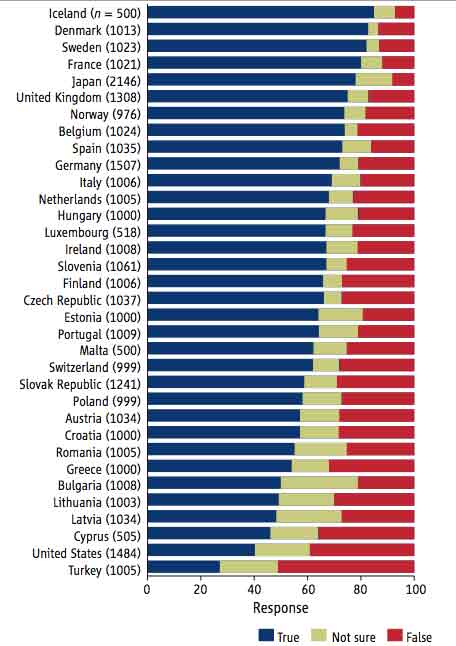
Evolution Less Accepted in U.S. Than Other Western Countries, Study Finds

Friday, April 27th, 2007

– The graph below speaks for itself. The United States, the most powerful nation in the world, a leader in science and technology for many many decades, the most forward thinking experiment in democracy in the world’s political history now stands on the brink of pissing it all away. We can and we will become a second rate nation at this rate. You cannot excel at science, technology and a vibrant democracy and think that religion should trump politics and science at the same time. It isn’t going to happen, folks. Read the chart – and then imagine the future.

———————————————————-

The end of a great nation is here - can you see it?

This chart depicts the public acceptance of evolution theory in 34 countries in 2005. Adults were asked to respond to the statement: “Human beings, as we know them, developed from earlier species of animals.” The percentage of respondents who believed this to be true is marked in blue; those who believed it to be false, in red; and those who were not sure, in yellow.

A study of several such surveys taken since 1985 has found that the United States ranks next to last in acceptance of evolution theory among nations polled. Researchers point out that the number of Americans who are uncertain about the theory’s validity has increased over the past 20 years.

To the original…

Research Thx to the Sietch Blog

Rare Leopardess Killed — Only 6 Remain

Friday, April 27th, 2007

– Sometimes I think this planet would be better off without human beings. We are so vicious to the other poor animals who’ve had the misfortune to be here on Earth at the same time our species has ascended to global dominance.

– A while ago, I wrote about the elephants being slaughtered in Africa . Just the other evening, Sharon and I watched part of the beautiful series currently running on the Discovery Channel called Planet Earth and they had some first-time-ever video of the extremely rare Amur Leopards in the wild. Strange and beautiful creatures so worthy of our respect and admiration.

And now this article.

– It was utterly criminal to have killed one of these last few beautiful leopards. But it wasn’t enough – the bastards had to beat the animal as well.

– Yeah, I think humans – maybe most of us – may be the worst plague ever unleashed on this planet. I cried when I read this. Eden is slipping through our fingers and most of us are too stupid to know it’s even happening.

——————————————————————

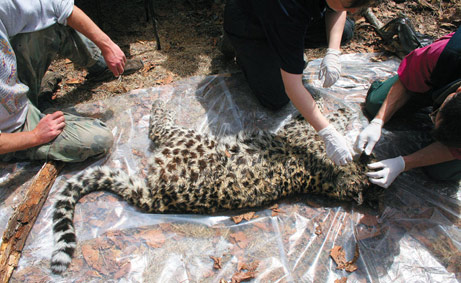
Amur leopard killed and beaten - only six females remain.

April 23, 2007—An Amur leopardess has been found dead a mere two days after a new census reported that just 25 to 34 Amur leopards remain alive in the wild—only 7 of them female.

The 77-pound (35-kilogram) cat, seen in this newly released photograph, was discovered on April 20 in Russia‘s Barsovy National Wildlife Refuge.

The animal had been shot in the back and beaten with a heavy object, according to the international conservation group WWF.

The killing of a reproductively capable female puts the threatened carnivore even further from the hundred or more individuals scientists say are needed to sustain its wild population.

Now the world’s rarest big cat, the Amur leopard once roamed across the Korean peninsula, in the Russian Far East, and in northeastern China. But human impacts have pulverized its population.

“This year’s census showed a desperate situation, with just seven female Amur leopards left in the wild and four rearing cubs,’ said Darron Collins, an expert in the species based at WWF’s Washington, D.C., office.

“Now we’ve lost a mature, reproductive leopardess and her potential cubs in a senseless killing.”

To the original…

Pollution ‘hits China’s farmland’

Thursday, April 26th, 2007

China’s a time bomb just ticking away. Their government has to walk several dangerous tightropes just to keep the place together:

One is between Capitalism and environmental destruction. Capitalism keeps China’s people under control because they feel that they are getting wealthier and have a future to look forward to. But the resulting environmental destruction is significant because it will ultimately produce a very ugly end to the party.

Another tightrope China walks is between the wealth of the coastal cities and the deep poverty of the inner regions of China. They’ve already instituted draconian measures to keep the folks down-on-ther-farms down there so that they can continue to grow food for the wealthy folks in the city but you can just imagine how popular that is. The tension between the haves and have nots in China draws tighter every year.

And then there’s the tension between how much central control the Communist Party can exert to control the society through control of information, human rights abuses, Internet blocking, religious persecution and one-party rule vs. how open and free running the place needs to be to realize the power of its booming Capitalistic expansion.

-The entire place is like a corporation growing at maximum speed. One mistake with, for example, the cash-flow calculations and the entire edifice could tumble. Heady but very dangerous stuff.

So, now add in the desertification destroying much of the country west of Beijing . Add in the Yangtze River, polluted beyond recovery , add in the story below about pollution hitting China’s farmlands.

Add in several other stories that have been posted here regarding China and her problems: .

Add them in – and ask how long do you think China can walk these highwires and what do you think will happen when they stumble?

———————————————-

More than 10% of China’s farm land is polluted, posing a “severe threat” to the nation’s food production, state media reports.

Arable land shrank by nearly 307,000 hectares (760,000 acres) in the first 10 months of 2006, government officials were quoted as saying.

Excessive fertiliser use, polluted water, heavy metals and solid wastes are to blame, the reports said.

Rapid economic growth has had a damaging impact on China’s environment.

Its cities, countryside, waterways and coastlines are among the most polluted in the world.

The Ministry of Land and Resources said agricultural land in China fell to 121.8 million hectares (300 million acres) by the end of October 2006 – a loss of 306,800 hectares since the start of the year.

Heavy metals alone contaminate 12m tonnes of grain each year, causing annual losses of 20bn yuan ($2.6bn), China’s Xinhua news agency quoted the ministry as saying.

Land and Resources Minister Sun Wensheng said agricultural land in China must not be allowed to fall below 120 million hectares.

“This is not only related to social and economic development, but is also vital to the long-term interests of the country,” he was quoted as saying.

China’s government has promised to spend heavily to clean up the country’s heavily polluted environment.

But clean-up efforts are often thwarted by lax enforcement of laws and administrative activity at a local level, correspondents say.

To the original story…

Antarctic Ice Streams Are No Bubbling Brook

Wednesday, April 25th, 2007

– A lot of good material comes out of the Climate Progress Blog.   Here’s another piece I found over there that is well worth passing on.

———————————————————–

Scientific and observational data from Antarctica are driving home the message that we have entered a period of consequences.

Most recently, scientists have discovered ice streams hiding bigger reservoirs of water in West Antarctica. The evidence has “major implications for glacial melt rates and associated sea-level rises“, and the rate of warming.

Equally frightening is that the ice streams feed into the Ross Ice Shelf, a major southern ice shelf whose melting would indicate “the end of the road” according to one scientist.

More…

Scientists feel climate report is too weak

Wednesday, April 25th, 2007

They take issue with how diplomats edited the latest warning on global warming and plan their own update.

BRUSSELS – Two distinctly different groups — data-driven scientists and nuanced offend-no-one diplomats — collided and then converged last week. At stake: a report on the future of the planet and the changes it faces with global warming.

An inside look at the last few hours of tense negotiations at the Intergovernmental Panel on Climate Change reveals how the diplomats won at the end thanks to persistence and deadlines. But scientists quietly note that they have the last say.

Diplomats from 115 countries and 52 scientists hashed out the most comprehensive and gloomiest warning yet about the possible effects of global warming, including increased flooding, hunger, drought, diseases and the extinction of species.

The 23-page summary certainly didn’t sound diplomatic. But it was too much so, scientists said.

In the past, scientists at these meetings felt that their warnings were conveyed, albeit slightly edited down. But several of them left Friday with the sense that they had lost control of their document. At one point, NASA’s Cynthia Rosenzweig filed a formal protest and left the building, only to return, make peace and talk in positive tones. Others talked about abandoning the process altogether.

“There was no split in the science — they were all mad,” said John Coequyt, who observed the closed-door negotiations for the environmental group Greenpeace.

The report doesn’t commit countries to action, like the 1997 Kyoto Protocol, but those involved agree that the science is accurate and that global warming is changing the planet and projected to get much worse.

Still, scientists have their fallback: a second summary that consists of 79 densely written, heavily footnoted pages.

The “technical summary,” which will eventually be released to the public but was obtained by the Associated Press, will not be edited by diplomats. The technical summary, Rosenzweig said, contains “the real facts.”

Some of its highlights, not included in the 23-page already-released summary:

• “More than one sixth of the world population live in glacier- or snowmelt-fed river basins and will be affected by decrease of water volume.” And depending on how much fossil fuels are burned in the future, “262-983 million people are likely to move into the water stressed-category” by 2050.

• Global warming could increase the number of hungry in the world in 2080 by anywhere between 140 million and 1 billion, depending on how much greenhouse gas is emitted over the next few decades.

• “Overall a 2- to 3-fold increase of population to be flooded is expected by 2080.”

• Malaria, diarrhea diseases, dengue fever, tick-borne diseases, heat-related deaths will all rise with global warming.

• In eastern North America, depending on fossil fuel emissions, smog will increase and there would be a 4.5 percent increase in smog-related deaths.

– Thx to the Climate Progress Blog for the link I traced to this story

– To the StarTribune article, itself:

Science & Cargo Cults, Global Warming, The Devil, and Democracy

Wednesday, April 25th, 2007

– This piece comes from the Talk to Action Blog which I’ve been following for some time. Their focus is, in their own words, “a platform for reporting on, learning about, and analyzing and discussing the religious right — and what to do about it.

– For the most part, I try to stay away from religion as a topic here unless the actions of religious people somehow relate to my primary theme, The Perfect Storm. Talk to Action ran a series of articles some months ago that I reported on however because the subject was so over-the-top I couldn’t resist. Those stories had to to with the Left Behind: Eternal Forces Christian video game. See these links:

– In the piece, below, Bruce Wilson of Talk to Action, discusses the current growing disrespect for science in America today and analyzes why it is happening. it makes for interesting reading.

———————————————————

Last October, I listened to United States Senator James Inhofe as he described, before an audience of perhaps one thousand people, his belief that Global Warming was a hoax foisted on Americans by a conspiracy to create a satanic one-world order….

n the end, faith in science is just that – faith. Have you ever seen a nuclear blast ? I haven’t, so how do we know nuclear weapons exist ? We take that on faith in the same way we assume that there’s a scientific reason our microwave ovens heat up our cups of coffee ; how do we know microwave ovens aren’t driven by magic, from elaborate incantations laid on microwave ovens at the factory in which they are made ? How do we know there’s a factory at all ?

Thousands of years ago, the Greek Skeptics demonstrated that it was impossible to really “prove” anything at all due to the facility of the human mind at generating alternative hypotheses for phenomenon. How do we know that there’s a world outside of our doors, really ? Can we prove we’re not brains in a vat ? How do we know we’re not living in The Matrix ? Or, how can we distinguish magical explanations for phenomenon from scientific explanations ? And, what happens to democracy when magical explanations, mystery cults in essence, supplant materialistic explanations of reality ? What does it mean when powerful politicians and religious leaders say scientific warnings about an alleged disaster of unprecedented scale bearing down on humanity and the Earth is really a satanic plot

20th Century Cargo cults believed that rich Western industrialized nations enjoyed a high level of material wealth from possessing special spells or magic that provided access to “cargo”, stuff that is. During the presidency of Lyndon Johnson one Pacific island nation where cargo cult belief was especially strong raised a sum of about $50,000 dollars as a bribe to offer president Johnson for the “secret of cargo”, the special magic that would conjure up cargo and so provide inhabitants of that nation the level of material prosperity enjoyed by Americans.

So, how do I know that “cargo” – consumer goods, the stuff of modern material existence – doesn’t simply pop into existence, conjured by magical spells ? Well, I don’t. I take it on faith. I could research the question by visiting factories where products get assembled and by traveling to mines and oilfields where raw material inputs for products get extracted from the Earth ; I don’t do that because I’m satisfied my explanation is “true”.

But, in the end, how am I different from a cargo cultist ? In the end I can only only give a qualified distinction – I believe in rational explanations rather than magical ones. And how can I demonstrate that my faith in a Heliocentric Solar System is better founded than the belief, by the Chalcedon Institute’s Martin Selbrede, in a Geocentric Solar System ?

In the end the Geocentric model assumes too much ; the theory is not parsimonious at all but posits that hundreds of years of scientific research and discovery, which has made possible such technological marvels as the computer I’m typing on now, nonetheless has gotten wrong a fundamental aspect of our reality. Geocentrism demands its adherents believe that centuries have passed and generations of scientists have been born and then died, yet it has only been in the past one or two decades that a tiny group of amateurs has uncovered the true nature of the Solar System.

I find that claim hard to accept because science is a highly competitive process and works in the end in ways not dissimilar to the way capitalist markets work. In science, better theories – which have more and wider explanatory force – arise in time to displace older theories which explain less. Individual scientists compete to generate the best theories and those who do attain status, favored teaching position, grants, awards, speaking engagements, and so on. Superstar scientists sometimes write bestselling books.

There is, in short, a competitive marketplace for ideas and so the claim that science has gotten the basic nature of the Solar System so wrong, and for so long, seems quite preposterous to me. It might be true, and computer laptops might be conjured, through magical incantations, out of thin air at a secret “cargo” factory inside a vast underground complex, run by aliens and nazis, hidden underneath the South Pole. Possibly. But that’s very unlikely.

More…

Australians warned of water cuts

Tuesday, April 24th, 2007

Australian PM John Howard has warned that irrigation of much of the nation’s farmland will be banned unless there is heavy rainfall in the next month.

Mr Howard said there would only be enough water in the huge Murray-Darling river system for drinking purposes.

He acknowledged that this would have a “potentially devastating” impact on many horticultural, crop and dairy industries around the river basin.

But he said there was no choice, and he described the situation as “grim”.

Irrigators are already warning that if they cannot water their land, there will be huge crop losses and Australian consumers will face large price rises.

More…

End of oil heralds climate pain

Tuesday, April 24th, 2007

Many people think that running out of oil, or “peak oil”, would be good for the climate. In his new book The Last Oil Shock, David Strahan begs to differ; he suggests it may bring catastrophe.

It is becoming increasingly clear that global oil production will soon go into terminal decline, with potentially devastating economic consequences.

Although the idea of peak oil has traditionally been ridiculed by the industry, now even some of the world’s most senior oilmen concede the case.

Last year Thierry Desmarest, chairman of Total, the world’s fourth largest oil company, declared that production would peak by around 2020.

He urged governments to find ways to suppress oil demand growth and put off the witching hour.

Other forecasters are convinced the peak date is even closer.

But many environmentalists continue to resist the idea.

Some seem to suspect that anybody who argues that oil production is set to fall must be a closet climate change denier with a secret agenda.

Others, like Stephen Tindale of Greenpeace, instinctively distrust forecasts of an imminent peak, but wish fervently that it would come soon.

“Let’s hope that the oil does run out”, he told me, “and that the world has to develop alternatives to oil seriously quickly, and from a climate point of view that would be an excellent outcome.”

Neither position could be more wrong.

More…