Date with Extinction

February 8th, 2008

For a thousand years before people settled in
New Zealand, a small alien predator may have been
undermining the islands’ seabird populations.

Our yellow Zodiac bobbed across the choppy sea and made its way slowly through the clouds of seabirds that wheeled and soared around us. Albatross, cape pigeons, diving petrels, mollymawks, mottled petrels, and sooty shearwaters all took their turns skimming our bow wave for fish. In the distance my boat mates and I could see the final stop on our sub-Antarctic tour: the Snares Islands, about 130 miles south of New Zealand’s South Island. The chorus of screeching birds drowned out our rumbling boat motor, and even from several miles away we could smell the acrid white guano that coats much of the Snares’s rocky coasts. During the summer breeding season the Snares, whose entire area totals not much more than one and a quarter square miles, are home to more than 6 million seabirds—as many as nest along the coasts of Great Britain and Ireland combined.

Today in the New Zealand archipelago, such dense seabird colonies persist only on small offshore islands, but at one time much of the coastline of the North and South Islands (by far New Zealand’s two largest islands, commonly called the mainland) would have been equally pungent and raucous. New Zealand once supported one of the most diverse seabird faunas in the world; the country was particularly rich in species of petrels. Nowadays those populations have crashed, and many species have been extirpated on the mainland. One can only imagine what it must have been like for ancient Polynesian seafarers reaching the shores of uninhabited New Zealand. The archipelago, no doubt a welcome sight after months of arduous ocean sailing in a double-hulled canoe, would also have presented a far different scene from that of most of New Zealand today.

But did these colonizers encounter a truly pristine environment? It would be easy to “round up the usual suspects” and blame the loss of so many species from the mainland on the encroachments of civilization. But in reality, the early Polynesian settlers were not responsible for the destruction of many of the seabird populations. Even before people settled this southern land, other visitors may have already irrevocably altered the New Zealand environment.

Those earlier arrivals on the New Zealand mainland were Pacific rats (Rattus exulans), or kiore, as they are called in the Maori language. It has been known for almost a decade that these small stowaways helped drive some of the native bird species from the mainland, or, in some cases, to outright extinction. According to the standard account of the invasion, the rats arrived in New Zealand between 800 and 1,000 years ago, in the canoes of the first Polynesian settlers. But in 1996, Richard Holdaway, an independent extinction biologist, presented evidence that the rodents first made landfall perhaps a thousand years earlier. That date has called into question the entire sequence of prehistoric events that shaped New Zealand—and, not surprisingly, has fueled much debate in New Zealand about the strength and validity of Holdaway’s evidence.

But even more, Holdaway has hypothesized that a rat-generated crash in island bird populations could have led to “a cascade of damage” and even to a change in the nearshore oceanic food web: seabird colonies generate a prodigious quantity of guano, which can form a kind of organic bridge between sea and shore, enriching soil and promoting plant growth. If the seabird populations crashed, Holdaway argues, so did this bridge. The islands would have lost a major source of nutrients. If Holdaway is right, the rats had accidentally landed on a choke point of the ecosystem, causing a ripple effect that went far beyond the destruction of seabirds.

Thanks to their remoteness—New Zealand lies 1,200 miles east of its nearest neighbor, Australia—the North and South Islands faced the onslaught of invaders considerably later than did many other islands around the globe. But just as they have on Hawaii and Guam, alien species that were suddenly introduced onto the islands have had devastating effects. New Zealand birds were particularly at risk, because they had evolved for millennia in the absence of mammalian predators (indeed, the only land mammals of prehistoric New Zealand were three species of ground-feeding bats). Many of the native birds were flightless and seminocturnal, making them easy prey for the rats and the eleven other introduced species of predatory mammals that eventually prospered in the archipelago. Even seabirds were vulnerable; though they can spend months of each year at sea, many of them nest in ground burrows and are helpless against terrestrial threats.

More…

New Zealand Sweet Stakes

February 8th, 2008

Natural History, May, 2001 by Laura Sessions

Sugar was a shared resource in a forest community until a greedy newcomer moved in.

Biologist E. O. Wilson has called invertebrates “little things that run the world,” because of their numbers, variety, and influence on larger organisms and even entire ecosystems. New Zealand is home to “little things” that, while each only a few millimeters long, have benignly modified about 250 million acres of the country’s beech forests. Known as sooty beech scale insects, these agents turn the resources of the beech trees into a substance crucial to their own survival and to that of other forest dwellers, from fungi to birds. The association of the insects and the trees is an ancient one, and the expansive food web in which they are actors was, until recently, intact.

Sooty beech scale insects (Ultracoelostoma assimile and U. brittini) are sap suckers, or homopterans, that grow in the furrowed bark off our species of southern beech trees (Nothofagus) in New Zealand. During its complex life cycle, the beech scale insect goes through several developmental stages called instars. The females pass through four stages, the males five. Second- and third-instar females insert their long mouthparts into the cells of a beech’s phloem–the tissues that carry nutrients through the tree–and suck up sugars. After satisfying their appetites, they excrete the excess sap and wastes through a waxy anal tube. A sweet liquid, called honeydew, accumulates one drop at a time at the tip of this tube, which looks like a thin white thread.

Homopterans are common and widespread. Most of the world’s 33,000 species produce honeydew, but few can match the beech scale’s enormous and constant output of the substance. In the Northern Hemisphere, honeydew producers such as aphids are active only seasonally, but beech scale insects draw off and convert energy from beech trees year-round, and they do so copiously during the austral summer. From January to April, the tree trunks in a southern beech forest often shimmer with a thick coat of honeydew, and the droplets’ heady, sweet smell fills the air.

In some forests, ten and a half square feet of tree trunk (think of the top of an average card table) may support as many as 2,000 scale insects. More than 40 percent of the food the trees have produced through photosynthesis may be lost to sooty beech scale insects. These beeches do not appear to be harmed, although for most plants, losses of much less than 40 percent of their energy reserves would be insupportable. Currently, scientists can only guess how the trees are able to withstand such a drain, but various theories are being explored. Possibly only the more vigorous and faster-growing beech trees are tapped by beech scale insects. Fallen drops may recycle sugars to the soil and thence to trees, or the insects may promote extra photosynthesis in host trees.

More…

India culls 3.4m birds but fails to contain avian flu outbreak

February 8th, 2008

India is struggling to contain its worst avian influenza -epidemic, in spite of culling 3.4m birds and setting up a 5km poultry exclusion zone round the state of West -Bengal, the epicentre of the outbreak.

The government’s failure to reassure farmers that they will receive fair compensation for birds culled by rapid response teams has left experts scrambling to stop the disease entering the crowded markets of Calcutta and Delhi and led to a crisis of confidence in India’s -poultry industry.

The latest outbreak of the H5N1 strain of bird flu, confirmed on January 15, is proving more difficult to contain than earlier manifestations at large poultry farms in the states of Maharashtra and Gujarat in 2006 and, last year, in Manipur.

Roughly 80 per cent of rural households in West Bengal keep hens and ducks in their backyards to supplement their incomes, a practice encouraged by the state government, which distributes millions of chicks to poor communities each year.

More…

Another big motorcycle trip

February 7th, 2008

The open road and its choices…I went off today on another big motorcycle adventure. This will probably be my last one this trip as I am departing for the US on Tuesday.

Today, I went off east from Christchurch searching for a particular type of land. Hilly and wooded land with natural woods, not managed forest. This type of land is harder to find here than many folks might think. Much of the Canterbury Plains have been cleared of its original cover in favor of grazing lands or managed forests. You can go for very long stretches in some areas and see nothing else.

Today, I headed east out of Christchurch on Hwy 73 until I got to Darfield when I switched onto the eastbound Hwy 77. This took me to Glentunnel when I took my first excursion off the main road. Glentunnel is the beginning of an area that fronts up the the southern flanks of some foothills of the Southern Alps. It is in areas like these that we think we have the best chances of finding the kind of land we’re looking for. At Glentunnel, I went north to Whitecliffs and then west again on gravels roads that took me onto the north side of Pullwool Peak and Mt. Misery Peak.

I found this area disappointing. On the map, it is marked as the Glen Arlie Forest and I’ve now begun to understand that here in NZ, an area marked forest generally means ‘managed forest’. And I ‘get’ now that the many roads shown weaving through the bodies of these forests are not there because they are densely settled with holiday homes but rather because they are logging roads which the New Zealanders, oddly enough, give names to just as if they were normal roads. So, enough with ‘forests’ on the maps.

The entire Canterbury Plains is a relatively dry area as well. It isn’t unusual to see big mountain ranges on the western side just as bare as a baby’s butt. I don’t know if they’ve always been like that or if they were logged off earlier and have just degraded into bare rock and soil but they look very bare. In general, the plains and the foothills are mostly areas cleared for crops or grazing or for managed forests.

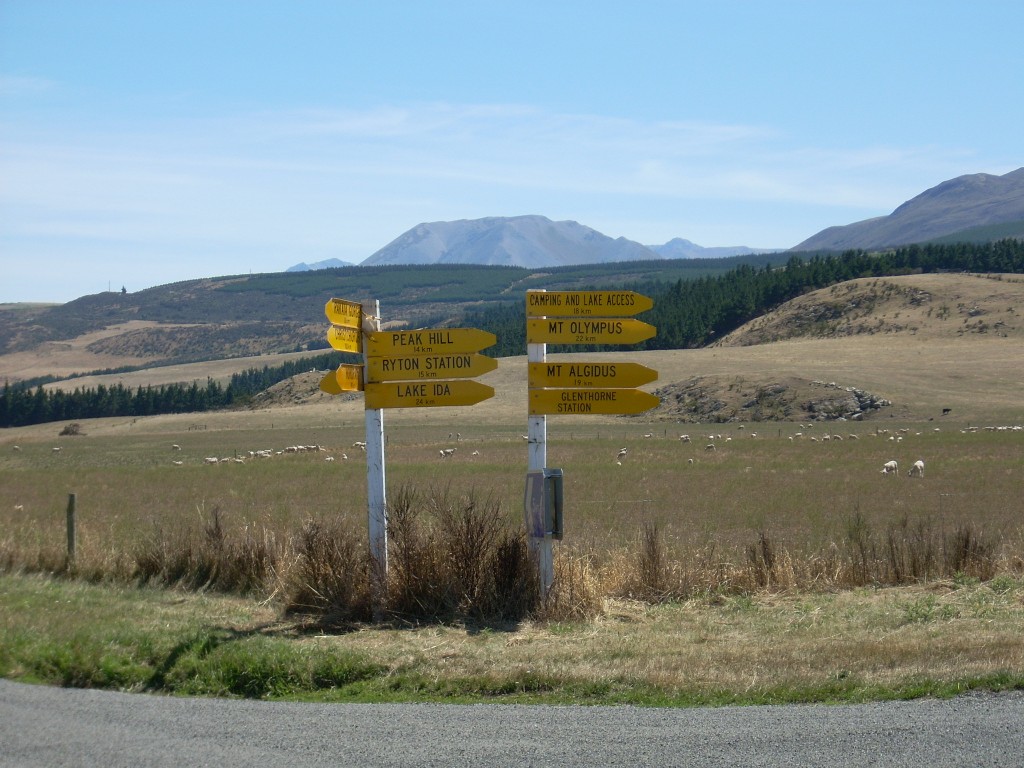
After the disappointment of the Glen Arlie Forest, I continued west on Hwy 77 to Windwhistle. here I cut north to Coleridge Road. And from it, I went a long spur to the east called High Peak Road. It was pretty, but again, it was grazing or managed forests. Then I cut back to Coleridge Road and was just going to go north for a bit.

I can see now that when I was on my way to Windwhistle and I did some exploring on Washpen Road, I missed a good bet when I failed to go north up Dart’s Road because I see now that it went up and into a Conservation Area called Rockwood (which I now understand is likely to hold the kind of forest we’re looking for). I’ll need to revisit this area next time.

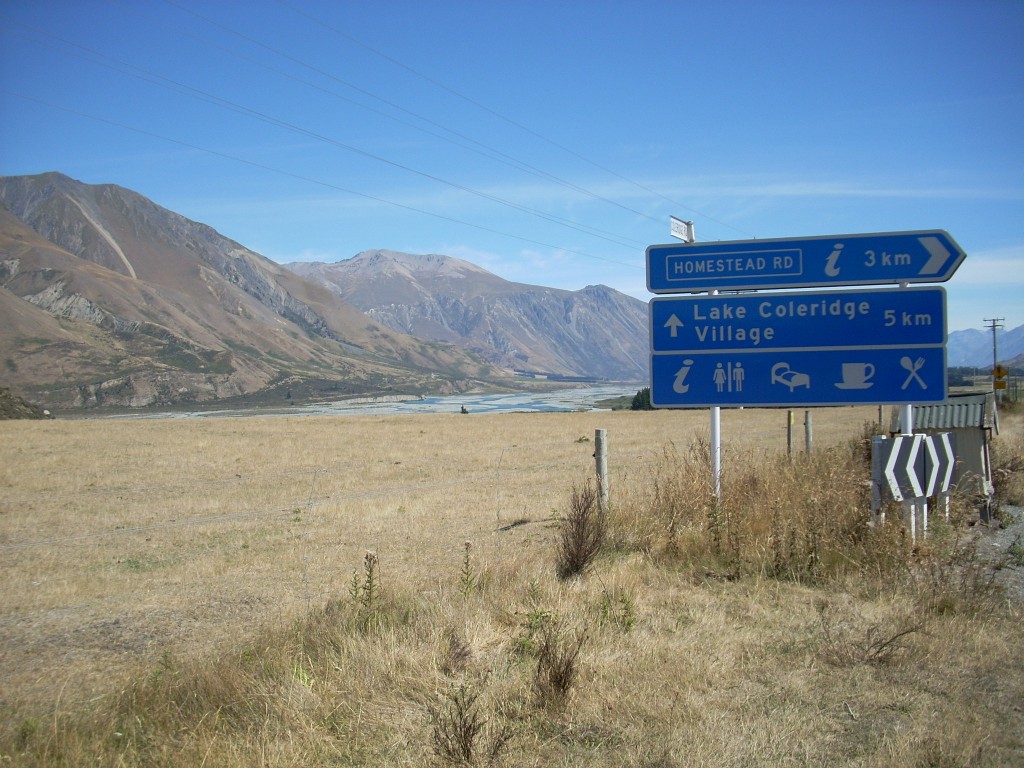
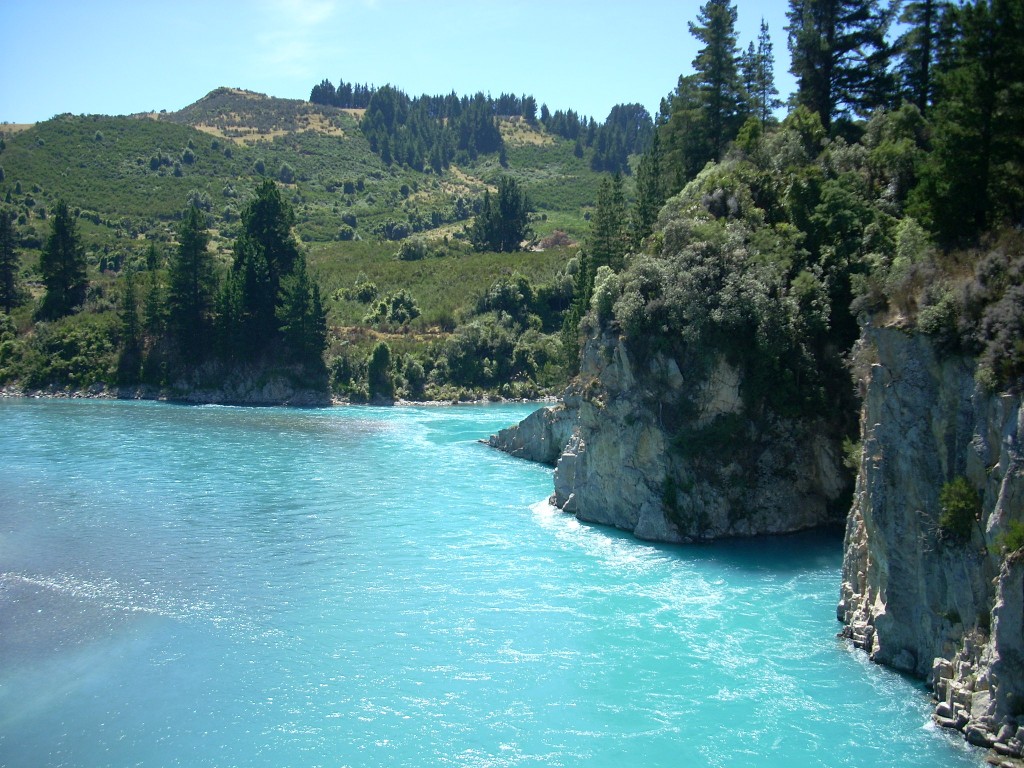
But I continued on Coleridge Road because the valley I found myself in, while not naturally forested, was arrestingly beautiful. On the western side, a huge range of bare but imposing mountains rose up over one of New Zealand braided rivers; the Rakaia. The Rakaia river, the bare mountains and the Southern Alps in the distanceFar to the west at the head of the valley, some of the big southern Alps rose up, covered with snow. I kept driving and driving just to see more and went miles away from the places I’d intended to investigate. I was tempted to just keep going and let the wanderlust take me but finally, I stopped at a place called Lake Coleridge; a town with the same name as a nearby lake. The road goes on for awhile beyond Lake Coleridge but I could see on the map that it just died before long. So, Lake Coleridge was literally the end of the world. A strange place. I think it mostly exists to support the hydroelectric plant there. Rakaia River - yep, the water really is that colorThey bring water over the hill from Lake Coleridge and huge pipes and deliver it to the plant by gravity which uses it to spin the turbines and then dumps it into the Rakaia River.

I turned around after taking a look at Lake Coleridge and its plant and headed back to Windwhistle where this diversion began. Once there, I turned west again and continued to follow Hwy 77.

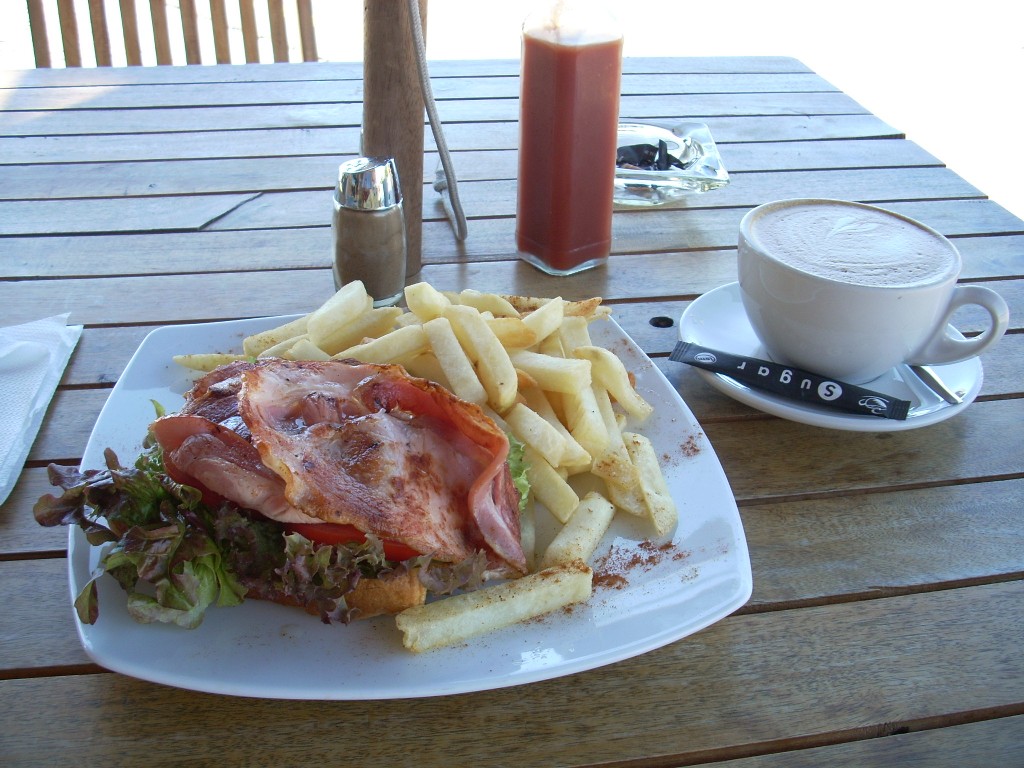
A Kiwi BLTI was running low on gasoline and it was time for a cup of coffee and some lunch so I took a detour down to Methven, a touristy town a few miles south, and filled up (an attendant who knows motorcycles came out and had a very good look at my motorcycle because very few of this model have ever made it to New Zealand) and I then had a Latte and a BLT at an outside table at a restaurant on the main drag in town. Ordering food in New Zealand can still bring the occasional surprise. The BLT, when it arrived, was open faced and had the NZ style thin round cut bacon on it. Surprising – but excellent to eat!

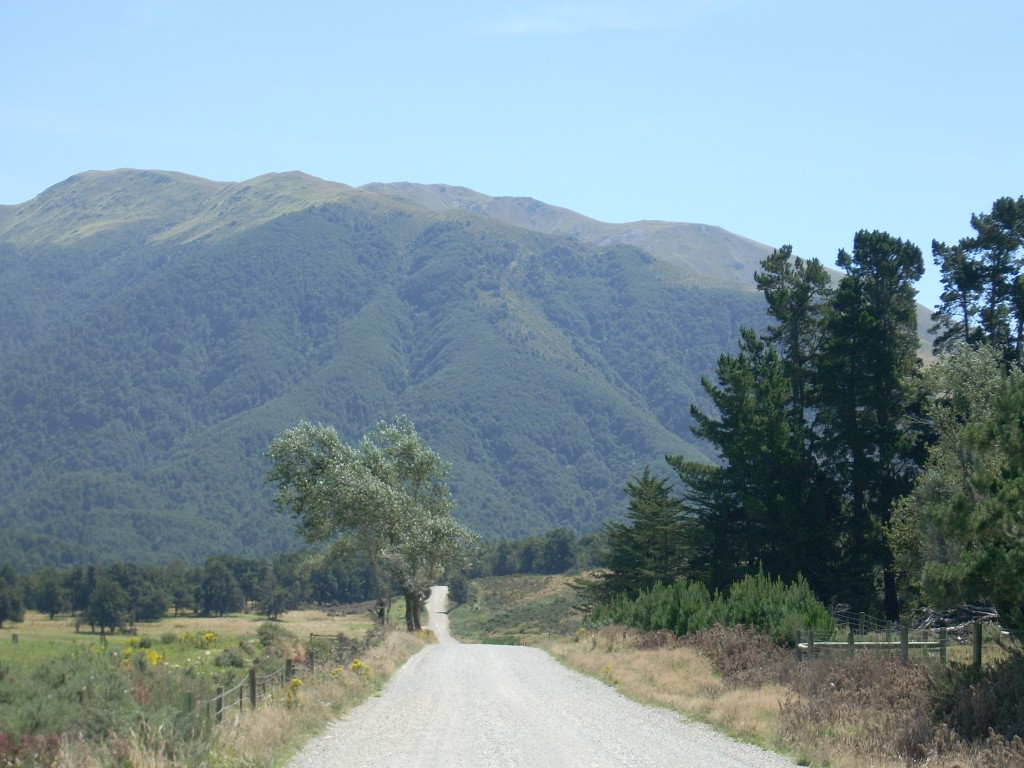
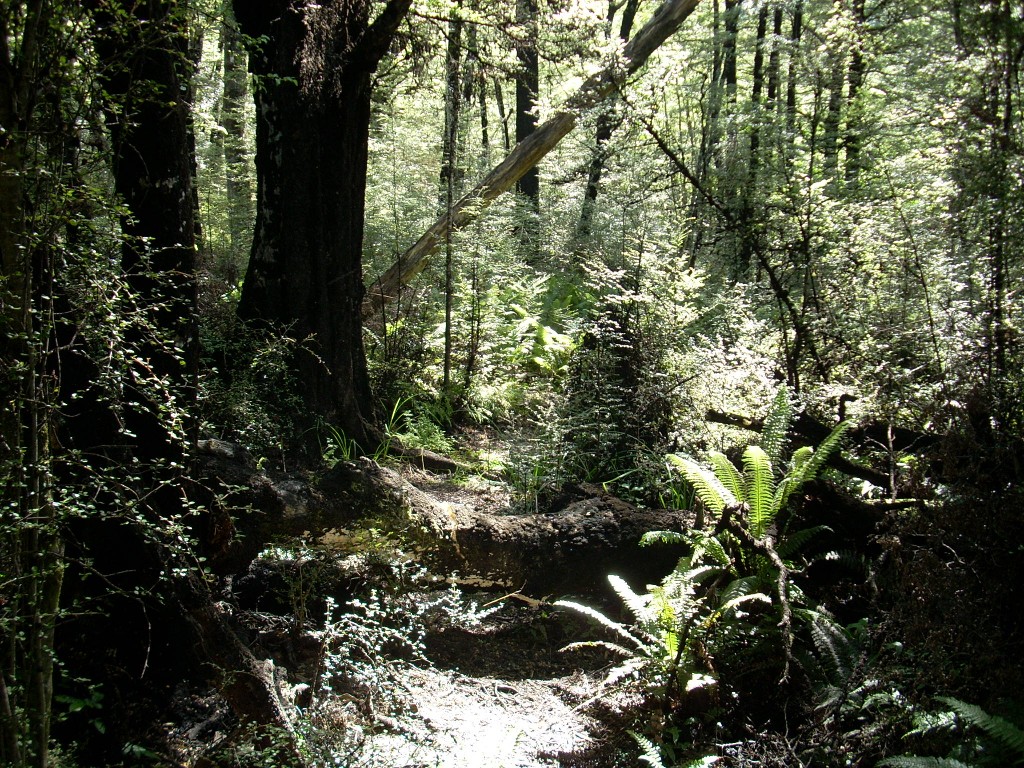
The next area I was interested in was the Alford Conservation Area and, specifically, the southern slopes of the area’s foothills. As I approached the area, I could see that the foothills here were forested and it looked like natural forest. Yahoo. Real forest at the end of the roadI went up a couple of the gravel side roads trying to get up into it and on the second one, Flynn’s Road, I got lucky and it took me right into the forest and to a trail head area that serves as a stepping off point for hikes to Sharplin Falls and other points. I spent a fair amount of time here shooting pictures and walking around. It was definitely the right kind of country. That’s what we’re talking about !And it soon occurred to me that the real question was did anyone have private land for sale in the area that abutted the Conservation Area and that contained this same type of forest.

Today was suppose to be a partial solar eclipse here in New Zealand (unless I’ve been the victim of a hoax) and it was due to hit maximum darkness at 437 PM. It was now about 405 PM and so I decided to zip down the Hwy to Mt. Somers and find a place to have an ice-cream cone and sit outside and watch the fun.

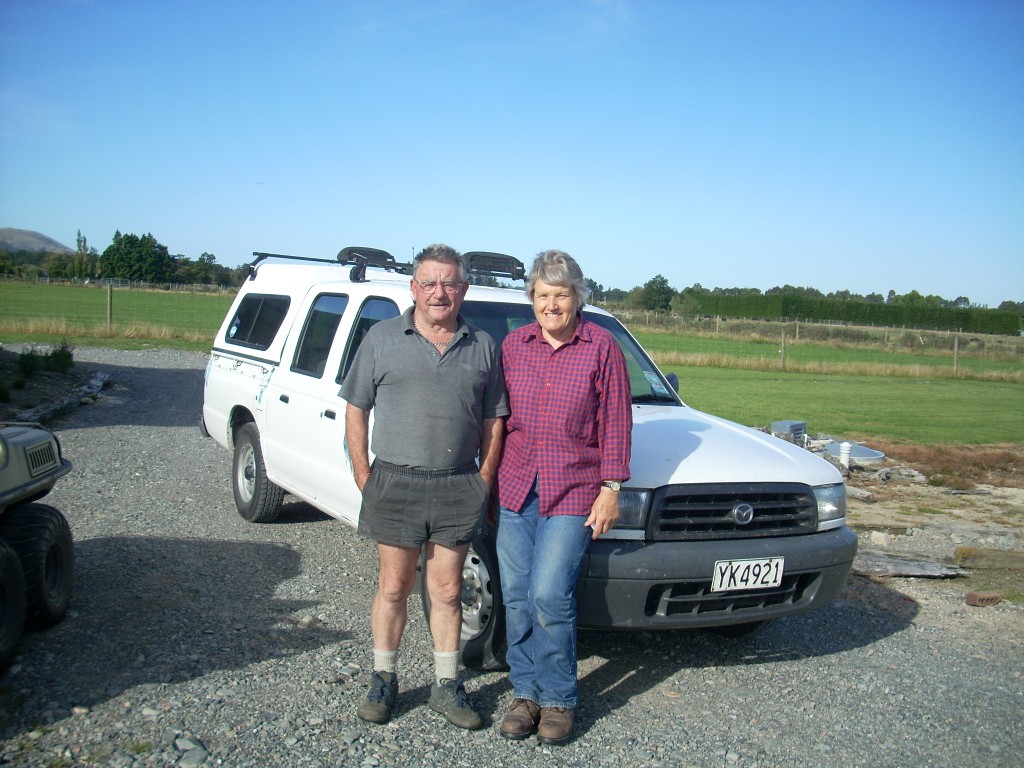
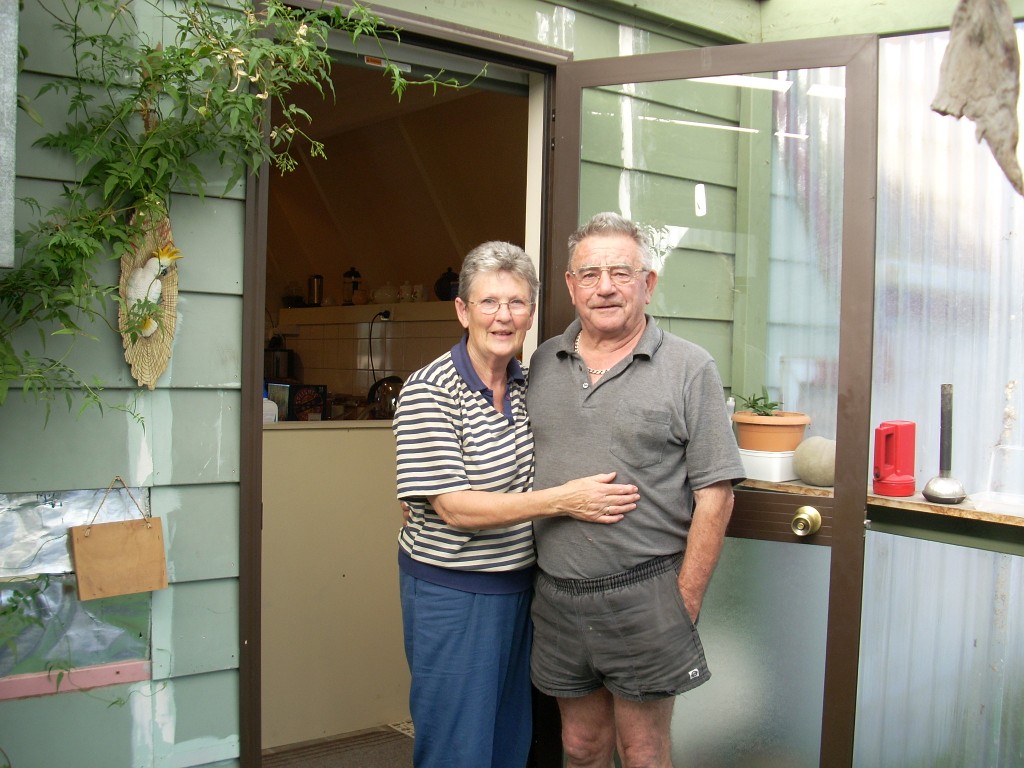
This was a very good decision. (I found out the following day that the eclipse was, indeed, real but I was unable to see it using the pin hole in a paper method). In the meantime, a fellow came up to the store where I was sitting eating my ice-cream and we began to talk and I asked him about properties in the area. What a stroke of luck that question was. Ken had moved from Christchurch nine years earlier to the Mt. Somers area and knew many of the farmers who owned properties along the southern flanks of the conservation area foothills. He invited me home for a cup of tea where I met his wife, Lynn, and he made a phone call to a friend of his with a property in the area I was interested in and off we went. How very lucky is that?

Ken and Jocelyn with her land behind Ken and Lynn at their house as I’m ready to depart

Jocelyn and her husband, Errol, own 94 hectares or about 233 acres of land just at the base of the foothills. She took Ken and I on a long tour of the place. A beautiful property it is. Paddocks, creeks, good outbuildings, well maintained and great views. After a good look around, I came to doubt it’s the place for us, though, as we’re looking for a place with more hills, less pasture and more forest (or bush as the Kiwis say) on it but someone’s going to get a great place here.

While we were looking at one corner of Jocelyn’s place that did have some bush on it, I ask them about the black encrustations I see on so many of the trees in naturally forested areas in New Zealand. They said it was a bug that lives there and that if you look close you can see a little hair that it puts out that often has a small drop of honey-like liquid on it. Honeydew, it is referred to. Sure enough, I looked and saw what they were talking about. They said it seems harmless to the trees and it’s been around for a long time. When I got home last night, I did some searching on the Internet and came up with some more information about what going on with this black encrustation. They are called, “Sooty beech scale insects”.

Ken and I went back to his placed and talked for a bit more. By now, it was 730 PM and I needed to take off for my ride back to Christchurch before it grew dark. Ken invited me to stay for tea (that’s how Kiwis refer to the evening meal) with he and his wife and daughter and her partner but I declined after consulting my watch. So, a few handshakes, the exchange of E-mail addresses and I was off. What a great bit of luck to meet someone like Ken who knows the area so well.

The ride home wasn’t much fun. Long straightaways across the Canterbury Plains at 100 kpm blasting into the teeth of a strong wind. But, it passed and about 830 PM, I arrived home after putting 220 miles or about 366 km on my bike for the day. A great machine, by the way. Never a complaint and it just roars down the road straight and true.

A poetry blog

February 6th, 2008

Quite some time ago, I put up a few poems here on Samadhisoft. At the time, I thought of it as an experiment. But, in truth, I wasn’t very happy with it. It was awkward, it was the wrong venue and the way I’d developed for displaying and indexing the poems was clumsy at best. I never really came back to it or gave it any more attention.

oldman-writing.jpgSince I’ve been in New Zealand, I’ve had some time on my hands and as one of my favorite pastimes is computer programming, I turned my attentions towards developing a better venue for my poetry. I’ve created a Blog called, SamadhiMuse. And, I’ve written my first WordPress plug-in to facilitate transferring my voluminous poetry into this Blog.

At the moment, it is a work in progress. One minute, I load a few poems onto the site to run a test on some function within the transfer software and then 10 minutes later, I’ve cleared all the poems off again for the next test. I’m currently working with an initial pool of 752 poems and at any point, you may find them all there and then a few minutes later, all gone again.

The software development efforts (in the PHP language) are coming along well, however, and I’m nearly to the point where things will be stable enough for an initial batch of work to take up permanent residence on the site.

Poetry is not everyone’s cup of tea. I know that. But, if you are curious to read a bit, I think you’ll finds sides of me that you were probably unaware of. You will, of course, have to decide if that’s good or bad.

Cheers

Update 15 Mar 08 – Things are now basically stable over at Samadhimuse.  Please feel free to browse the site.

Ice: A Catalyst for Life in the Universe?

February 4th, 2008

The unusual properties of frozen water may have been the ticket that made life possible. Over the decades, several notable scientists have began to suspect that life on Earth did not evolve in a warm primordial soup, but in ice—at temperatures that few living things can now tolerate. The very laws of chemistry may have actually favored ice, says Jeffrey Bada, at the Scripps Institution of Oceanography in La Jolla, California. “We’ve been arguing for a long time,” he says, “that cold conditions make much more sense, chemically, than warm conditions.”

If Bada and others are correct, it would not only answer how life arose on our planet, but would dramatically change how we search for life in the Solar System and beyond. At that point, our chances of finding life elsewhere may be better than previously understood.

More…

The Monty Hall Problem

February 3rd, 2008

The Monty Hall ProblemBack on May 4th of 2007, I wrote a piece entitled “Trust Your Brain?” in which I discussed a problem I called “The Three Box Problem”.

The Three Box problem has been around for awhile and I now know that it is better known as “The Monty Hall Problem”.

Over forty papers and news articles have been published over the years about this little logical conundrum and there’s a nice write up on it on Wikipedia that I didn’t know about when I wrote my original piece.

If you still ‘trust your brain‘ or if you like amazing little puzzles, I suggest you have a look.

– thanks to Rolf A. for this new information

Western U.S. Faces Drought Crisis, Warming Study Says

February 2nd, 2008

The U.S. West will see devastating droughts as global warming reduces the amount of mountain snow and causes the snow that does fall to melt earlier in the year, a new study says.

By storing moisture in the form of snow, mountains act as huge natural reservoirs, releasing water into rivers long into the summer dry season.

“We’re losing that reservoir,” said research leader Tim Barnett, an oceanographer and climate researcher at the University of California, San Diego.

“Spring runoff is getting earlier and earlier in the year, so you have to let water go over the dams into the ocean.”

Summers are also becoming hotter and longer. “That dries things out more and leads to fires,” Barnett added.

“Our results are not good news for those living in the western United States,” the scientists write in their report, which appears in today’s online edition of the journal Science.

Unnatural Changes

Barnett and his team used computer models to study water flow in Western rivers over the past 50 years.

The researchers found that the changes currently affecting the U.S. West have less than a one percent chance of being due to natural variability, Barnett told National Geographic News.

His team verified that by running a variety of control tests under pre-industrial conditions that mimicked known natural cycles.

(Related: “Ancient “Megadroughts” Struck U.S. West, Could Happen Again, Study Suggests” [May 24, 2007].)

What’s been occurring recently, he said, is different from natural variability and is driven by the buildup of greenhouse gases such as carbon dioxide in Earth’s atmosphere.

More…

Sentenced to die for downloading report on women

February 1st, 2008

– Remember, this is the government we (the US) put into power and are supporting in Afghanistan.

= = = = = = =

A young man, a journalism student, is sentenced to death by an Islamic court for downloading a report from the internet.

The sentence is then upheld by the country’s rulers. This is Afghanistan – not in Taleban times but six years after “liberation” and under the democratic rule of the West’s ally Hamid Karzai.

The fate of Sayed Pervez Kambaksh has led to domestic and international protests, and deepening concern about the erosion of civil liberties in Afghanistan.

He was accused of blasphemy after he downloaded a report from a Farsi website which said Muslim fundamentalists who claimed the Koran justified the oppression of women had misrepresented the views of the prophet Muhammad.

Kambaksh, 23, distributed the tract to fellow students and teachers at Balkh University in Mazari Sharif, capital of Balkh province, with the aim, he said, of provoking a debate on the matter. But a complaint was made against him and he was arrested, tried by religious judges without – say friends and family – legal representation and sentenced to death.

More…

Coincidence?

January 31st, 2008

This year in the U.S., both Groundhog Day and the State of the Union address occur on the same day. And as it has been pointed out:

It is an ironic juxtaposition of events: one involves a meaningless ritual in which we look to a creature of little intelligence for prognostication, while the other involves a Groundhog.